
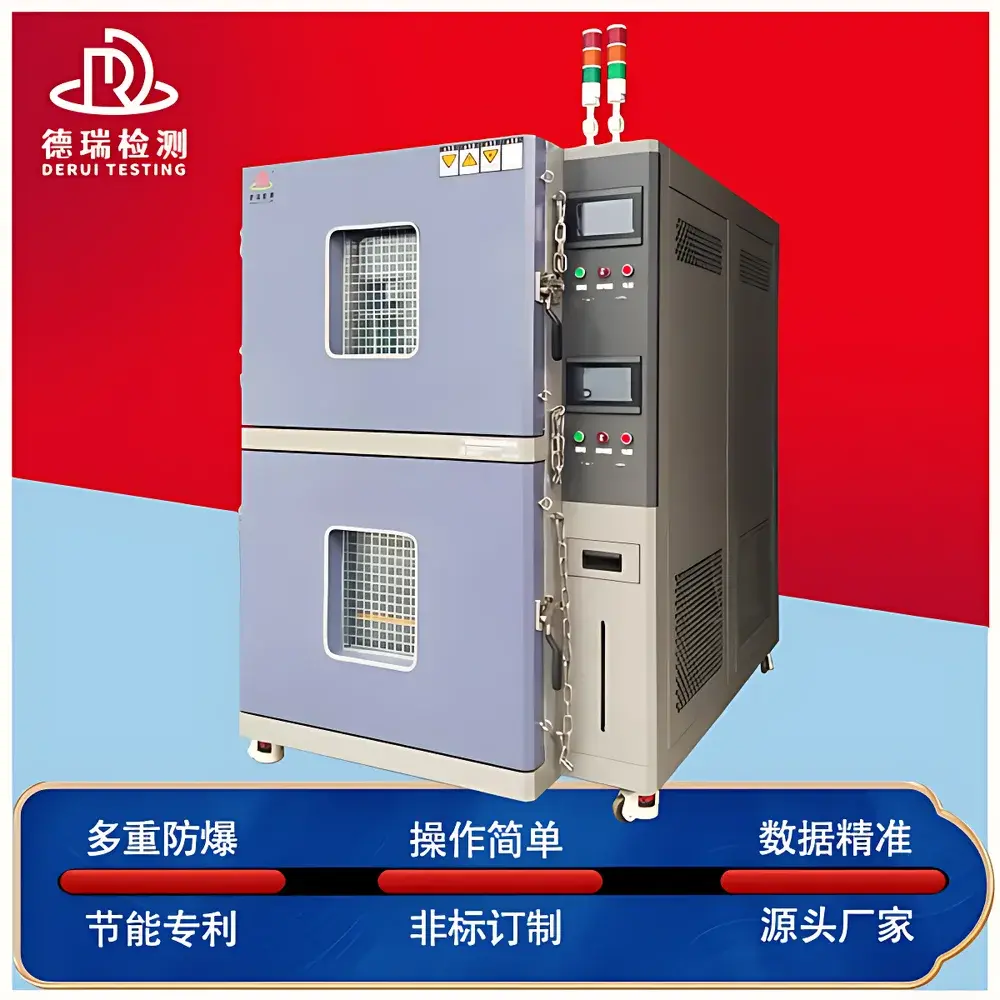
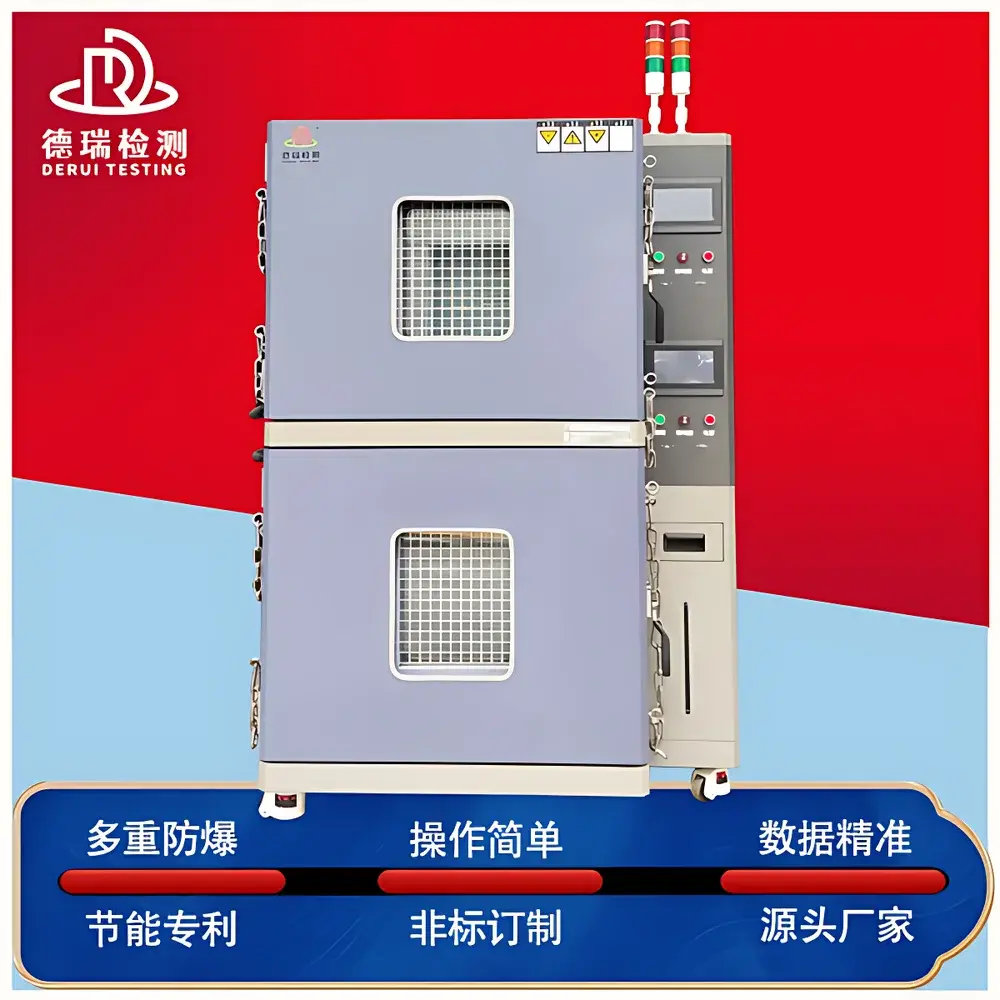
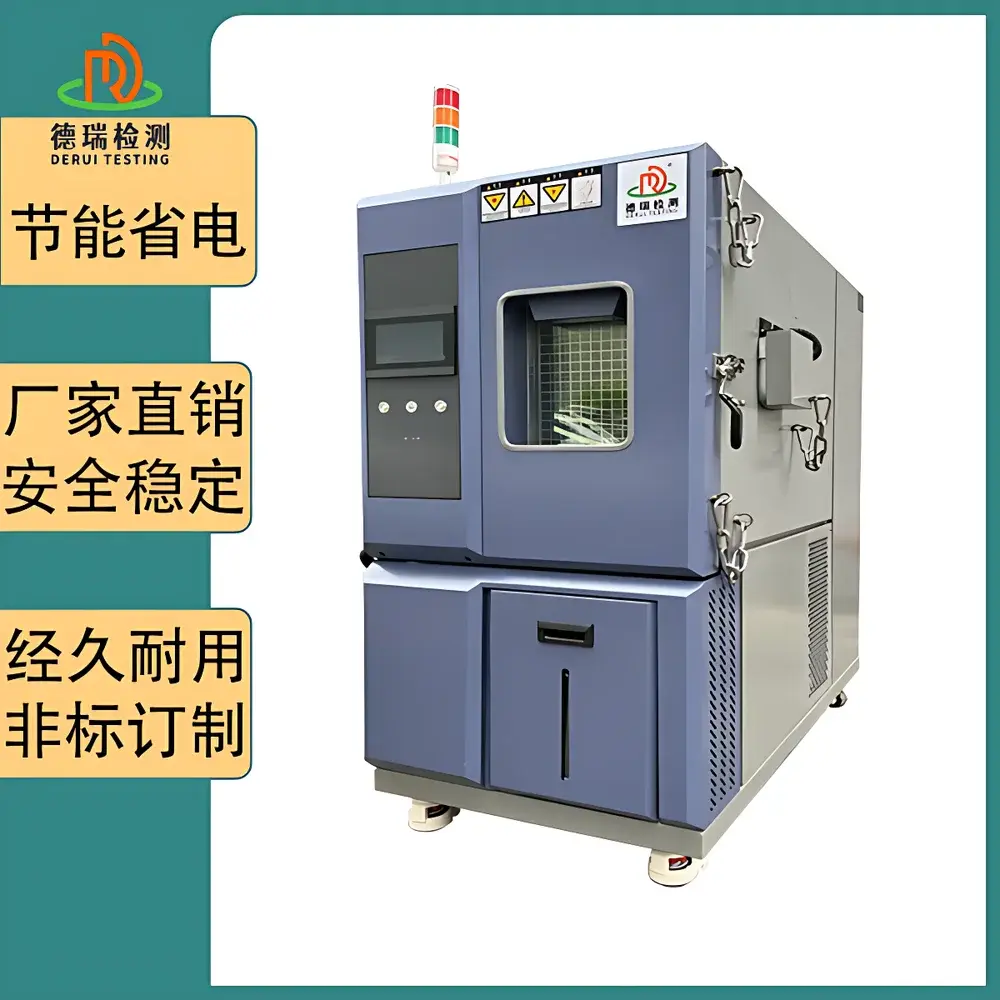
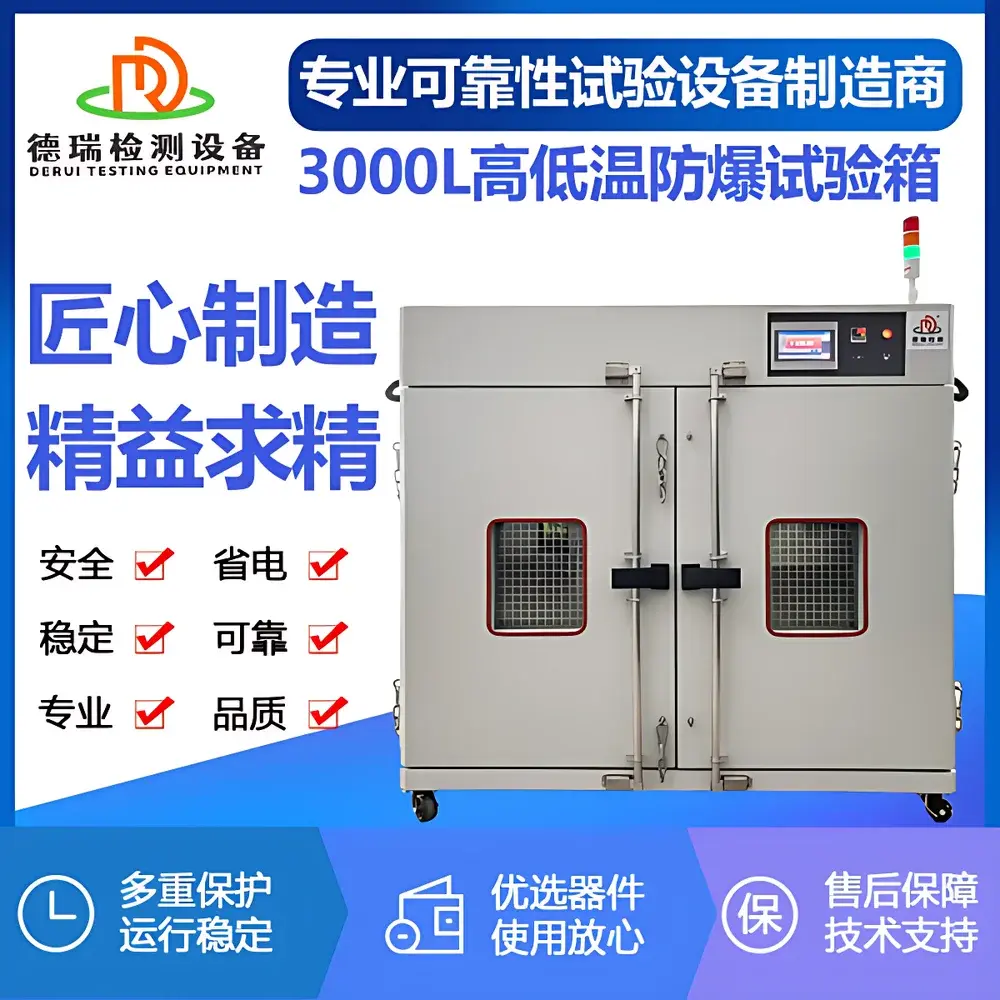
Derui Testing DR-D201-225E Dual-Zone Explosion-Proof Environmental Test Chamber
| Brand | Derui Testing |
|---|---|
| Origin | Guangdong, China |
| Manufacturer Type | Direct Manufacturer |
| Country of Origin | China |
| Model | DR-D201-225E |
| Temperature Range | −60 °C to +150 °C |
| Refrigeration Method | Compressor-Based Cooling |
| Explosion-Proof Design | Yes (Class I, Division 1 compliant per GB/T 3836.1–2021) |
| Temperature Fluctuation | ±0.5 °C (empty chamber) |
| Temperature Deviation | ±2.0 °C (loaded, steady-state) |
| Temperature Uniformity | ±2.0 °C (empty chamber) |
| Heating Rate | ≤60 min (−60 °C to +150 °C) |
| Cooling Rate | ≤45/60/80 min (varies by target temperature span) |
| Interior Dimensions | 500 mm × 750 mm × 600 mm (W × H × D), dual-layer configuration |
| Effective Volume | 225 L (total, split across two independent zones) |
Overview
The Derui Testing DR-D201-225E is a dual-zone, explosion-proof environmental test chamber engineered for precise, repeatable simulation of extreme thermal conditions in safety-critical applications. Designed around a robust dual-chamber architecture—comprising two vertically stacked, independently controlled compartments—it enables concurrent testing under divergent temperature profiles without cross-contamination or thermal interference. The system operates on a high-efficiency compressor-based refrigeration cycle, supported by PID-controlled heating elements and insulated with multi-layer vacuum-sealed polyurethane foam (≥150 mm thickness). Its core function is to replicate climatic stressors—including rapid thermal transients, prolonged low-temperature exposure, and high-temperature soak—as defined in international standards such as IEC 60068-2-1 (cold), IEC 60068-2-2 (dry heat), and MIL-STD-810H Method 502.7. The explosion-proof enclosure conforms to GB/T 3836.1–2021 (equivalent to IEC 60079-0), with flameproof joints, intrinsically safe control circuitry, and pressure-relief venting—ensuring operational integrity when evaluating lithium-ion battery modules, solvent-based coatings, or volatile chemical intermediates.
Key Features
- Dual independent test zones: Each chamber features separate temperature setpoint control, real-time monitoring, and programmable ramp/soak profiles—enabling parallel qualification of dissimilar samples under distinct environmental regimes.
- Explosion-proof certification: Certified for use in hazardous locations (Zone 1/21, Class I, Group IIA/IIB, T4 maximum surface temperature), with reinforced stainless-steel housing, explosion-resistant viewing window (tempered borosilicate glass), and sealed cable entries meeting IP65 ingress protection.
- High-fidelity thermal performance: Achieves ±0.5 °C temperature fluctuation (empty) and ±2.0 °C uniformity (per IEC 60068-3-5), validated using NIST-traceable PT100 sensors calibrated at three reference points per zone.
- Automated defrost management: Continuous low-temperature operation down to −60 °C for >1000 h without frost accumulation; intelligent defrost algorithm initiates only upon sensor-confirmed ice formation, preventing chamber temperature overshoot or condensate pooling.
- Integrated thermal mapping capability: Pre-installed six-channel thermocouple array (Type T, Class 1 accuracy) provides spatial temperature profiling across both zones; data logged at user-defined intervals and exportable in CSV format.
- Intuitive 7-inch capacitive touchscreen HMI: Supports multi-step profile programming, real-time trend visualization, alarm history review, and password-protected parameter locking—aligned with GLP/GMP documentation requirements.
Sample Compatibility & Compliance
The DR-D201-225E accommodates diverse sample geometries up to 450 mm (W) × 650 mm (H) × 500 mm (D) per zone, including battery packs, PCB assemblies, automotive ECUs, polymer specimens, and pharmaceutical stability batches. Its dual-layer design supports comparative aging studies—e.g., simultaneous evaluation of electrolyte decomposition kinetics at −40 °C versus SEI growth at +85 °C. Regulatory alignment includes full traceability to ISO/IEC 17025 calibration protocols, compliance with ASTM D3574 (flexible cellular materials), USP <1151> (drug product stability), and EN 61373 (railway equipment shock/vibration pre-conditioning). All firmware and control logic are architected to support FDA 21 CFR Part 11-compliant audit trails when integrated with validated LIMS environments.
Software & Data Management
Chamber operation is managed via embedded DeruiControl™ firmware (v4.2+), offering local HMI control and optional Ethernet/Wi-Fi connectivity for remote supervision through the DeruiLink™ PC application. Data logging captures timestamped temperature values from all six thermocouples at 1-second resolution, with configurable alarms (high/low limits, rate-of-change thresholds) triggering visual, audible, and relay outputs. Export formats include CSV, PDF test reports (with digital signature fields), and XML metadata compliant with ASAM MCD-2 MC standards. Audit trail functionality records operator ID, parameter changes, start/stop events, and alarm acknowledgments—with immutable storage retained for ≥36 months. Optional integration with LabArchives ELN or Siemens Desigo CC enables automated result ingestion into enterprise quality systems.
Applications
- Lithium-ion battery safety validation: Thermal runaway propagation testing under UN 38.3 Section 5.3, including nail penetration preconditioning at −20 °C and post-impact thermal soak at +75 °C.
- Automotive electronics qualification: AEC-Q200 stress screening of ADAS controllers across −40 °C to +125 °C cycles, with simultaneous humidity control (optional add-on).
- Pharmaceutical stability studies: ICH Q1A(R3)-aligned long-term and accelerated testing of lyophilized formulations, leveraging dual-zone capability to run real-time (25 °C/60% RH) and accelerated (40 °C/75% RH) conditions concurrently.
- Aerospace component verification: Thermal cycling per RTCA/DO-160G Section 4.3 for avionics enclosures, with controlled ramp rates (≤3 °C/min) and dwell stabilization verified via internal thermal mapping.
- Coating & composite material aging: UV-inert thermal aging of epoxy resins and carbon fiber laminates per ASTM D5883, minimizing oxidative degradation through nitrogen purge compatibility (optional).
FAQ
What explosion-proof certification does the DR-D201-225E hold?
It complies with GB/T 3836.1–2021 (identical to IEC 60079-0:2017) for flameproof enclosure “d” protection, rated for Class I, Division 1, Group IIA/IIB, T4 ambient temperature classification.
Can both zones operate at different temperatures simultaneously?
Yes—each zone has independent PID controllers, dedicated refrigeration circuits, and isolated air circulation paths, enabling differential setpoints with no thermal crosstalk (verified per IEC 60068-3-5 Annex B).
Is humidity control available as a factory option?
Standard configuration is temperature-only; humidity control (10–98% RH, ±2% RH accuracy) is available as an engineered option (model suffix “-H”), requiring additional steam generator and dehumidification subsystems.
How is calibration traceability maintained?
Each unit ships with a NIST-traceable calibration certificate covering all six thermocouples and chamber display sensor, performed per ISO/IEC 17025-accredited procedures; annual recalibration services are available through Derui’s global service network.
Does the system support automated reporting for regulatory submissions?
Yes—PDF reports include chamber ID, operator ID, test parameters, raw data plots, pass/fail determinations against user-defined acceptance criteria, and electronic signatures compliant with 21 CFR Part 11 when deployed with validated software configurations.



