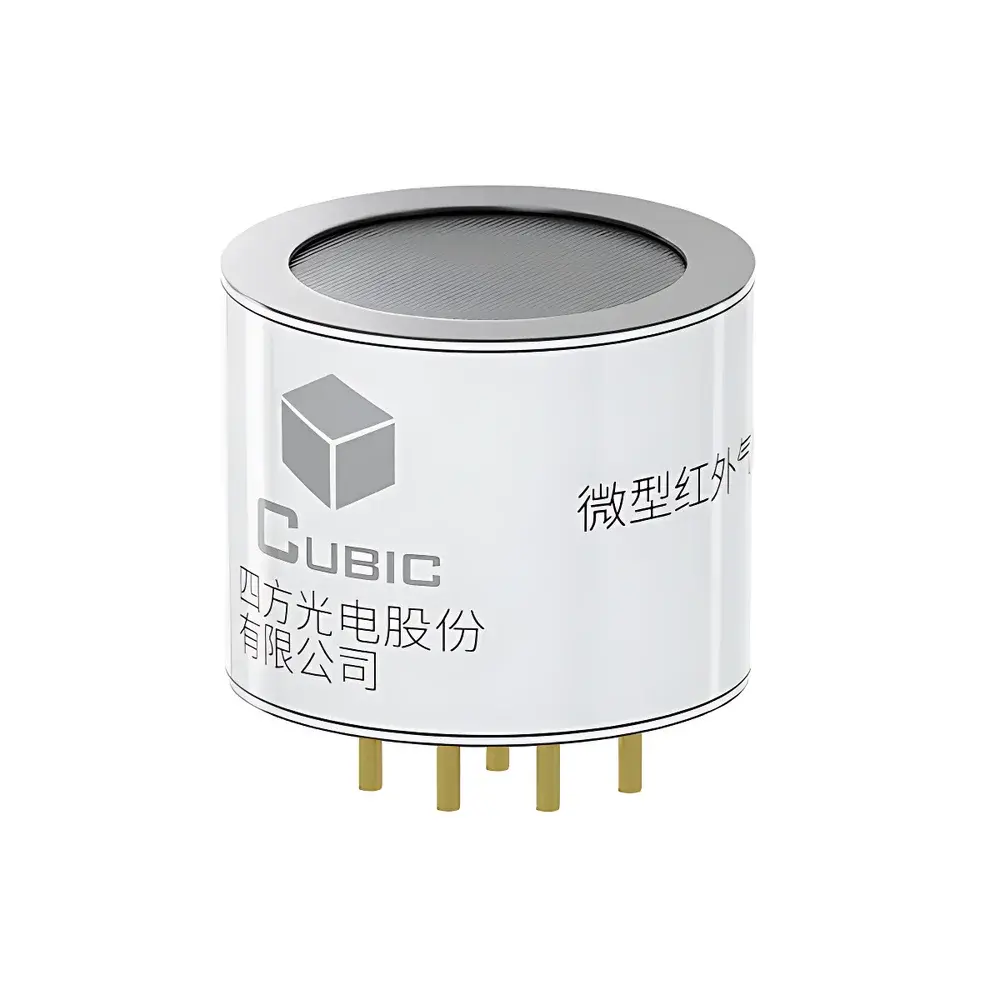
Cubic SBrH Miniature NDIR Methyl Bromide (CH₃Br) Gas Sensor
| Brand | Cubic |
|---|---|
| Origin | Hubei, China |
| Manufacturer Type | Authorized Distributor |
| Country of Origin | China |
| Model | SBrH |
| Price | USD 295 (FOB) |
| Detection Principle | Non-Dispersive Infrared (NDIR) |
| Measurement Range | 0–5% vol CH₃Br |
| Accuracy | ±0.06% vol (0–1% vol), ±6% of reading (1–5% vol) @ 25°C ±2°C, 101.3 kPa |
| Operating Temperature | −40°C to +70°C |
| Storage Temperature | −40°C to +70°C |
| Humidity Range | 0–95% RH (non-condensing) |
| Explosion Protection | Exia II C T4 Ga |
| Output Options | Analog (0–5 V / 4–20 mA) and Digital (UART TTL/RS485) |
| Housing | All-metal, dual-beam optical architecture |
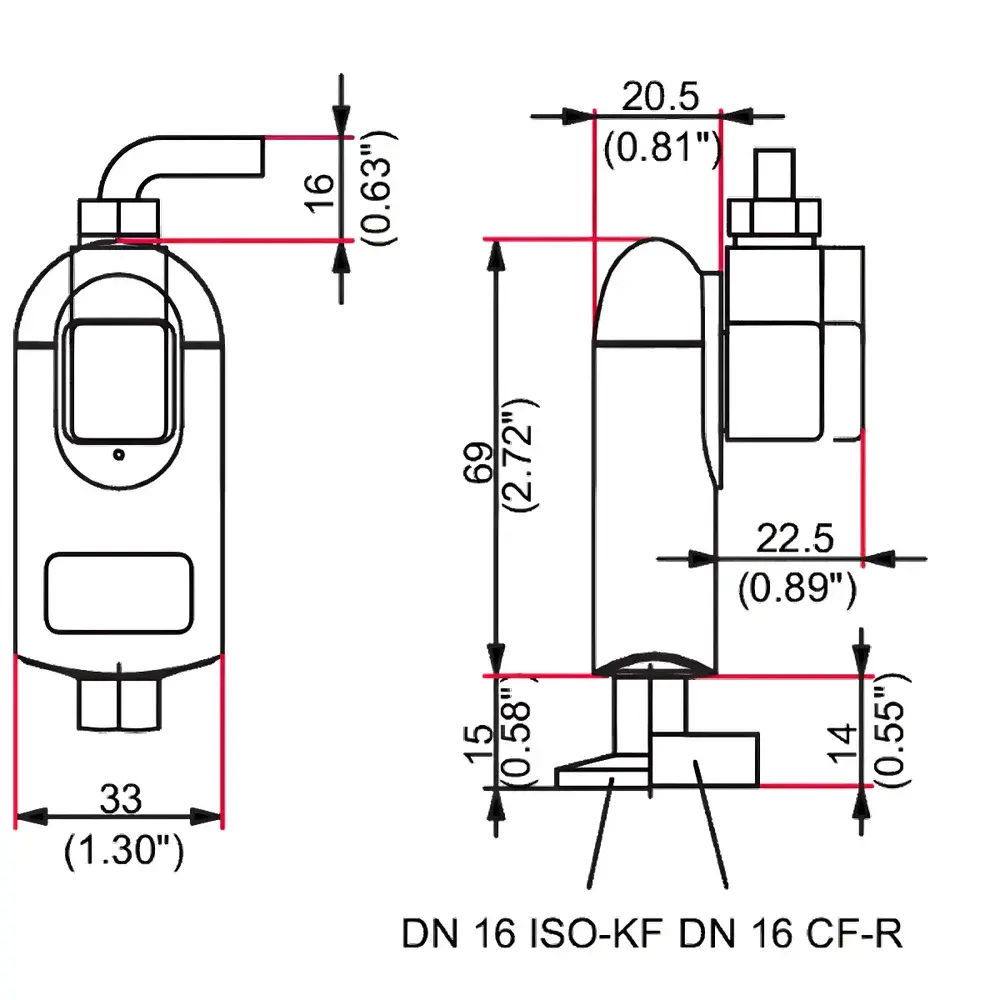
| Dimensions | Φ20 × 19 mm / Φ20 × 16.6 mm (excluding pins) |
Overview
The Cubic SBrH Miniature NDIR Methyl Bromide (CH₃Br) Gas Sensor is an industrial-grade, non-dispersive infrared (NDIR) sensing module engineered for reliable, continuous measurement of methyl bromide concentration in ambient air. Leveraging a dual-beam optical design with matched reference and measurement channels, the SBrH compensates for source drift, window fouling, and environmental fluctuations—ensuring high reproducibility across extended operational cycles. Unlike electrochemical or metal-oxide semiconductor (MOS) sensors, the NDIR principle provides inherent selectivity for CH₃Br through its characteristic absorption band near 5.7 µm, minimizing cross-sensitivity to common interferents such as CO₂, CH₄, or water vapor (within specified humidity limits). The sensor is calibrated and validated under controlled conditions per ISO 12039 and ASTM D6786 protocols for trace gas quantification, supporting traceability to NIST-traceable standards. Its compact cylindrical form factor and robust all-metal housing enable direct integration into portable analyzers, fixed-gas monitoring systems, fumigation control cabinets, and laboratory-grade gas chromatography auxiliary detectors.
Key Features
- Dual-beam NDIR architecture with temperature-stabilized IR source and thermopile detector for long-term baseline stability
- Full-scale automatic temperature compensation across −40°C to +70°C operating range, eliminating need for external thermal management
- Exia II C T4 Ga certified intrinsic safety rating—suitable for Zone 0/1 hazardous locations handling flammable or toxic gases
- Simultaneous analog (0–5 V DC or 4–20 mA) and digital (UART TTL logic level or RS485 interface) output options for flexible system integration
- All-metal hermetic housing with IP65-rated ingress protection (when properly mounted), resistant to mechanical shock, corrosion, and condensation-induced signal attenuation
- Factory-calibrated with individual calibration certificate; supports user-initiated zero/span verification via serial command protocol
Sample Compatibility & Compliance
The SBrH sensor is optimized for gaseous-phase methyl bromide detection in clean, dry-to-moderately humid air matrices (0–95% RH, non-condensing). It is not intended for use in aerosol-laden, particulate-rich, or highly acidic/alkaline environments without upstream filtration (e.g., sintered stainless steel particulate filter + hydrophobic membrane). The device complies with IEC 60079-0 (Explosive Atmospheres – General Requirements) and IEC 60079-11 (Intrinsic Safety “i” Protection), meeting the Exia II C T4 Ga classification for Group II C gases (including hydrogen and acetylene) at surface temperatures ≤135°C. It adheres to EMC Directive 2014/30/EU (EN 61326-1:2013) and RoHS 2011/65/EU. While not FDA 21 CFR Part 11 compliant out-of-the-box, its digital output supports audit-ready data logging when integrated with compliant host firmware implementing secure timestamping, user access control, and electronic signature workflows.
Software & Data Management
The SBrH communicates via ASCII-based UART protocol (default 9600 bps, 8N1) or Modbus RTU over RS485, enabling plug-and-play integration with PLCs, SCADA systems, or custom embedded controllers. Cubic provides a Windows-compatible PC configuration utility (SBrH ConfigTool v2.1) for firmware updates, span adjustment, alarm threshold setting, and real-time waveform visualization. Raw sensor outputs are linearized and temperature-compensated internally; host systems receive calibrated concentration values directly in % vol units. For GMP/GLP-regulated environments, third-party middleware (e.g., LabVIEW™ DAQmx drivers or Python-based PySerial wrappers with SHA-256 log hashing) may be deployed to enforce data integrity, version-controlled calibration history, and ALCOA+ (Attributable, Legible, Contemporaneous, Original, Accurate, Complete, Consistent, Enduring, Available) compliance.
Applications
- Phytosanitary fumigation monitoring in quarantine facilities, grain silos, and shipping containers
- Occupational health and safety (OHS) compliance in chemical manufacturing plants handling methyl bromide as intermediate or sterilant
- Leak detection and process endpoint verification in pharmaceutical cold sterilization chambers
- Environmental emission monitoring at soil fumigation sites per EPA Method TO-15 and EU Directive 2008/50/EC
- Research-grade gas standard generation and dynamic dilution system feedback control
FAQ
What is the recommended calibration frequency for the SBrH sensor in continuous operation?
For critical applications (e.g., fumigation safety monitoring), zero and span calibration is recommended every 3 months; for general industrial use, biannual verification suffices. Calibration requires certified CH₃Br gas standard (±2% uncertainty) and clean zero air.
Can the SBrH be exposed to condensing humidity or liquid ingress?
No. Operation above 95% RH or exposure to condensation will impair optical path transmission and accelerate detector aging. Use with hydrophobic particulate filters and desiccant traps in high-humidity environments.
Is the sensor compatible with explosion-proof enclosures rated for Class I, Division 1?
Yes—the Exia II C T4 Ga certification permits installation in Class I, Division 1 hazardous locations per NEC Article 500, provided wiring conforms to IEC 60079-14 requirements.
Does the SBrH support custom measurement ranges outside 0–5% vol?
Yes. Cubic offers factory-configured variants for 0–100 ppm, 0–1000 ppm, or 0–1% vol ranges with corresponding accuracy specifications and optical path optimization.
How does the dual-beam design improve measurement stability compared to single-beam NDIR sensors?
Dual-beam architecture actively references the IR source intensity in real time, decoupling absorbance calculation from source degradation, lens contamination, or ambient thermal drift—yielding <0.5% full-scale drift over 12 months under typical field conditions.