
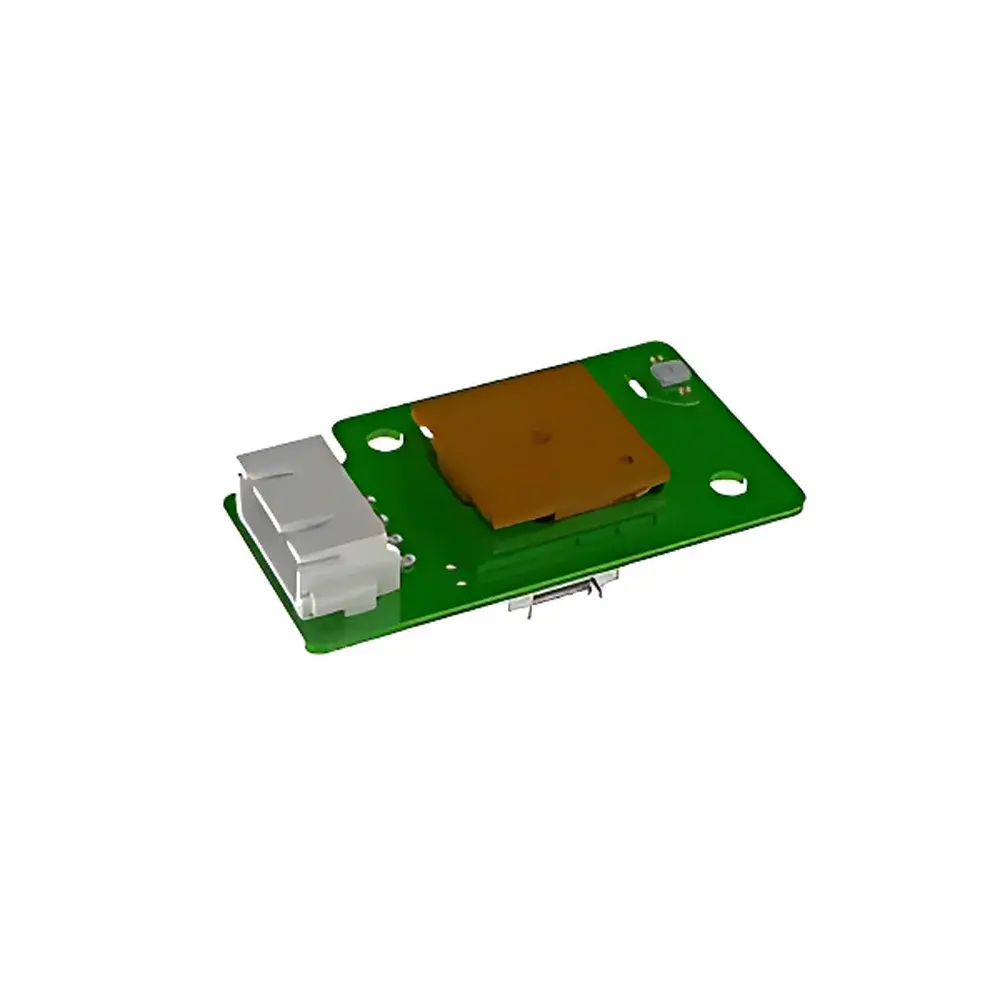
Cubic CB-HCHO-V5 Electrochemical Formaldehyde & VOC Sensor Module
| Brand | Cubic |
|---|---|
| Origin | Hubei, China |
| Model | CB-HCHO-V5 |
| Detection Principle | Electrochemical |
| Measurement Range | 0–1 ppm |
| Resolution | 1 ppb |
| Response Time | <90 s |
| Operating Temperature | −20 °C to +60 °C |
| Accuracy | ±0.02 ppm or ±20% (whichever is greater) at 25 ± 2 °C, 50 ± 10% RH |
| Lifetime | >6 years |
| Output Interface | UART TTL |
| Dimensions | 43 × 8.8 × 24 mm |
| Integrated Temperature & Humidity Compensation | Yes |
| Cross-sensitivity to Ethanol | Low |
| Power Consumption | Ultra-low (battery-compatible) |
Overview
The Cubic CB-HCHO-V5 is a high-stability, electrochemical-based formaldehyde (HCHO) and volatile organic compound (VOC) sensing module engineered for continuous, real-time indoor air quality (IAQ) monitoring. Unlike optical or metal-oxide semiconductor (MOS) sensors, the CB-HCHO-V5 employs a three-electrode electrochemical cell with proprietary electrolyte encapsulation technology—ensuring long-term baseline stability and minimal signal drift under variable environmental conditions. The sensor operates on amperometric detection: formaldehyde molecules diffuse through a selective membrane, undergo oxidation at the working electrode, and generate a current proportional to gas concentration. This principle enables trace-level quantification in the sub-ppb range while maintaining robustness against common interferents such as ethanol, CO, and NO₂. Designed for integration into embedded systems, the module delivers calibrated digital output via UART TTL interface, eliminating the need for external signal conditioning or analog-to-digital conversion.
Key Features
- Ultra-high resolution of 1 ppb across the full 0–1 ppm measurement range, supporting compliance with stringent IAQ standards including WHO guidelines and ISO 16000-23.
- Integrated digital temperature and relative humidity sensors coupled with adaptive compensation algorithms—ensuring consistent accuracy across −20 °C to +60 °C operating temperatures and 0–95% RH (non-condensing).
- Proven low cross-sensitivity to ethanol (<5% interference at 100 ppm), critical for reliable operation in residential kitchens, laboratories, and hospitality environments where alcohol-based disinfectants are routinely used.
- Extended operational lifetime exceeding 6 years under typical indoor conditions—validated through accelerated aging tests per IEC 60068-2-60 and ASTM D5116.
- Ultra-low power consumption (average <150 µA in sleep mode), enabling battery-powered deployment in portable monitors and wireless sensor networks without compromising measurement frequency or data integrity.
- Compact form factor (43 × 8.8 × 24 mm) with standardized pinout—optimized for OEM integration into HVAC controllers, air purifiers, smart thermostats, and building management systems (BMS).
Sample Compatibility & Compliance
The CB-HCHO-V5 is validated for use in ambient air matrices containing typical indoor VOCs (e.g., formaldehyde, acetaldehyde, benzene derivatives) and common background gases (N₂, O₂, CO₂, H₂O vapor). It meets functional safety requirements for Class II equipment per IEC 61000-6-3 (EMC emissions) and IEC 61000-6-2 (immunity). While not certified as a standalone medical or occupational exposure device, its performance aligns with the technical specifications referenced in ISO 16000-23 (indoor air—determination of formaldehyde—electrochemical sensor method) and supports GLP-compliant data acquisition when paired with audit-trail-enabled firmware and timestamped logging.
Software & Data Management
The module communicates via UART TTL (3.3 V logic level) at configurable baud rates (default 9600 bps), transmitting ASCII-formatted frames containing calibrated HCHO concentration (ppm), temperature (°C), and relative humidity (%RH). Cubic provides a reference firmware library (C/C++ compatible) supporting automatic zero-point calibration, span adjustment, and diagnostic flag reporting (e.g., sensor saturation, low battery, communication timeout). When integrated into cloud-connected platforms, the CB-HCHO-V5 supports time-series data export compliant with MQTT v3.1.1 and HTTP/HTTPS RESTful APIs—enabling interoperability with BACnet MS/TP gateways and ISO 16484-5–compliant building automation systems.
Applications
- Embedded IAQ monitoring in residential and commercial HVAC systems, including demand-controlled ventilation (DCV) logic based on real-time formaldehyde load.
- OEM integration into consumer-grade air purifiers and smart home hubs requiring regulatory-grade HCHO feedback for filter life estimation and auto-mode optimization.
- Portable handheld analyzers for facility managers conducting periodic indoor air audits per ASHRAE Standard 62.1 and LEED IEQ Credit 3.2.
- Research-grade environmental chambers where long-duration, unattended formaldehyde exposure studies require stable, low-drift sensing over weeks or months.
- Smart window controllers and energy recovery ventilators (ERVs) that modulate airflow rates based on dynamic VOC thresholds rather than static CO₂ setpoints.
FAQ
What calibration protocol is recommended for long-term accuracy?
Cubic recommends initial two-point calibration (zero air and 0.5 ppm formaldehyde standard) followed by quarterly zero-checks using filtered ambient air; field span verification is advised annually using NIST-traceable gas standards.
Can the sensor be exposed to condensation or high-humidity environments?
The module is rated for operation up to 95% RH non-condensing; prolonged exposure to condensation may compromise membrane integrity and requires mechanical shielding or desiccant integration.
Is firmware update capability supported over UART?
Yes—bootloader-enabled firmware updates are available via UART using Cubic’s proprietary DFU (Device Firmware Upgrade) protocol, supporting version rollback and CRC-verified payload validation.
Does the sensor comply with RoHS, REACH, and WEEE directives?
Yes—the CB-HCHO-V5 is fully compliant with EU Directive 2011/65/EU (RoHS), Regulation (EC) No 1907/2006 (REACH), and Directive 2012/19/EU (WEEE), with full material declaration documentation available upon request.
How does temperature compensation affect measurement uncertainty?
The integrated thermistor and capacitive RH sensor feed into a multi-variable compensation model; under ISO 16000-23 test conditions, this reduces total measurement uncertainty from ±20% to ±7.5% across the −10 °C to +40 °C range.
Related Products







