
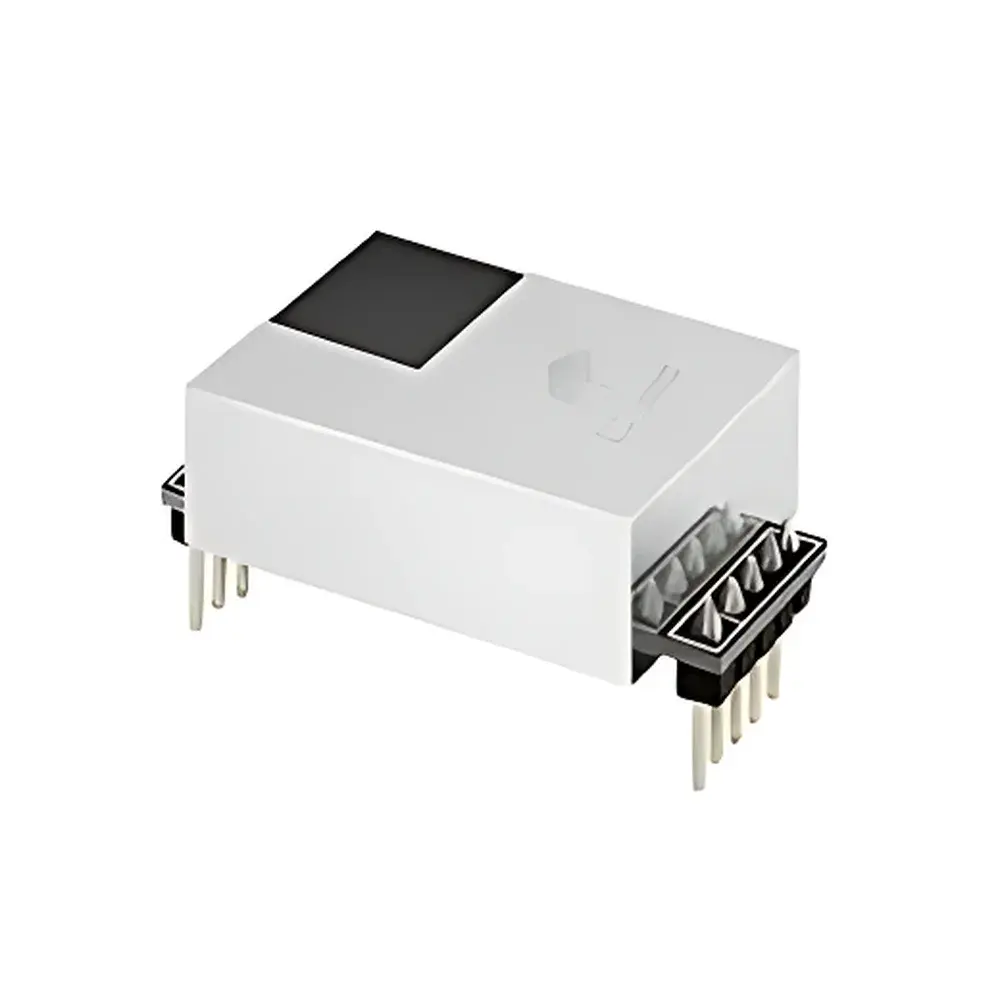
Cubic CM1107 Dual-Channel NDIR Carbon Dioxide (CO₂) Sensor
| Brand | Cubic |
|---|---|
| Origin | Hubei, China |
| Manufacturer Type | Authorized Distributor |
| Country of Origin | China |
| Model | CM1107 |
| Detection Principle | Non-Dispersive Infrared (NDIR) |
| Measurement Range | 0–5000 ppm (customizable up to 12,000 ppm) |
| Warm-up Time | ≤30 s |
| Data Update Rate | 1 Hz |
| Accuracy | ±(30 ppm + 3% of reading) at 25°C±2°C, 50%±10% RH |
| Operating Temperature | −10°C to +50°C |
| Operating Humidity | 0–95% RH (non-condensing) |
| Storage Conditions | −30°C to +70°C, 0–95% RH (non-condensing) |
| Supply Voltage | DC 5 V ±0.1 V |
| Average Current Consumption | <70 mA |
| Output Interfaces | UART TTL (3.3 V / 5 V), I²C, PWM |
| Dimensions (L×W×H) | 33 mm × 21.7 mm × 10 mm (excluding pins) |
Overview
The Cubic CM1107 Dual-Channel NDIR Carbon Dioxide (CO₂) Sensor is an engineered solution for reliable, long-term CO₂ concentration monitoring in indoor air quality (IAQ), HVAC control, agricultural enclosures, and industrial safety applications. Built upon non-dispersive infrared (NDIR) spectroscopy, the CM1107 leverages the characteristic absorption band of CO₂ near 4.26 µm. Its dual-channel architecture integrates a measurement channel and a reference channel within a single optical path—enabling real-time compensation for optical drift, aging of the IR source, and environmental fluctuations such as temperature-induced detector responsivity shifts. Unlike single-beam NDIR sensors, this design eliminates reliance on external calibration references or periodic zero-point adjustments under stable ambient conditions, thereby delivering high reproducibility across extended deployment cycles.
Key Features
- Dual-channel NDIR architecture with integrated measurement and reference photodetectors for active baseline correction and enhanced long-term stability
- Factory-calibrated across full scale; no field recalibration required under standard operating conditions
- Short warm-up time of ≤30 seconds, enabling rapid system integration into battery-powered or duty-cycled monitoring nodes
- Full-scale temperature compensation via embedded matrix-based correction algorithm, covering −10°C to +50°C operational range
- Multi-interface digital output: configurable UART TTL (3.3 V / 5 V logic levels), I²C (standard mode, 100 kHz), and pulse-width modulated (PWM) analog-equivalent signal
- Compact form factor (33 mm × 21.7 mm × 10 mm) optimized for PCB-level integration in space-constrained OEM devices
- Low average power consumption (<70 mA at 5 V DC) supporting energy-efficient continuous operation in edge-sensing networks
Sample Compatibility & Compliance
The CM1107 is designed for gaseous sampling in ambient air environments. It is not intended for direct exposure to corrosive, condensing, or particulate-laden gas streams without appropriate pre-conditioning (e.g., hydrophobic membrane filtration, thermal dew-point management). The sensor complies with RoHS Directive 2011/65/EU and meets EMC immunity requirements per IEC 61000-4-2 (ESD), -4-3 (Radiated RF), and -4-4 (EFT). While not certified to UL 2075 or EN 50131 for life-safety alarm use out-of-the-box, its output stability and repeatability support integration into systems compliant with ISO 16000-8 (indoor air—CO₂ measurement), ASHRAE Standard 62.1 (ventilation control), and EN 13779 (ventilation for non-residential buildings). For regulated environments requiring audit trails or data integrity, OEMs may implement firmware-level logging aligned with FDA 21 CFR Part 11 principles when paired with validated host controllers.
Software & Data Management
The CM1107 operates as a smart peripheral—requiring no onboard configuration software. All communication is protocol-transparent: UART frames follow a fixed 9-byte structure (start byte, command ID, payload, CRC8); I²C uses a 7-bit slave address (0x68 default) with register-mapped access to CO₂ value (16-bit), temperature (16-bit), and status flags. Host microcontrollers can parse raw values and apply optional linearization or humidity cross-correction using documented coefficients provided in the technical datasheet. Cubic supplies comprehensive integration guides—including Arduino and STM32 HAL examples—and supports firmware-level timestamping and buffered readout for synchronized multi-sensor deployments. When embedded in cloud-connected gateways, the sensor’s 1 Hz update rate ensures sufficient temporal resolution for trend analysis, demand-controlled ventilation (DCV) logic, and anomaly detection without overloading wireless bandwidth.
Applications
- Indoor Air Quality (IAQ) monitors and smart thermostats for commercial and residential HVAC optimization
- Greenhouse climate controllers where CO₂ enrichment (up to 1200 ppm) must be maintained within ±50 ppm tolerance
- Portable air quality analyzers used in occupational health assessments and building commissioning
- Education and research platforms requiring stable, low-cost NDIR reference sensors for comparative studies
- OEM integration into medical device ancillaries (e.g., capnography adjuncts, incubator atmosphere controllers) where regulatory responsibility lies with the final system integrator
FAQ
Is the CM1107 suitable for outdoor deployment?
No—it is rated for indoor or sheltered environments only. Exposure to rain, direct sunlight, or sustained condensation will degrade optical performance and void warranty.
Can the sensor be calibrated by the end user?
Field calibration is not supported. Zero-point adjustment requires controlled N₂ environment and factory-grade instrumentation; users should rely on the sensor’s built-in drift compensation and scheduled replacement per manufacturer’s service life guidance (typically 10 years MTBF under nominal conditions).
Does the CM1107 output require signal conditioning before ADC conversion?
No—UART and I²C outputs deliver digitally processed, temperature-compensated CO₂ values directly. PWM output provides a 0–100% duty cycle proportional to full-scale range and may require RC filtering if interfaced with legacy analog inputs.
What is the recommended mounting orientation?
Horizontal placement with vent holes unobstructed is optimal. Avoid vertical installation with openings facing downward to prevent dust or moisture ingress.
How does the dual-channel architecture improve accuracy versus single-channel NDIR sensors?
By continuously measuring both target absorption and background drift on adjacent photodiodes within the same optical cavity, the CM1107 cancels common-mode errors arising from source intensity decay, window contamination, and thermal lensing—yielding superior baseline retention over time without external references.







