
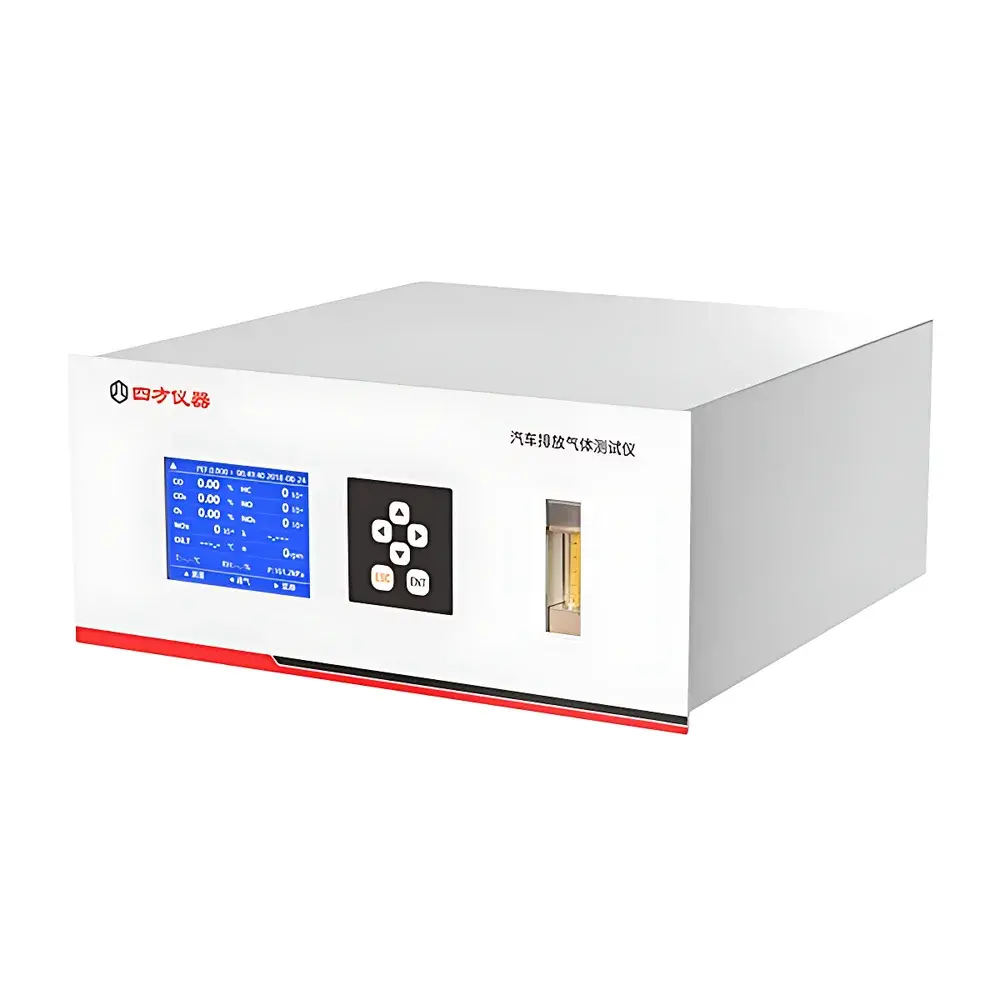
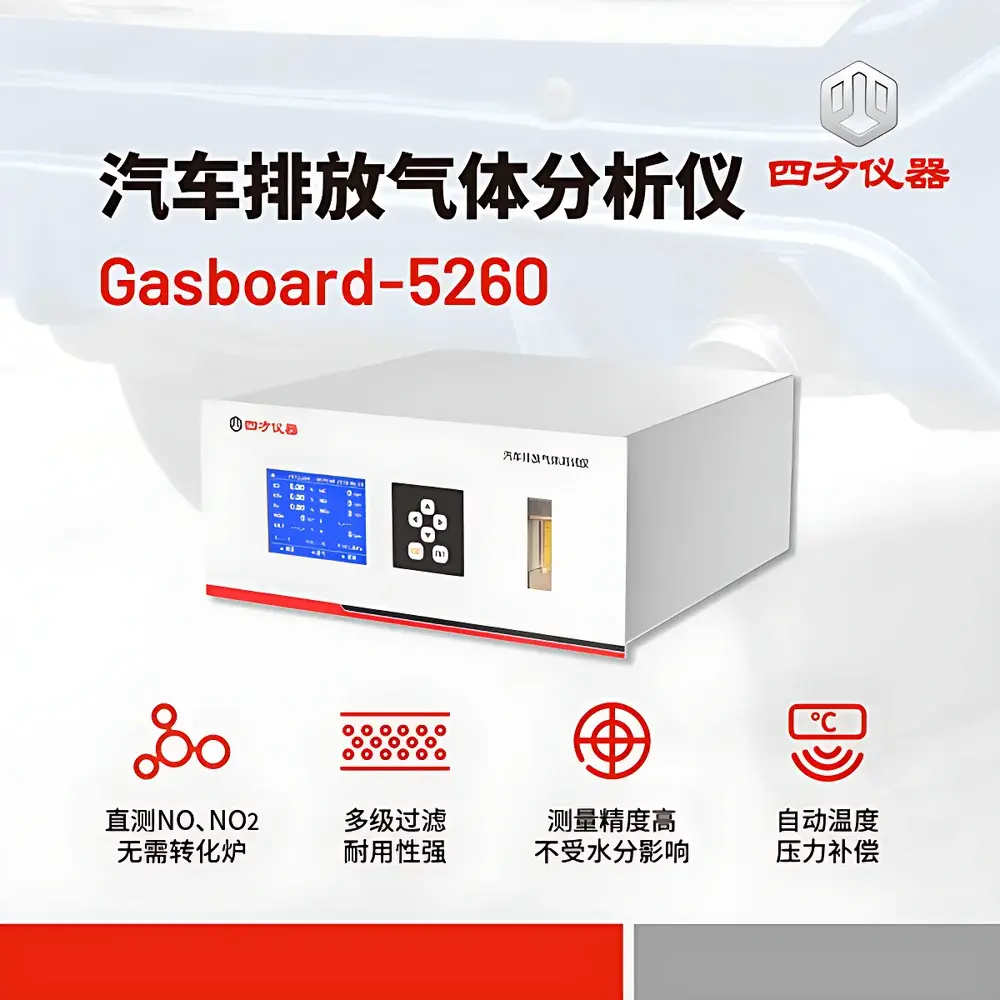
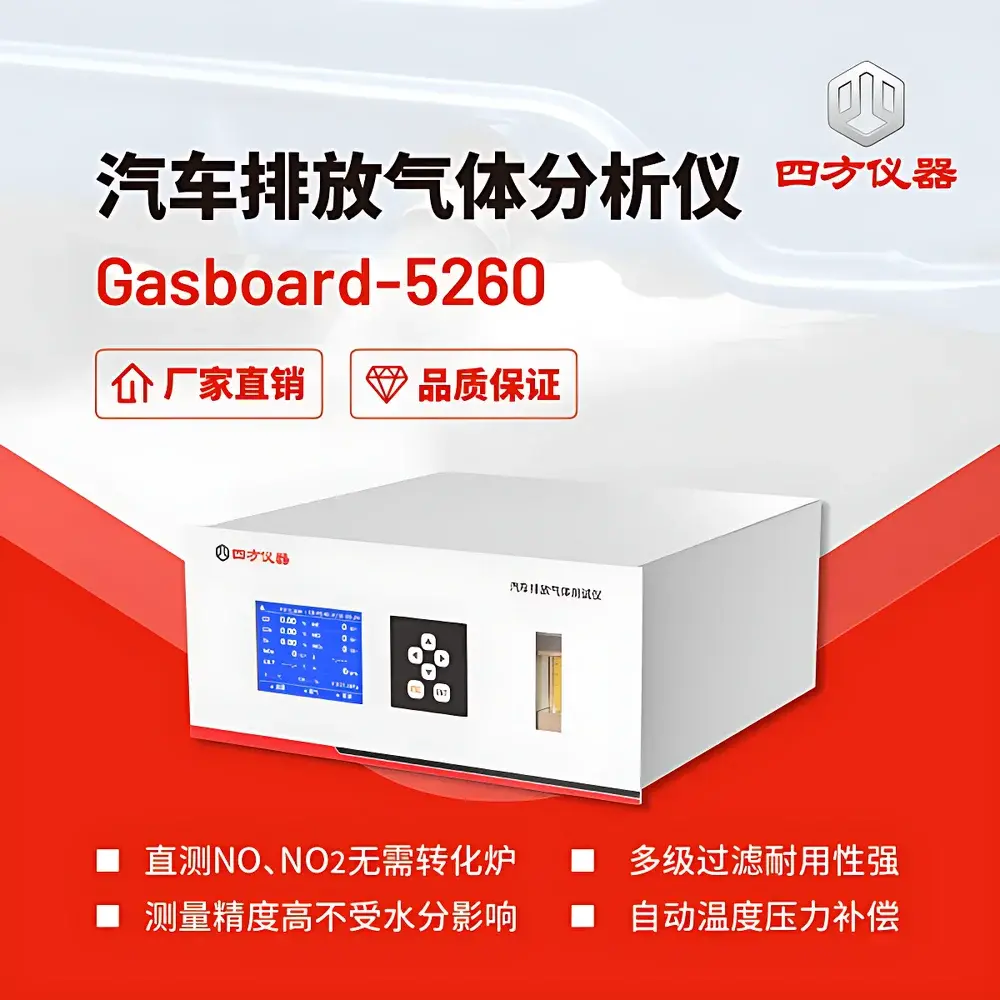
CUBIC INSTRUMENTS Gasboard-5230 Automotive Exhaust Gas Analyzer for Diesel Vehicles
| Brand | CUBIC INSTRUMENTS |
|---|---|
| Origin | Hubei, China |
| Model | Gasboard-5230 |
| Instrument Type | Online Analyzer |
| Measurement Principle | Microflow Dual-Chamber Infrared (NO), NDUV (NO₂), NDIR (CO₂, CO, HC), Electrochemical (O₂) |
| Measured Gases | HC, CO, CO₂, NO, NO₂, O₂ |
| CO₂ Range | (0.0–16.0) % vol (±0.03 % vol or ±3%) |
| NO Range | (0–4000) ppm (±25 ppm or ±4%) |
| NO₂ Range | (0–1000) ppm (±25 ppm or ±4%) |
| Resolution | NO/NO₂: 1 ppm |
| CO₂ | 0.01 % vol |
| Response Time (T₉₀) | CO₂ ≤ 8 s |
| Warm-up Time | 30 min |
| Communication | RS-485 / RS-232 |
| Power Supply | 100–240 VAC, 150 W |
Overview
The CUBIC INSTRUMENTS Gasboard-5230 is a certified online automotive exhaust gas analyzer engineered specifically for regulatory-grade emissions testing of diesel-powered vehicles. It implements a multi-physical-optical detection architecture to simultaneously quantify six critical exhaust constituents—hydrocarbons (HC), carbon monoxide (CO), carbon dioxide (CO₂), nitric oxide (NO), nitrogen dioxide (NO₂), and oxygen (O₂)—in real time. Its core measurement technologies include patented microflow dual-chamber infrared sensing for NO (PCT/CN2018100767), non-dispersive ultraviolet (NDUV) absorption for direct NO₂ quantification without catalytic conversion, and non-dispersive infrared (NDIR) for CO, CO₂, and HC. Oxygen is measured via high-stability electrochemical cell technology. Designed in strict conformance with China’s mandatory standard GB 3847–2018 (“Limits and Measurement Methods for Pollutants from Diesel Vehicles – Free Acceleration and Loaded Mode Testing”) and metrological verification regulation JJG 688–2017 (Class 0 accuracy grade), the Gasboard-5230 delivers traceable, repeatable, and legally defensible data for official inspection, type approval, and R&D applications.
Key Features
- Direct, interference-free NO and NO₂ measurement using dual-spectrum optical methods—eliminates reliance on NOx converters and associated calibration drift and maintenance.
- Proprietary microflow dual-chamber infrared sensor for NO: incorporates temperature-compensated optical filtering and symmetrical reference/detection chambers to suppress thermal drift and long-term electronic aging effects.
- Multi-stage particulate and moisture filtration system integrated upstream of the optical path, extending sensor lifetime and ensuring stable operation under high-soot diesel exhaust conditions.
- Real-time signal linearization algorithms embedded in firmware correct for nonlinearity across full dynamic ranges—particularly critical for low-concentration NO₂ and high-CO₂ regimes.
- Modular hardware architecture enables seamless integration with complementary instruments such as the Gasboard-6000 transmittance-type opacimeter for simultaneous opacity and gaseous pollutant analysis per GB 3847–2018 Annex D.
- Robust industrial enclosure rated IP54, designed for continuous operation in vehicle inspection bays and mobile emission testing units.
Sample Compatibility & Compliance
The Gasboard-5230 is validated for use with raw, uncooled, and un-diluted diesel exhaust streams sampled directly from tailpipes during free acceleration and loaded-mode (e.g., ASM or VMAS) tests. It accommodates exhaust gas temperatures up to 180 °C at the probe inlet and tolerates transient water vapor condensation due to its hydrophobic filtration and heated sample line interface (optional). All measurement uncertainties comply with JJG 688–2017 Class 0 metrological requirements—including absolute and relative error limits across specified concentration ranges—and are traceable to national primary standards. The instrument supports audit-ready documentation per GLP/GMP principles, with timestamped raw data logging, user-access control, and optional electronic signature functionality compatible with 21 CFR Part 11–aligned software configurations.
Software & Data Management
The analyzer interfaces via RS-485 or RS-232 to host systems running Windows-based test management software (e.g., CUBIC’s proprietary EmissionTest Suite or third-party inspection platforms). Firmware supports Modbus RTU protocol for OEM integration into automated test lanes. All concentration outputs are delivered as calibrated digital signals with 16-bit resolution and sub-second update intervals. Internal memory logs ≥30 days of second-by-second measurements with metadata (test ID, operator, vehicle VIN, ambient T/P, calibration timestamps). Export formats include CSV and XML, structured to align with national environmental data reporting gateways. Calibration history, fault logs, and sensor diagnostics are retained with immutable timestamps for regulatory review.
Applications
- Regulatory vehicle inspection stations performing mandatory annual or biennial diesel emissions checks under GB 3847–2018.
- OEM powertrain development labs conducting engine calibration, aftertreatment system validation (e.g., SCR, DPF), and RDE (Real Driving Emissions) correlation studies.
- Third-party certification bodies executing type-approval testing for new diesel models entering the Chinese market.
- Environmental protection bureaus deploying mobile monitoring units for roadside enforcement and hotspot screening.
- Academic and government research institutions studying diesel combustion chemistry, NOx speciation dynamics, and low-temperature oxidation pathways.
FAQ
Does the Gasboard-5230 require an NOx converter to measure NO₂?
No. It employs non-dispersive ultraviolet (NDUV) absorption spectroscopy for direct, selective NO₂ detection—eliminating converter-related inaccuracies, cross-sensitivity to SO₂, and scheduled replacement costs.
How does the instrument handle water vapor interference in diesel exhaust?
It integrates a multi-stage filtration system including hydrophobic membrane filters and optional heated sample lines. NDIR and NDUV optical paths are inherently insensitive to H₂O absorption bands, and firmware applies spectral compensation where necessary.
Is the analyzer suitable for both laboratory and field deployment?
Yes. Its ruggedized chassis, wide input voltage range (100–240 VAC), and compliance with IEC 61000-4 electromagnetic immunity standards enable reliable operation in workshop, mobile lab, and outdoor inspection environments.
What calibration standards are required for routine verification?
Certified gas mixtures traceable to NIM (National Institute of Metrology, China) or equivalent national metrology institutes—specifically: NO (100/1000 ppm), NO₂ (50/500 ppm), CO (1.0/5.0 %), CO₂ (5.0/15.0 %), and zero air (hydrocarbon-free, <0.1 ppm THC).
Can the Gasboard-5230 be integrated into an automated test lane?
Yes. Its RS-485 interface supports Modbus RTU protocol, enabling bidirectional communication with PLCs and central test management systems for fully automated start/stop, data acquisition, and pass/fail decision logic per GB 3847–2018 Annex F.
Related Products







