
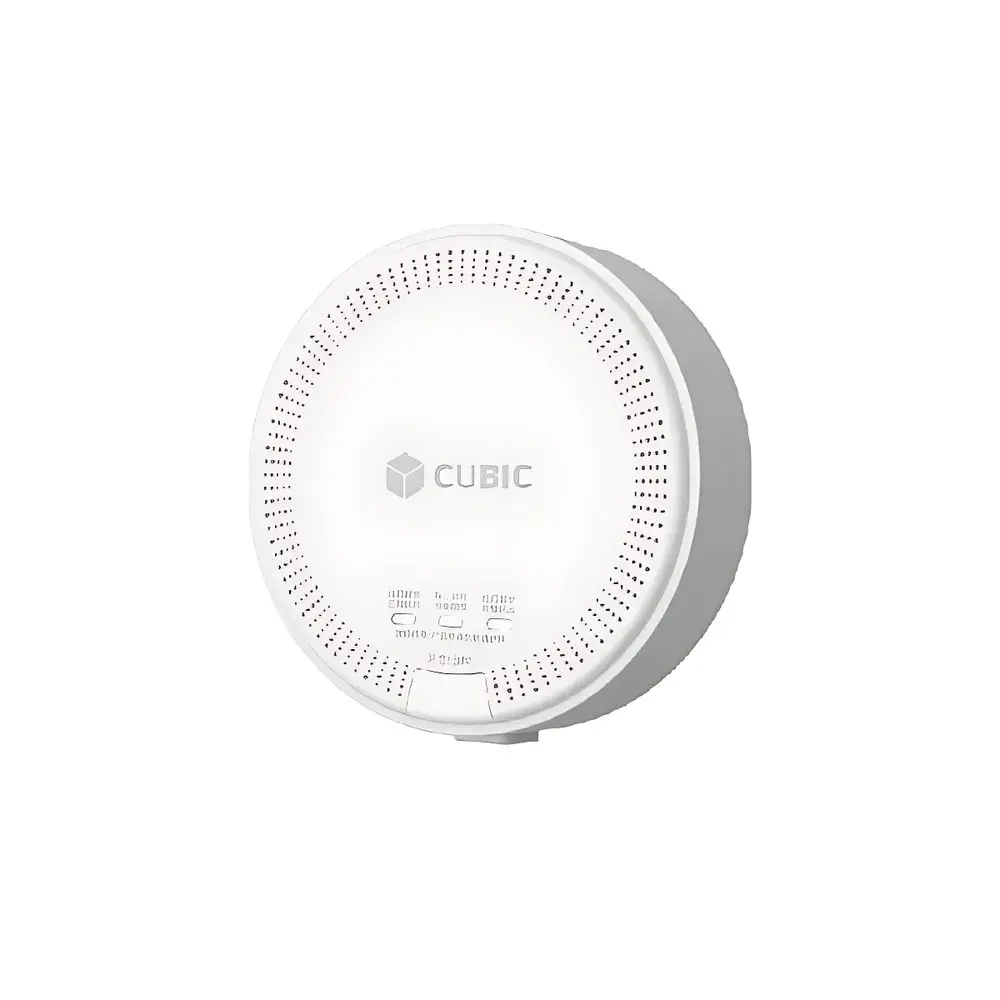
Cubic JT-AM5301 NDIR Methane (CH₄) Residential Gas Detector
| Brand | Cubic |
|---|---|
| Model | JT-AM5301 |
| Detection Principle | Non-Dispersive Infrared (NDIR) |
| Target Gas | CH₄ |
| Range | 0–100% LEL |
| Accuracy | ±3% LEL |
| Alarm Threshold | 10% LEL |
| Response Time | <30 s (diffusion) |
| Operating Temp. | −10°C to +50°C |
| Humidity | 0–90% RH |
| Power Supply | AC 220 V ±10%, 50 Hz |
| Power Consumption | 3 W |
| IP Rating | IP30 (per GB 23757) |
| Compliance | GB 15322.2–2019, CCC Fire Certification (3CF) |
| Communication | NB-IoT (default), optional Wi-Fi or 4G |
| Sensor Lifetime | ≥10 years |
| Dimensions | 84 × 84 × 33.5 mm |
| Weight | 240 g |
Overview
The Cubic JT-AM5301 is a residential-grade, fixed-mount methane (CH₄) gas detector engineered for reliable, long-term monitoring in domestic and light commercial environments. It employs non-dispersive infrared (NDIR) sensing technology—a physically stable, drift-resistant optical method that measures CH₄ concentration by quantifying absorption at its characteristic mid-infrared wavelength (≈3.3 µm). Unlike catalytic bead or electrochemical sensors, NDIR eliminates poisoning risks from silicones, sulfides, or halogenated compounds and delivers consistent performance across temperature fluctuations without frequent recalibration. Designed specifically for natural gas (primarily CH₄) leak detection, the JT-AM5301 operates within the lower explosive limit (LEL) scale—reporting real-time concentration from 0 to 100% LEL with ±3% LEL accuracy and alarm activation at a factory-set threshold of 10% LEL. Its compact form factor and plug-and-play AC-powered architecture make it suitable for wall or ceiling mounting in kitchens, residential utility rooms, food markets, and small-scale storage facilities where continuous, unattended operation is required.
Key Features
- NDIR-based methane specificity: Dual-wavelength optical design suppresses cross-sensitivity to common interferents including ethanol and acetic acid vapors—critical in cooking and food-handling environments.
- Full-temperature compensation: Embedded thermal modeling ensures measurement stability across −10°C to +50°C ambient conditions without external calibration adjustments.
- Multi-mode communication: Standard NB-IoT connectivity enables low-power, wide-area network reporting; optional Wi-Fi or 4G modules support flexible integration into existing building management or smart-home ecosystems.
- Integrated safety logic: Relay output supports direct interlocking with solenoid valves and exhaust fans upon alarm confirmation—compliant with basic functional safety expectations for residential gas mitigation.
- Self-diagnostics & status indication: Real-time LED feedback (green = normal operation, red = alarm, yellow = fault or end-of-life warning) and automatic sensor health checks reduce maintenance overhead.
- Certified reliability: Certified to GB 15322.2–2019 (Chinese standard for household combustible gas detectors) and awarded mandatory 3CF fire safety certification—ensuring conformity with national installation and performance requirements.
Sample Compatibility & Compliance
The JT-AM5301 is optimized for indoor detection of methane in air under standard atmospheric pressure (86–106 kPa) and relative humidity up to 90% RH. It is not intended for use in corrosive, dusty, or high-velocity airflow environments without protective housing. The device complies with GB 15322.2–2019, which defines performance criteria for sensitivity, response time (<30 s), repeatability, and environmental robustness in residential applications. While not certified to IEC 60079 or EN 50194 for industrial hazardous areas, its IP30 ingress protection (per GB 23757) confirms suitability for dry indoor locations only—excluding outdoor, washdown, or explosion-proof deployments. For regulatory traceability, each unit bears a unique serial number and supports firmware version logging compatible with internal quality audits.
Software & Data Management
Data handling is managed via Cubic’s proprietary cloud platform accessible through a dedicated mobile application. The detector logs all alarm events—including timestamp, peak concentration, and duration—as well as periodic diagnostic reports (e.g., sensor baseline drift, supply voltage stability). Historical records are retained for ≥90 days and exportable in CSV format. The app supports push notifications, voice call alerts, and SMS escalation per user-defined contact lists. All remote configuration changes (e.g., alarm threshold adjustment, communication mode switching) are logged with user ID and timestamp, satisfying basic audit trail requirements for GLP-aligned documentation practices. Firmware updates are delivered over-the-air (OTA) with cryptographic signature verification to ensure integrity.
Applications
- Residential kitchens and apartment utility closets
- Small-scale food markets and wet markets with piped gas infrastructure
- On-site liquefied petroleum gas (LPG) cylinder storage rooms in commercial buildings
- Staff dormitories and shared housing units using centralized natural gas supply
- Preventive safety layers in mixed-use developments where municipal gas lines serve both domestic and light commercial tenants
Note: Not recommended for refinery process areas, petrochemical plants, or confined underground spaces requiring ATEX/IECEx certification.
FAQ
What gases does the JT-AM5301 detect?
It is calibrated and optimized exclusively for methane (CH₄), the primary component of pipeline natural gas. It does not detect propane, hydrogen, carbon monoxide, or other combustible gases.
Can the alarm threshold be adjusted?
Yes—the 10% LEL default can be modified via the mobile app or local configuration interface, subject to regional code compliance (e.g., some jurisdictions mandate fixed thresholds).
Does it require regular calibration?
No routine field calibration is needed due to NDIR’s inherent stability; however, annual functional verification using certified CH₄ test gas is recommended per GB 15322.2–2019 maintenance guidelines.
Is battery backup available?
No—the unit operates solely on AC 220 V power and lacks integrated battery support. For uninterrupted operation during outages, external UPS integration is advised.
How is sensor end-of-life indicated?
A yellow LED flashing at 2 Hz signals approaching end-of-life (typically after ≥10 years); the device continues to operate but with reduced confidence in metrological validity.
Related Products







