
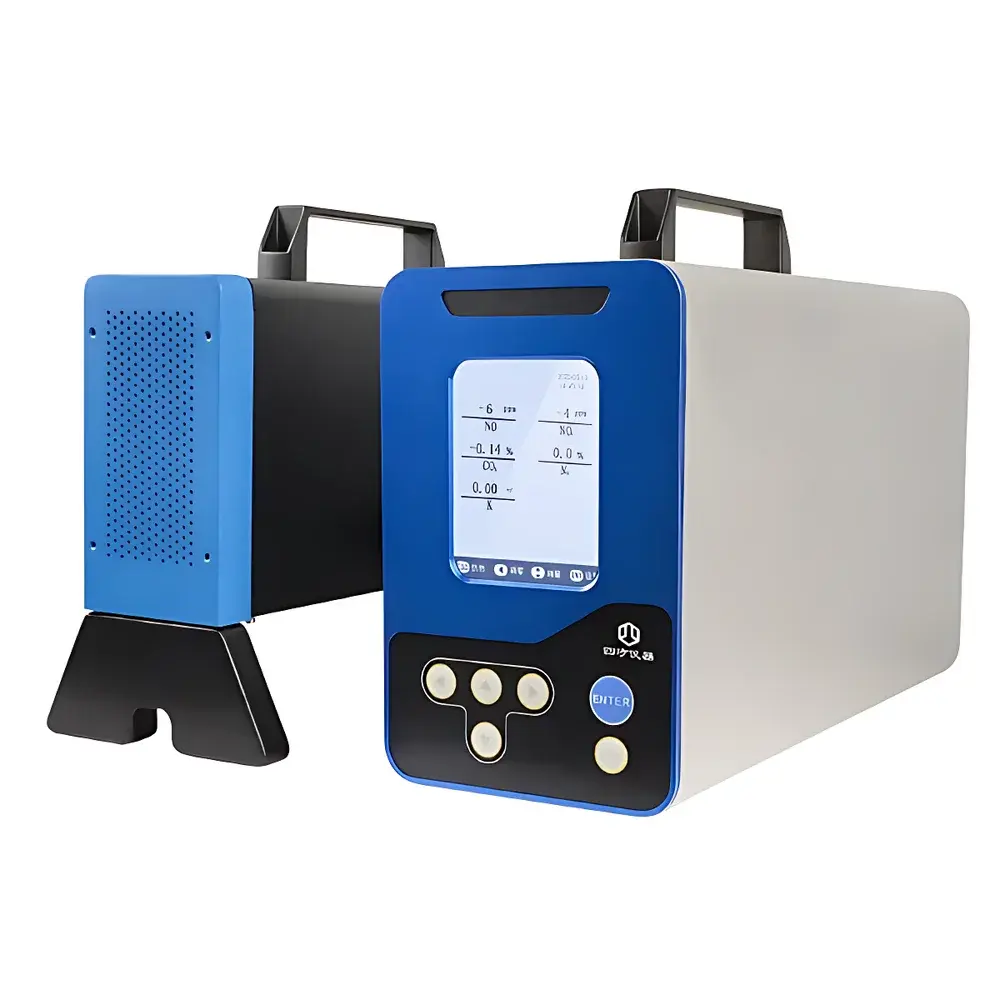
CUBIC INSTRUMENTS Portable Engine Emission Analyzer
| Brand | CUBIC INSTRUMENTS |
|---|---|
| Origin | Hubei, China |
| Manufacturer Type | Authorized Distributor |
| Country of Origin | China |
| Model | Portable Engine Emission Analyzer |
| Instrument Type | Portable |
| Detection Principle | UV-DOAS / NDUV / NDIR |
| Max. Permissible Error | NO/NO₂: ±2% rel. or ±25 ppm abs. |
| CO₂ (0–16%) | ±3% rel. or ±0.3% abs., (16–18%): ±5% rel. |
| Opacity (K) | ±2.0% rel. |
| Measurement Range | NO: 0–4000 ppm |
| NO₂ | 0–1000 ppm |
| CO₂ | 0–18% vol |
| K | 0–16 m⁻¹ |
| Resolution | NO/NO₂: 1 ppm |
| CO₂ | 0.1% vol |
| K | 0.01 m⁻¹ |
Overview
The CUBIC INSTRUMENTS Portable Engine Emission Analyzer is an integrated, field-deployable gas measurement system engineered for real-world emission compliance verification and diagnostic assessment of internal combustion engines. It employs three complementary optical spectroscopic techniques—Ultraviolet Differential Optical Absorption Spectroscopy (UV-DOAS) for nitric oxide (NO), Non-Dispersive Ultraviolet (NDUV) for nitrogen dioxide (NO₂), and Non-Dispersive Infrared (NDIR) for carbon dioxide (CO₂)—enabling simultaneous, interference-free quantification of key gaseous pollutants without chemical conversion or catalytic sampling. Unlike conventional chemiluminescence or electrochemical analyzers, this architecture eliminates the need for NO-to-NOx converters, reducing calibration drift, maintenance frequency, and measurement uncertainty. The system is specifically validated for in-situ testing of off-road diesel engines—including marine propulsion units, construction machinery, agricultural equipment, and heavy-duty on-road diesel vehicles—under dynamic operating conditions. Its self-contained power architecture, ruggedized housing, and embedded tablet-based control interface support unattended operation during roadside inspections, workshop diagnostics, and regulatory enforcement campaigns.
Key Features
- Multi-technique optical detection: UV-DOAS for NO (0–4000 ppm), NDUV for NO₂ (0–1000 ppm), and NDIR for CO₂ (0–18% vol), ensuring spectral specificity and minimal cross-sensitivity
- Direct-species measurement: Real-time, independent quantification of NO and NO₂ without reliance on thermal or catalytic conversion, preserving stoichiometric accuracy
- Integrated opacity module: Transmissive optical smoke meter compliant with ISO 8528-10 and GB/T 3846–2021, reporting light absorption coefficient K (0–16 m⁻¹) with 0.01 m⁻¹ resolution
- Robust particulate mitigation: Multi-stage filtration system (heated inlet, hydrophobic membrane, particle trap) minimizes optical window fouling and sensor degradation during extended field use
- Autonomous operation: High-capacity rechargeable lithium battery pack supports ≥4 hours of continuous measurement at full duty cycle; optional external DC input for vehicle integration
- Field-ready data handling: Bluetooth-enabled thermal printer for on-site report generation; tablet-mounted application with graphical waveform display, trend logging, and configurable alarm thresholds
Sample Compatibility & Compliance
The analyzer is designed for direct exhaust stream sampling via heated probe and flexible sampling line (standard 3 m, optional up to 6 m). It accommodates exhaust temperatures up to 200 °C (with optional high-temp probe) and flow velocities typical of low-RPM off-road engines and idling heavy-duty vehicles. All gas measurements conform to ISO 8178-4 (Reciprocating internal combustion engines — Exhaust emission measurement — Part 4: Test cycles for different engine applications) and align with the technical requirements of China’s GB 36886–2018 (Emission limits and measurement methods for exhaust pollutants from non-road mobile machinery). Opacity measurements satisfy ISO 11614 (Stationary source emissions — Determination of the opacity of emissions) and EPA Method 9 equivalency criteria. Data acquisition and storage meet GLP traceability standards, with timestamped records, operator ID tagging, and audit-ready metadata export (CSV/Excel).
Software & Data Management
The embedded Android-based application provides a unified interface for instrument configuration, real-time parameter visualization (gas concentrations, opacity K-value, temperature, pressure), and post-test analysis. All measurements are time-stamped and stored locally with automatic backup to microSD card. Remote data retrieval is supported via Bluetooth or Wi-Fi, enabling integration into centralized fleet monitoring platforms or municipal inspection databases. Software features include configurable averaging intervals (1–60 s), auto-zero compensation routines, calibration certificate import/export (PDF), and digital signature capability for legally defensible reporting. The system supports 21 CFR Part 11-compliant electronic record workflows when deployed in certified M-stations or third-party verification labs, including user authentication, change logs, and immutable audit trails.
Applications
- Regulatory enforcement: On-road diesel vehicle screening (RDE-style spot checks), non-road machinery site audits, port authority marine engine inspections
- Aftertreatment diagnostics: Verification of SCR, DOC, and DPF performance in repair workshops (M-stations), including NO/NO₂ ratio analysis for ammonia slip risk assessment
- Engine development support: Field validation of prototype calibration maps under transient load conditions where laboratory dynamometer testing is impractical
- Environmental monitoring programs: Long-term emission trend analysis across municipal construction fleets, agricultural cooperatives, and inland waterway operators
- Research & education: Mobile lab deployments for university emissions research, vocational training in diesel technology, and technician certification programs
FAQ
Does the analyzer require periodic calibration with certified span gases?
Yes—initial factory calibration is traceable to NIST-certified reference materials. Users must perform zero/span verification before each measurement session using certified NO, NO₂, and CO₂ standard gases per ISO 12039 and GB/T 3846–2021 protocols.
Can CO be measured as an optional parameter?
Yes—CO measurement capability can be added via NDIR channel expansion upon request; requires hardware modification and recalibration.
Is PN/PM (particulate number/mass) detection currently available?
PN/PM module integration is under active development and available as a custom-engineered add-on; delivery timelines and regulatory validation status depend on regional type-approval requirements.
What is the operating temperature range for field deployment?
Ambient operating range: −10 °C to +50 °C; exhaust gas inlet tolerance: up to 200 °C with optional high-temperature probe assembly.
How is data integrity ensured during wireless transmission?
All Bluetooth/Wi-Fi transfers use TLS 1.2 encryption; local storage employs write-once filesystem attributes to prevent post-acquisition tampering.
Related Products







