
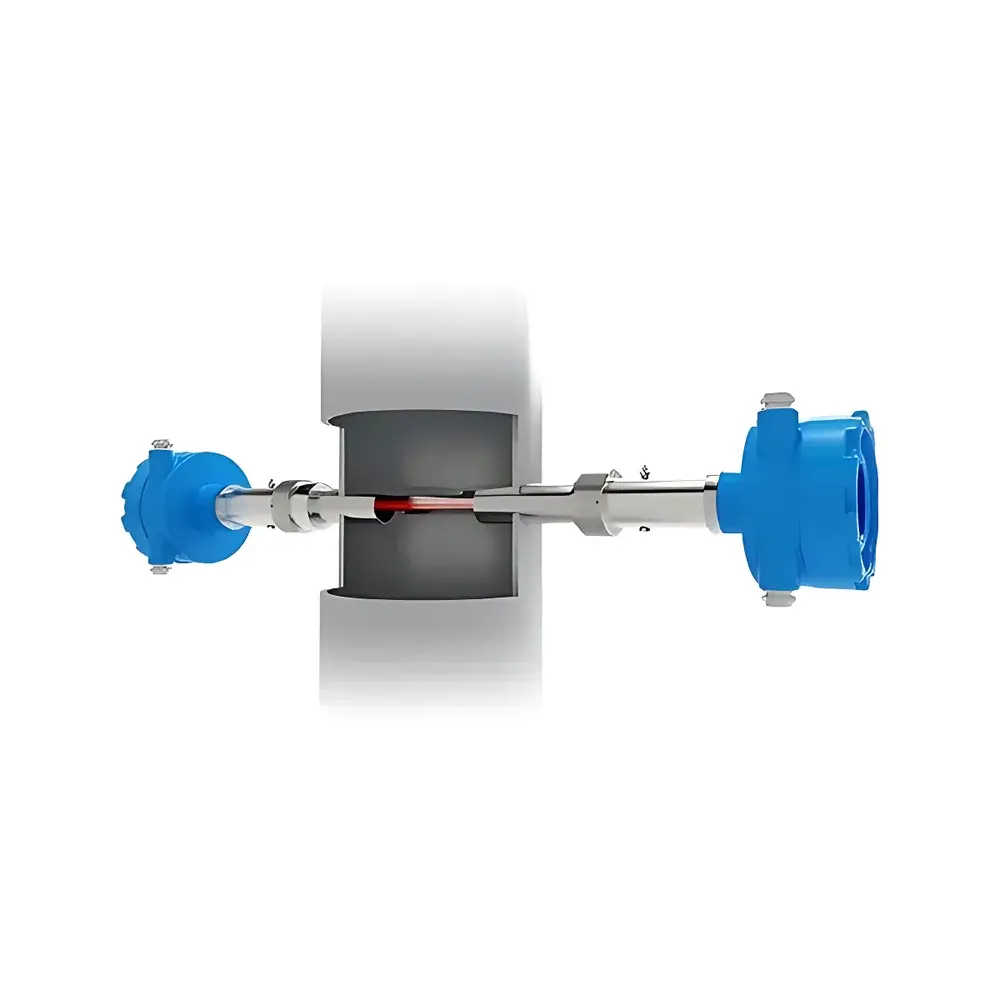
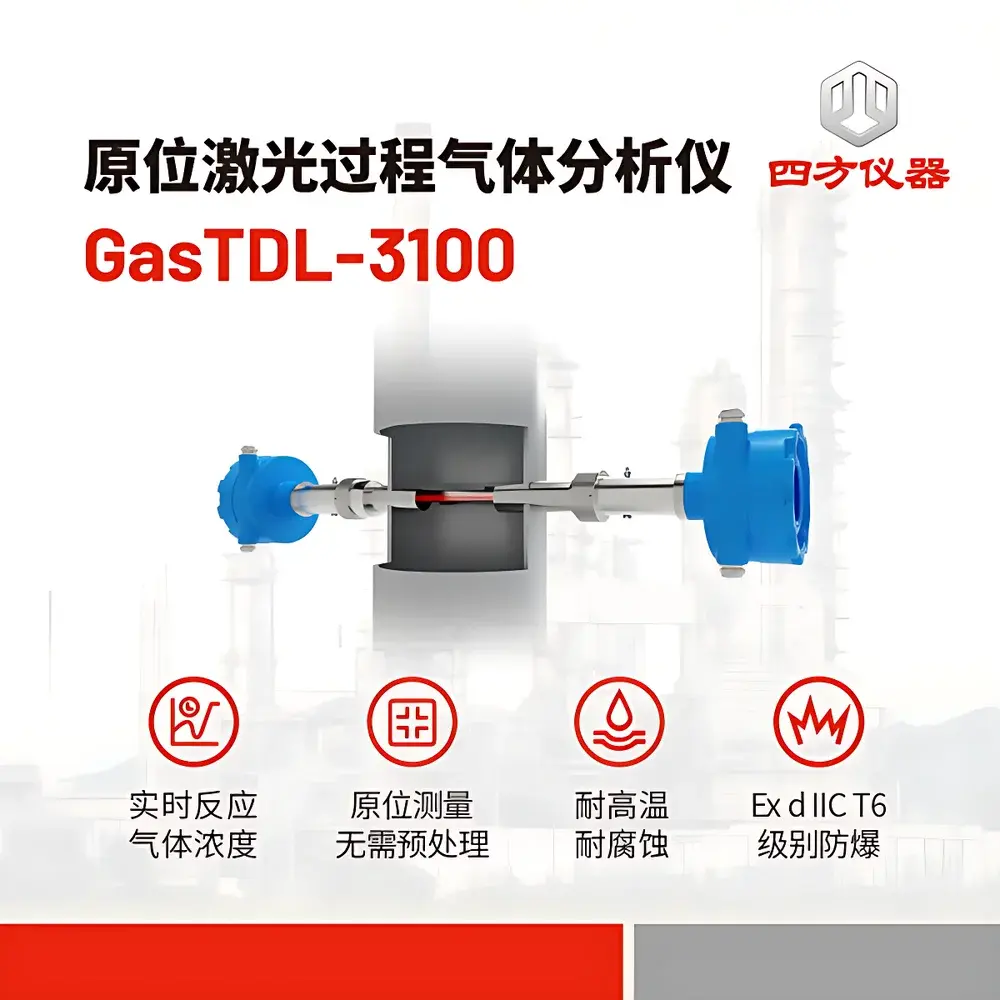
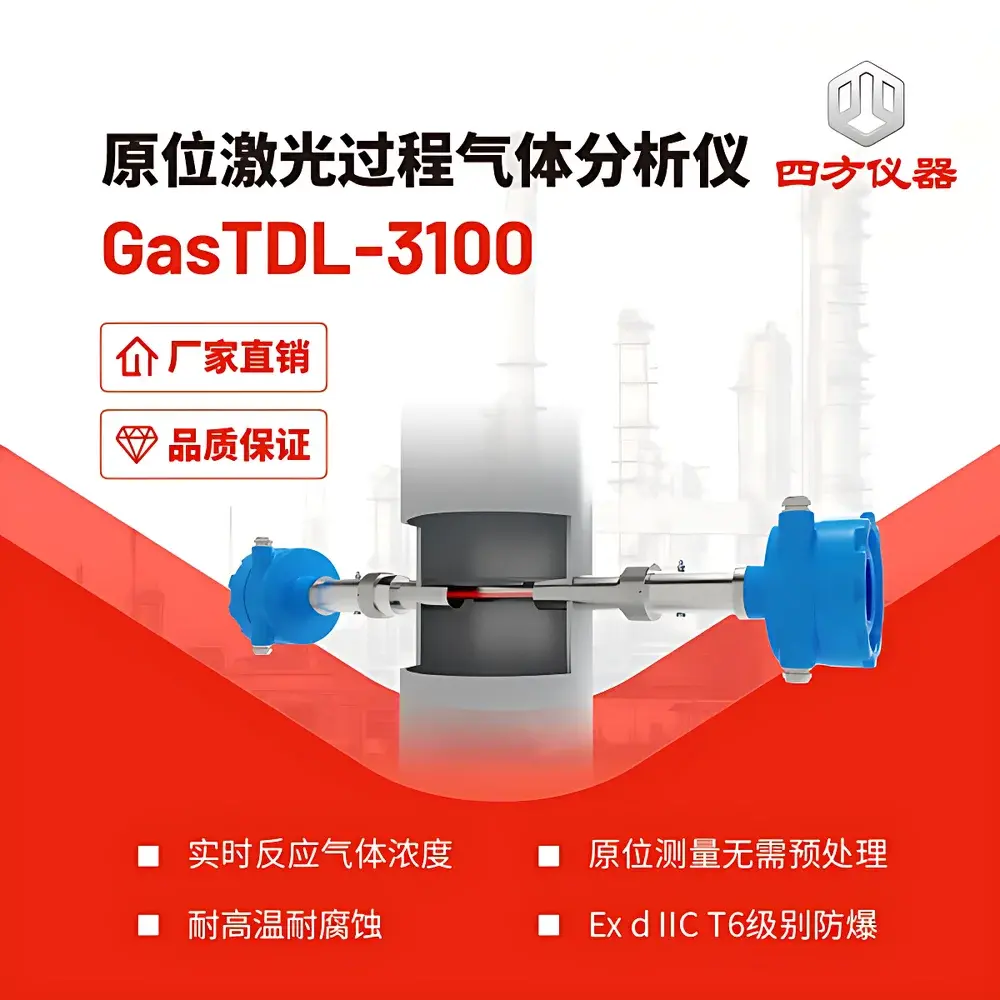
CUBIC INSTRUMENTS GasTDL-3100-CO In-Situ Tunable Diode Laser Absorption Spectroscopy (TDLAS) Carbon Monoxide Analyzer
| Brand | CUBIC INSTRUMENTS |
|---|---|
| Origin | Hubei, China |
| Model | GasTDL-3100-CO |
| Instrument Type | In-situ online analyzer |
| Measured Gas | CO (primary), with optional multi-component capability (O₂: 0–5% vol, CO₂: 0–100% vol, CH₄: 0–20% vol) |
| Accuracy | ≤±1% F.S. |
| Repeatability | ≤±1% |
| Resolution | 0.01% vol |
| Response Time (T90) | ≤4 s |
| Span Drift | ≤±1% F.S. |
| Linearity Error | ≤±1% F.S. |
| Operating Temperature | −20 to +60 °C |
| Power Supply | 24 V DC, 24 W |
| Explosion Protection | Exd II CT6 |
| Purge Gas | Industrial nitrogen, 0.3–0.8 MPa |
| Output Signals | 2 × 4–20 mA, 3 × relay |
| Communication | RS485, RS232 |
Overview
The CUBIC INSTRUMENTS GasTDL-3100-CO is an in-situ, real-time carbon monoxide (CO) analyzer engineered for continuous emission monitoring and industrial process control in demanding environments. It employs Tunable Diode Laser Absorption Spectroscopy (TDLAS)—a well-established, physics-based optical measurement technique that exploits the unique near-infrared absorption fingerprint of CO molecules at specific wavelengths (e.g., ~2.33 µm). Unlike extractive sampling systems, the GasTDL-3100-CO performs direct, non-contact measurement across the process duct or stack using a dual-optic, through-beam configuration. This eliminates sampling lines, conditioning hardware, and associated delays—ensuring true process synchronization with T90 response ≤4 seconds. Its optical path is inherently immune to particulate interference, condensation, and corrosive matrix effects, making it suitable for high-temperature, high-dust, high-moisture, and high-velocity gas streams commonly found in cement kilns, waste incinerators, syngas plants, and metallurgical furnaces.
Key Features
- In-situ measurement architecture: No sample extraction, no heated lines, no gas conditioning—reducing maintenance burden and eliminating transport lag.
- TDLAS-based selectivity: High spectral resolution enables discrimination of CO from overlapping absorptions of H₂O, CO₂, CH₄, and O₂—minimizing cross-sensitivity and eliminating need for complex background compensation algorithms.
- Robust mechanical design: All-optical path housed in an Exd II CT6 certified explosion-proof enclosure rated for Zone 1 hazardous areas.
- Zero-moving-parts optical system: No choppers, no filters, no pumps—ensuring long-term stability and >5-year mean time between failures (MTBF) under continuous operation.
- Thermally stabilized laser and detector: Active temperature control maintains wavelength alignment and signal integrity across ambient temperatures from −20 °C to +60 °C.
- Integrated purge air management: Dual-purge ports support continuous nitrogen purging (0.3–0.8 MPa) to protect optical windows from fouling in high-dust applications.
Sample Compatibility & Compliance
The GasTDL-3100-CO is validated for direct measurement of CO in flue gases, synthesis gas, combustion exhaust, and biogas streams containing up to 20% CO₂, 10% H₂O (v/v), and suspended particulates ≤10 g/Nm³. It complies with key international performance standards for continuous emissions monitoring systems (CEMS), including EN 15267-3 (QAL1 certification framework), EPA Method 10 (CO), and ISO 14064-1 (GHG quantification). While not pre-certified per US EPA PS-11 or MCERTS, its TDLAS architecture meets the fundamental metrological requirements for regulatory-grade CO monitoring—including documented linearity, repeatability (≤±1%), span drift (≤±1% F.S.), and response time (T90 ≤4 s). The device supports audit-ready data logging and can be configured to meet GLP/GMP traceability requirements when integrated with compliant SCADA or DCS platforms.
Software & Data Management
The analyzer operates via embedded firmware supporting Modbus RTU over RS485/RS232 for integration into plant-level automation systems. Local configuration and diagnostics are accessible via a secure web interface (HTTPS) or optional touchscreen HMI. Measurement data—including raw absorbance, calculated concentration, laser temperature, photodiode current, and diagnostic flags—are timestamped and logged internally at user-selectable intervals (1–60 s). Two isolated 4–20 mA analog outputs support redundant transmission to PLCs or safety systems; three programmable relays provide alarm staging (e.g., low/high limit, fault, calibration due). All digital communications support CRC error checking and configurable baud rates (up to 115.2 kbps). Optional firmware upgrades enable CSV export, remote firmware updates, and compatibility with OPC UA servers for Industry 4.0 integration.
Applications
- Combustion optimization in coal-fired and biomass boilers—real-time CO feedback for air/fuel ratio control.
- Continuous emissions monitoring (CEM) in municipal solid waste (MSW) and hazardous waste incinerators per EU IED Directive and local permitting requirements.
- Syngas quality assurance in gasification plants—monitoring CO as a primary energy content indicator and catalyst poison indicator.
- Process safety in coke oven batteries and blast furnace stoves—early detection of CO breakthrough to prevent worker exposure.
- Biogas upgrading facilities—tracking CO as a contaminant prior to membrane or pressure swing adsorption (PSA) units.
- Carbon capture readiness assessments—baseline CO concentration profiling during oxy-fuel or post-combustion capture trials.
FAQ
Does the GasTDL-3100-CO require periodic calibration with certified gas standards?
Yes—while the TDLAS principle provides inherent stability, quarterly zero/span verification using NIST-traceable CO standard gases (e.g., 100 ppm and 1,000 ppm in N₂) is recommended per ISO 14064-3 and internal QA procedures.
Can the same unit measure multiple gases simultaneously?
No—the GasTDL-3100-CO is configured for single-component measurement (CO). Multi-gas variants (e.g., GasTDL-3100-Multi) use separate lasers and detectors per target species and require distinct optical alignment.
Is the analyzer compatible with wet or corrosive gas streams?
Yes—its in-situ design avoids contact with condensate; optical windows are sapphire-coated and purged continuously with dry nitrogen to resist acid gas corrosion (e.g., SO₂, HCl) and particulate deposition.
What is the minimum optical path length required for reliable CO measurement?
The standard configuration assumes ≥0.5 m path length; path lengths down to 0.3 m are supported with sensitivity-adjusted firmware—though detection limit degrades proportionally per Beer-Lambert law.
Does the device support FDA 21 CFR Part 11 compliance?
The base firmware does not include electronic signature or audit trail functionality; however, full Part 11 compliance can be achieved via integration with validated third-party data acquisition software meeting ALCOA+ principles.







