
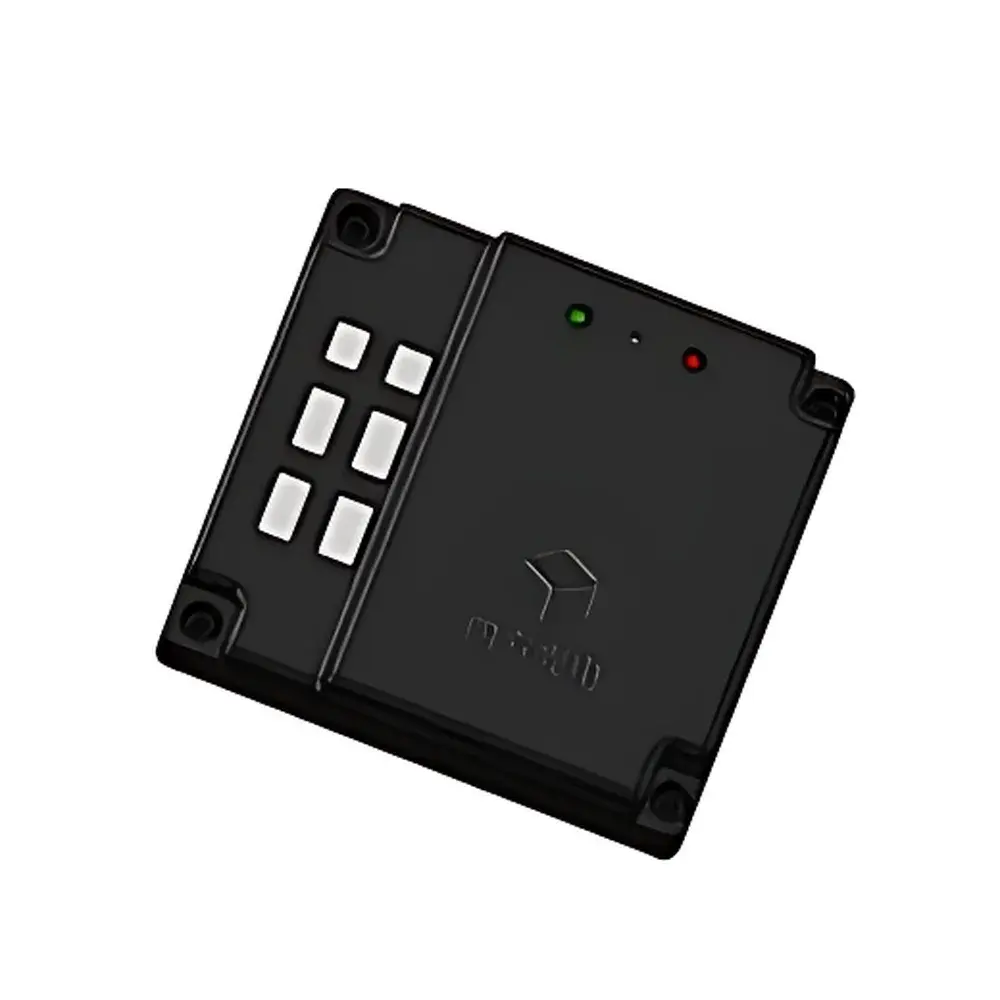
Cubic AM4207 R454A Refrigerant Leak Detection Sensor
| Brand | Cubic |
|---|---|
| Origin | Hubei, China |
| Model | AM4207 |
| Detection Principle | Non-Dispersive Infrared (NDIR) |
| Measurement Range | 0–50% LFL |
| Accuracy | ±5% LFL |
| Response Time (T50) | ≤10 s |
| Operating Temperature | −40 °C to +85 °C |
| Storage Temperature | −40 °C to +85 °C |
| Humidity Range | 0–100% RH |
| Supply Voltage | DC 9–36 V |
| Current Consumption | <250 mA |
| Communication Interface | CAN bus |
| Protection Rating | IP67 (detector housing), IP65 (sensor head) |
Overview
The Cubic AM4207 is a purpose-engineered non-dispersive infrared (NDIR) gas sensor designed for continuous, real-time detection of R454A refrigerant leaks in HVAC&R systems. As a near-azeotropic blend of 68.9% R32 and 31.1% R1234yf, R454A exhibits a low global warming potential (GWP ≈ 466) and is increasingly adopted in residential and commercial air conditioning units under regulatory phase-down schedules (e.g., EU F-Gas Regulation No. 517/2014 and EPA SNAP program). The AM4207 operates on the fundamental principle of selective absorption of infrared radiation at characteristic wavelengths—specifically tuned to the asymmetric C–F stretching vibration band of R454A (~8.5–9.2 µm)—enabling high selectivity against common interferents such as CO₂, CH₄, and water vapor. Its robust optical path design incorporates temperature-compensated dual-wavelength referencing to maintain measurement integrity across wide ambient gradients, eliminating drift associated with thermal lensing or detector aging.
Key Features
- Wide operational envelope: Certified for continuous operation from −40 °C to +85 °C, supporting deployment in outdoor condensing units, rooftop HVAC assemblies, and cold-chain refrigeration enclosures without external thermal management.
- Rapid response performance: Achieves T50 ≤ 10 seconds under standard test conditions (ISO 20471:2022 Annex B), enabling early-stage leak identification before concentration reaches hazardous thresholds (R454A LFL = 13.3% vol in air).
- Environmental resilience: Detector housing rated IP67 per IEC 60529; sensor head rated IP65. Structural reinforcement allows resistance to high-pressure washdown (up to 30 bar water jet) typical in industrial maintenance protocols.
- Condensation mitigation: Integrated self-heating element maintains sensor head surface temperature above dew point across 0–100% RH, preventing optical window fogging and signal attenuation in humid environments.
- Flexible integration: CAN 2.0B interface compliant with ISO 11898-2, supporting daisy-chained multi-sensor networks with configurable node IDs and standardized message frames (SAE J1939-71 compatible data structures).
Sample Compatibility & Compliance
The AM4207 is validated for quantitative detection of R454A in air matrices under static and low-velocity flow conditions (0–0.5 m/s). It demonstrates negligible cross-sensitivity to R134a (<2%), R410A (<1.5%), and ambient CO₂ (<0.8%) when calibrated per manufacturer’s procedure. The sensor meets EMC requirements per EN 61000-6-3 (emissions) and EN 61000-6-2 (immunity), and its electrical safety design complies with IEC 61010-1 for measurement/control equipment. While not intrinsically safe certified (e.g., ATEX/IECEx), it is suitable for installation in Zone 2/Class I Division 2 locations when integrated with appropriate barrier systems. Documentation supports traceable calibration against NIST-traceable R454A reference standards (certified gas mixtures, ±1% uncertainty).
Software & Data Management
Configuration, diagnostics, and firmware updates are performed via CAN-based host software tools (Windows/Linux compatible), supporting parameter adjustment—including alarm thresholds (low/medium/high), sampling interval (1–60 s), and auto-zero cycle scheduling. All configuration changes and sensor status events (e.g., fault codes, calibration due alerts) are logged with UTC timestamps and stored in non-volatile memory. Audit trails comply with GLP/GMP principles where applicable, and raw CAN frames include CRC-16 checksums for data integrity verification. Integration with BMS platforms (e.g., Tridium Niagara, Siemens Desigo) is enabled through standardized CANopen or custom gateway modules supporting Modbus TCP translation.
Applications
- Leak monitoring in R454A-charged variable refrigerant flow (VRF) systems and ductless mini-split units
- Pre-commissioning verification and periodic maintenance testing in commercial chillers and heat pumps
- Continuous safety surveillance in refrigerant charging stations and service workshops
- OEM integration into smart thermostats, HVAC controllers, and remote condition monitoring gateways
- Compliance support for ASHRAE Standard 15-2022 (safety requirements for refrigerating systems) and ISO 5149-2:2014 (leak detection thresholds)
FAQ
Does the AM4207 require periodic recalibration?
Yes—recommended annually or after exposure to concentrations exceeding 75% LFL; calibration uses certified R454A span gas (±1% uncertainty) and zero air per ISO 17025-accredited procedures.
Can the sensor be installed outdoors without enclosure?
The detector housing (IP67) permits direct outdoor mounting; however, prolonged UV exposure may degrade polycarbonate optical windows—use of optional UV-stabilized cover is advised for >5-year deployments.
Is CAN termination required for multi-node networks?
Yes—120 Ω termination resistors must be placed at both physical ends of the CAN bus; intermediate nodes require no termination.
What is the expected service life under continuous operation?
Minimum 5 years (typical), assuming ambient conditions within specification limits and adherence to recommended maintenance intervals.
Does the sensor support analog output alternatives?
No—the AM4207 is CAN-native only; analog variants (e.g., 4–20 mA) are available under separate model numbers (AM4207-AO) with identical sensing core and environmental ratings.
Related Products







