
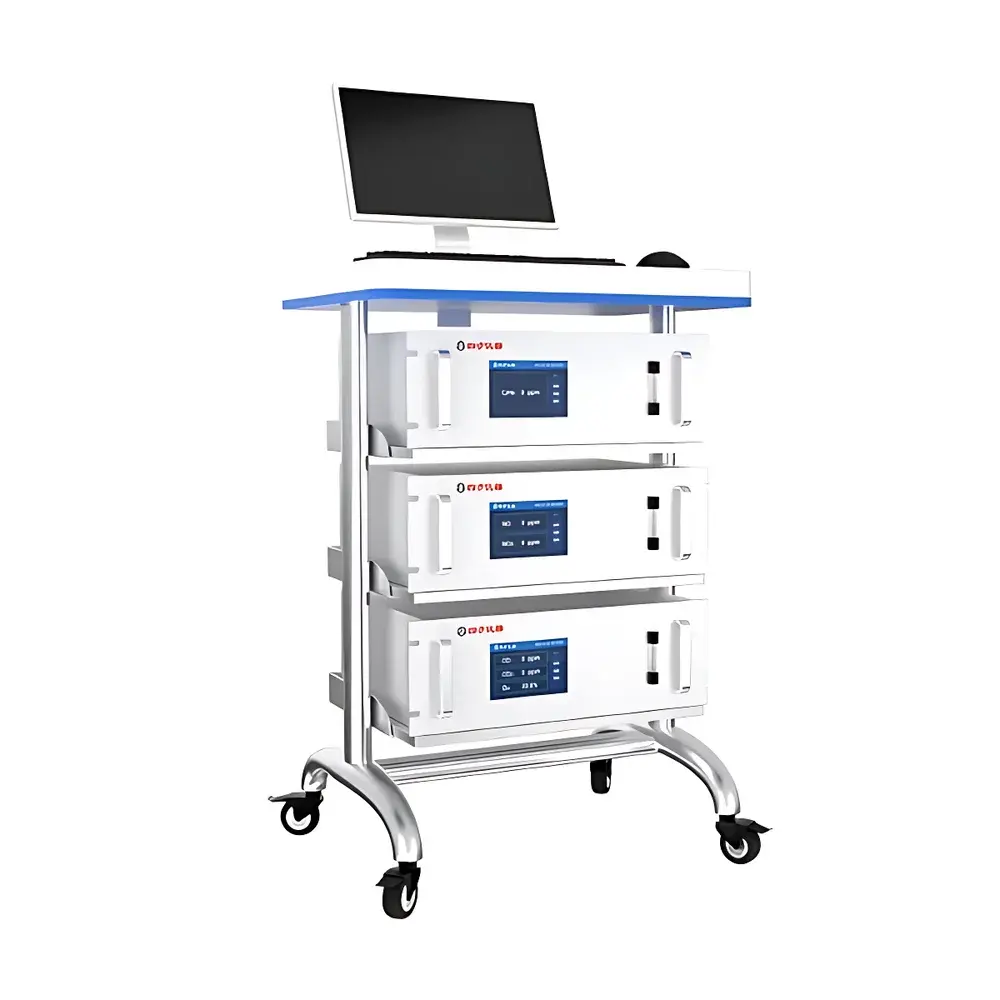
CUBIC INSTRUMENTS Zero Air Generator Calibration Analyzer
| Brand | CUBIC INSTRUMENTS |
|---|---|
| Origin | Hubei, China |
| Manufacturer Type | Authorized Distributor |
| Country of Origin | China |
| Zero Air Flow Rate | 1.0 L/min |
| Operating Pressure | 80–106 kPa |
| Measurement Components | CO, CO₂, C₃H₈, NO, NO₂, O₂ |
| Measurement Principles | GFC + NDIR (CO, CO₂, C₃H₈), UV-DOAS (NO, NO₂), TD-LAS/ECD (O₂) |
| Range | 0–20 ppm (CO, NO, NO₂), 0–40 ppm (CO₂, C₃H₈), 0–25% (O₂) |
| LOD | 0.05 ppm (gases), 0.05% (O₂) |
| Accuracy | ≤ ±2% F.S. (CO/CO₂/C₃H₈/NO/NO₂), ≤ ±0.2% (O₂) |
| Interfaces | RS-232, RS-485, USB |
| Power Input | 220 VAC ±10% |
| Operating Temp. | 5–40 °C |
| Humidity | 0–90% RH |
| Design | Modular, thermally stabilized, portable benchtop unit |
Overview
The CUBIC INSTRUMENTS Zero Air Generator Calibration Analyzer is a purpose-built trace gas verification system engineered for metrological validation of zero air generators used in environmental emission testing laboratories and vehicle exhaust inspection facilities. It operates on a hybrid optical and electrochemical detection architecture: non-dispersive infrared (NDIR) with gas filter correlation (GFC) for CO, CO₂, and propane (C₃H₈); ultraviolet differential optical absorption spectroscopy (UV-DOAS) for nitric oxide (NO) and nitrogen dioxide (NO₂); and tunable diode laser absorption spectroscopy combined with electron capture detection (TD-LAS/ECD) for oxygen (O₂). This multi-principle design ensures minimal cross-sensitivity and high specificity under real-world calibration conditions—critical for verifying compliance with stringent regulatory zero air purity thresholds defined in GB 18285–2018 (spark ignition engine exhaust measurement) and GB 3847–2018 (compression ignition engine exhaust measurement). The analyzer is not a general-purpose gas detector but a reference-grade calibration verification instrument, deployed downstream of zero air generators to quantify residual contaminants at sub-ppm levels and confirm that output gas meets the ≤0.1 ppm NOx, ≤1 ppm CO, ≤1 ppm hydrocarbons (as C₃H₈), and ≤0.1% O₂ deviation limits required for certified emissions testing.
Key Features
- Multi-analyte simultaneous quantification of six critical zero air impurities: CO, CO₂, C₃H₈, NO, NO₂, and O₂
- Thermally stabilized optical path and reaction chamber, maintaining measurement repeatability across ambient temperature fluctuations (5–40 °C)
- Imported narrow-band UV and IR light sources with calibrated spectral output, ensuring long-term photometric stability and drift <0.5% over 180 days
- Proprietary interference compensation algorithms trained on matrix-matched gas mixtures, reducing cross-response between NO₂ and NO by >92% and minimizing water vapor quenching effects on NDIR channels
- Sub-90-second system warm-up time and <30-second response time (T90) per analyte, enabling rapid line verification during daily QC checks
- Modular sensor cartridge architecture—each gas channel is independently replaceable without recalibration of adjacent modules—reducing lifecycle maintenance downtime and total cost of ownership
- Portable benchtop form factor (W × D × H: 420 × 320 × 180 mm) with integrated flow control and pressure regulation, designed for mobility across multiple inspection lanes or mobile lab deployments
Sample Compatibility & Compliance
The analyzer accepts zero air streams at a nominal flow rate of 1.0 L/min and accommodates inlet pressures from 80 to 106 kPa (absolute), covering standard atmospheric variations across elevations up to 2,000 m. It is validated for use with compressed air-fed catalytic zero air generators, membrane-based purifiers, and heated chemical scrubber systems. All measurement protocols align with the instrumental performance criteria specified in GB 18285–2018 Annex D and GB 3847–2018 Clause 6.2 for zero gas verification. While not certified to ISO/IEC 17025 as a standalone calibration laboratory, its output data—when paired with NIST-traceable span gases and documented procedural controls—supports GLP-compliant audit trails required by provincial ecological environment monitoring centers in China. The device’s accuracy specifications meet the maximum permissible error thresholds for Class I verification equipment under China’s JJF 1557–2016 metrological verification regulation for gas analyzers.
Software & Data Management
Built-in embedded firmware supports real-time concentration logging at 1 Hz resolution, with onboard storage for ≥30 days of continuous 6-channel data (timestamped, pressure- and temperature-compensated). Data export is supported via USB mass storage mode or serial communication (RS-232/RS-485) using ASCII-based protocol compatible with LabVIEW, MATLAB, and custom SCADA integrations. The optional PC application provides automated pass/fail reporting against GB-defined zero air limits, generates PDF calibration certificates with digital signature fields, and maintains an immutable audit log of all configuration changes, zero/span events, and sensor diagnostics—fully compliant with basic data integrity requirements analogous to FDA 21 CFR Part 11 Annex 11 principles (though not formally validated for pharmaceutical use). Firmware updates are delivered via signed binary packages to prevent unauthorized modification.
Applications
- Daily verification of zero air generator output prior to exhaust gas analyzer calibration in MVE (Motor Vehicle Emission) testing stations
- Periodic performance validation of catalytic converters and carbon molecular sieve filters in zero air purification systems
- Root-cause analysis of elevated background signals in chemiluminescence NOx analyzers or NDIR CO monitors
- Commissioning support for new zero air infrastructure in provincial environmental monitoring stations
- Field troubleshooting of cross-contamination events during multi-lane I/M (Inspection and Maintenance) program operations
FAQ
Is this instrument suitable for calibrating zero air generators used in EPA Method 205 or EN 14181 compliance testing?
It is designed specifically for Chinese national standards (GB 18285/3847) and has not undergone formal equivalence assessment against EPA or CEN test protocols. Its measurement ranges and uncertainty budgets align with GB requirements but do not substitute for EPA Protocol Gas Certification or EN 14181 QAL2 validation.
Can the analyzer operate continuously for 24/7 unattended monitoring?
Yes—it supports continuous duty cycle with thermal management optimized for stable 8-hour shifts; extended operation beyond 16 hours/day requires periodic zero verification (every 8 hours) due to baseline drift accumulation in UV-DOAS channels.
Does it include built-in zero and span calibration capability?
No. It is a verification-only instrument. External certified zero air (≤0.02 ppm NOx) and multi-component span gases traceable to NIM (National Institute of Metrology, China) are required for initial setup and periodic verification.
What maintenance intervals are recommended for field service?
Optical windows should be inspected every 90 days; sensor cartridges have a rated lifetime of 18 months under typical use (≤8 h/day, ≤60% RH); firmware and calibration certificate updates are issued biannually via CUBIC’s authorized service portal.







