
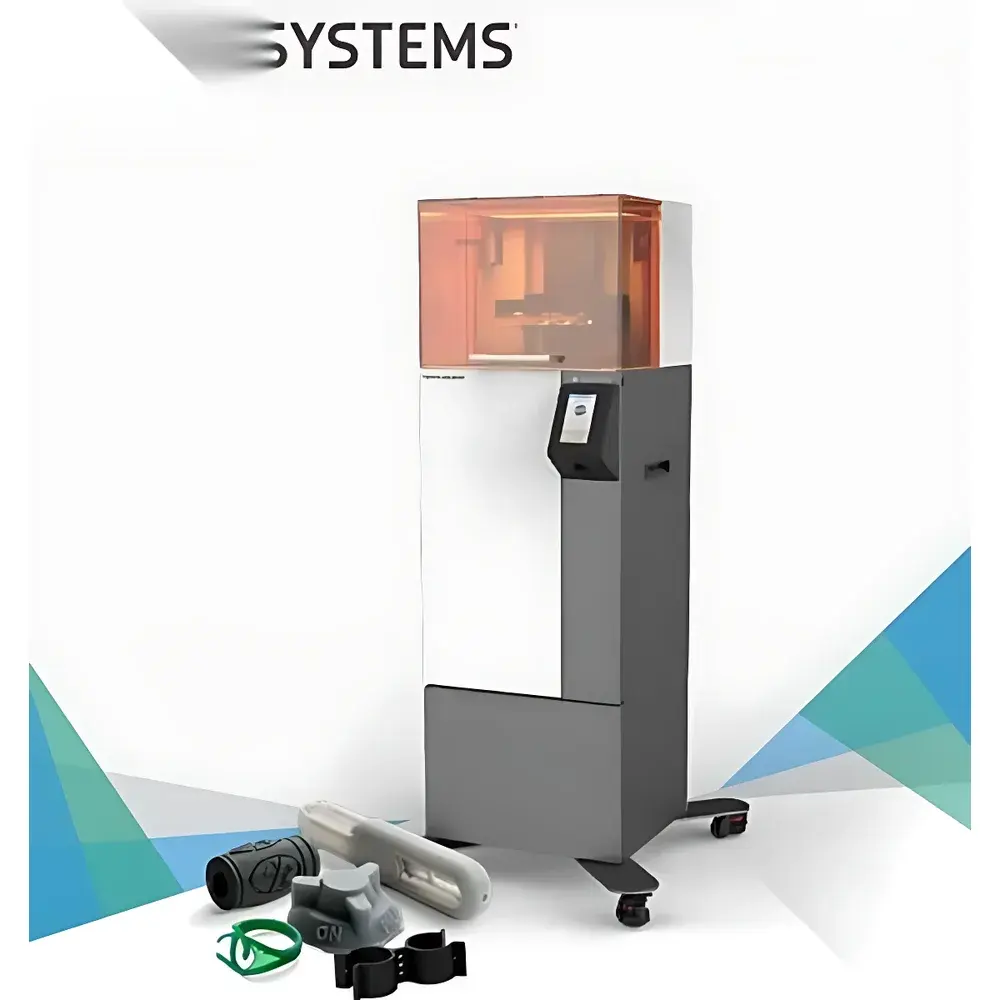
3D Systems Figure 4 Standalone™ Production-Grade 3D Printer
| Brand | 3D Systems |
|---|---|
| Technology | DLP (Digital Light Processing) |
| Process | UV-Curable Resin Photopolymerization |
| Architecture | Modular, Standalone Platform |
| Material Class | Engineering-Grade Thermoset Resins |
| Surface Finish | Molecular-Level Smoothness |
| Build Approach | Continuous Liquid Interface Production (CLIP)-Inspired Digital Light Synthesis™ |
| Compliance | Designed for ISO 13485-aligned environments |
Overview
The 3D Systems Figure 4 Standalone™ is a production-grade additive manufacturing system engineered for high-fidelity, repeatable fabrication of end-use polymer parts in laboratory and pilot-production settings. It employs Digital Light Synthesis™—a proprietary implementation of continuous photopolymerization—leveraging high-resolution DLP projection, oxygen-permeable optics, and chemically tuned UV-curable resins. Unlike traditional layer-by-layer vat photopolymerization, this process enables near-continuous part growth with minimal interlayer artifacts, resulting in isotropic mechanical properties and surface roughness values approaching <0.8 µm Ra without post-processing. The system operates as a self-contained unit, requiring no external nitrogen purge, inert gas supply, or integrated powder handling infrastructure—making it suitable for controlled lab environments where footprint, safety, and operational autonomy are critical.
Key Features
- Modular architecture supporting scalable deployment: single-unit operation or networked fleet management via secure Ethernet/IP interface
- DLP-based imaging engine with 75 µm native XY resolution and Z-layer thickness adjustable from 10–100 µm
- Integrated real-time resin monitoring: viscosity, temperature, and photoinitiator depletion tracking via embedded optical sensors
- Automated build platform leveling and optical calibration—performed pre-build without manual intervention
- Tool-change-ready design accommodating interchangeable resin modules (e.g., rigid, flexible, biocompatible, high-temp formulations)
- UL 61010-1 and IEC 61000-6-3 certified electrical safety and EMC compliance
Sample Compatibility & Compliance
The Figure 4 Standalone™ accepts a validated portfolio of Figure 4® resins—including Figure 4 Rigid Polyurethane, Figure 4 Elastomeric, Figure 4 High Temp, and Figure 4 BioMed AM—each formulated to meet ASTM D412 (tensile), D790 (flexural), and ISO 10993-5 (cytotoxicity) requirements where applicable. Resin cartridges are serialized and RFID-tagged to enforce material traceability, batch consistency, and usage history logging—critical for regulated development workflows. The system supports audit-ready reporting aligned with FDA 21 CFR Part 11 (electronic records/signatures) when deployed with optional Secure Mode firmware and validated IT infrastructure.
Software & Data Management
Powered by 3D Sprint™ 3.0 software suite, the platform delivers deterministic slice preparation, lattice optimization, and support structure simulation using physics-based thermal and stress modeling. All build files are encrypted and digitally signed; job queues maintain immutable timestamps and user attribution. Data export conforms to AMF and 3MF standards, with optional integration into LIMS or MES platforms via RESTful API. Audit trails capture every parameter change, resin load event, and calibration cycle—retained for ≥36 months per configurable retention policy.
Applications
- Functional prototyping: Direct fabrication of snap-fit assemblies, fluidic manifolds, and haptic feedback housings with dimensional stability across thermal cycles (−20 °C to +80 °C)
- Jewelry investment casting: High-detail wax-like patterns with sub-50 µm feature fidelity and burnout residue <0.02% mass loss
- Medical device development: Biocompatible prototypes for ergonomic validation, surgical guides, and custom-fit orthotics (ISO 13485-supported workflows)
- Tooling & jigs: Low-volume fixtures with compressive strength >65 MPa and wear resistance comparable to machined PEEK
- Elastomeric components: Seals, gaskets, and overmold substrates compatible with secondary injection molding of TPEs and thermoplastics
FAQ
What resin families are qualified for use on the Figure 4 Standalone™?
Only 3D Systems’ Figure 4®-branded resins—validated for chemistry, rheology, and photoreactivity with this platform—are supported. Third-party resins void warranty and compromise process repeatability.
Is post-curing required after printing?
Yes. All printed parts must undergo UV and thermal post-curing per material-specific protocols (e.g., 60 min @ 60 °C + 30 min UV exposure at 365 nm) to achieve full crosslink density and mechanical specification compliance.
Can the system be integrated into an existing PLM or ERP environment?
Yes—via standardized OPC UA or REST API interfaces. Integration packages include BOM synchronization, job status polling, and automated QC report ingestion.
Does the printer support remote monitoring and diagnostics?
Yes. Embedded telemetry streams machine health metrics—including optical throughput decay, resin temperature deviation, and build chamber O₂ concentration—to a secure cloud dashboard with configurable alert thresholds.
What regulatory documentation is provided for GxP environments?
A complete Validation Support Package (VSP) is available—including IQ/OQ protocols, traceable calibration certificates, and risk assessments aligned with ISO 14971—upon request for qualified customers.



