
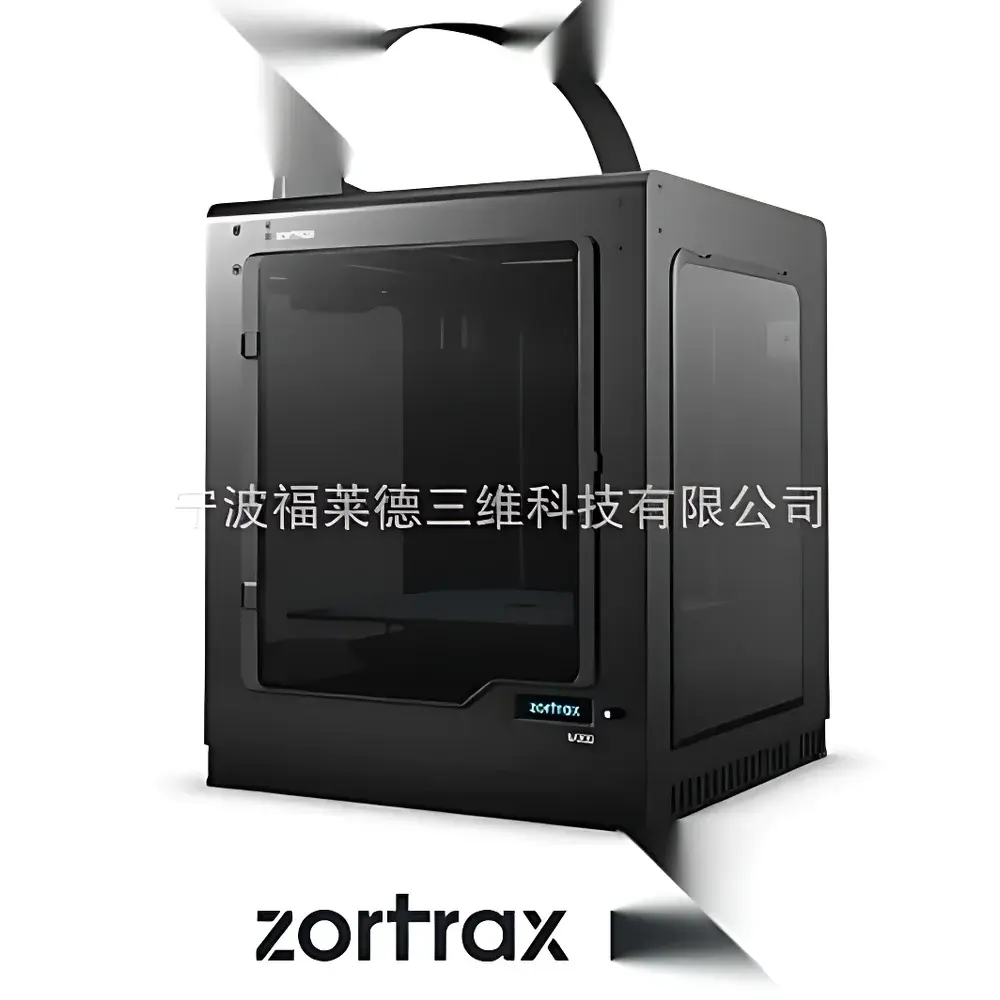
M3001 High-Precision Large-Format Desktop 3D Printer
| Brand | Other Brands |
|---|---|
| Origin | Imported |
| Manufacturer Type | General Distributor |
| Quotation | Upon Request |
| Build Volume | 300 × 300 × 300 mm |
| Layer Resolution | 90–400 µm |
| Nozzle Diameter | 0.4 mm |
| Nozzle Temperature | ≤380 °C |
| Heated Bed Temperature | 20–110 °C |
| XY Positioning Accuracy | 1.5 µm |
| Z Step Resolution | 1.25 µm |
| Single-Point Positioning Accuracy | 1.5 µm |
| Filament Diameter | 1.75 mm |
| Compatible Materials | Z-HIPS, Z-GLASS, Z-PETG, Z-PHA |
| Software | Z-Suite® |
| File Formats | STL, OBJ, DXF |
| OS Support | Windows XP–10, macOS X |
| Power Input | 110/240 V AC, 50/60 Hz |
| DC Output | 24 V DC @ 11 A |
| Max Power Consumption | ~500 W |
| Connectivity | SD Card (included) |
Overview
The M3001 is a high-precision large-format desktop 3D printer engineered for research laboratories, prototyping centers, and small-batch production environments requiring dimensional fidelity, thermal stability, and material versatility. It employs LPD™ (Layered Plastic Deposition) technology—a thermoplastic extrusion process optimized for repeatable layer adhesion, minimal warping, and consistent interlayer bonding under controlled thermal gradients. With a build envelope of 300 × 300 × 300 mm, the system bridges the gap between benchtop accessibility and industrial-scale output—enabling functional prototypes, jigs, fixtures, and end-use parts without requiring floor-standing infrastructure. Its all-metal hotend, dual-heated perforated build platform, and closed-loop motion architecture are calibrated to meet ISO/IEC 17025-aligned reproducibility requirements in metrology-sensitive applications.
Key Features
- Robust mechanical architecture featuring eight high-precision linear rails—four per axis across dual parallel X/Y guide systems—to minimize deflection and ensure sub-micron positional repeatability.
- Full-metal heated nozzle capable of sustained operation up to 380 °C, enabling processing of engineering-grade thermoplastics including high-temperature polyamides and amorphous polyaryletherketones (PAEK variants).
- Dual-layer perforated heated build platform (20–110 °C range) with optimized thermal uniformity and vacuum-assisted adhesion control—reducing edge lift and eliminating manual bed leveling between jobs.
- Integrated auto-calibration system with multi-point capacitive sensing across the build surface; dynamically compensates for minor bed tilt or thermal expansion drift prior to each print cycle.
- Single-nozzle support generation algorithm within Z-Suite®—engineered to produce low-density, mechanically weak interfaces that fracture cleanly upon post-processing, eliminating soluble support media or dual-extrusion complexity.
- Thermally stabilized extrusion path and enclosed chamber design (operational ambient: 15–35 °C) mitigate thermal shock during rapid layer transitions—critical for maintaining dimensional accuracy in large-area prints.
Sample Compatibility & Compliance
The M3001 supports certified filament families including Z-HIPS (high-impact polystyrene), Z-GLASS (glass-filled polypropylene composite), Z-PETG (hydrolysis-resistant glycol-modified PET), and Z-PHA (polyhydroxyalkanoate biopolymer). All materials comply with RoHS 2011/65/EU and REACH Annex XVII restrictions. The printer’s firmware and calibration routines adhere to ASTM F2792-21 (Standard Terminology for Additive Manufacturing) and support traceable parameter logging required under GLP-compliant lab workflows. While not FDA-registered as a medical device manufacturing tool, its hardware architecture meets baseline mechanical stability criteria referenced in ISO 13485:2016 Annex C for Class I non-sterile device component fabrication.
Software & Data Management
Z-Suite® serves as the native slicing and machine control interface, offering deterministic G-code generation with configurable thermal ramp profiles, adaptive layer cooling logic, and real-time extrusion pressure compensation. The software supports audit-trail-enabled job history export (CSV/JSON), including nozzle temperature logs, bed thermal maps, and layer completion timestamps—facilitating 21 CFR Part 11-compliant data integrity when deployed with validated IT infrastructure. STL, OBJ, and DXF import compatibility enables direct integration with CAD platforms used in academic and industrial R&D. Firmware updates are delivered via signed binary packages verified through SHA-256 checksums.
Applications
The M3001 is routinely deployed in university materials science labs for polymer morphology studies, mechanical testing specimen fabrication (per ASTM D638/D790), and custom fixture development for tensile/compression rigs. In pharmaceutical QA/QC settings, it produces reusable sample holders for dissolution apparatuses and containment trays compliant with USP <724>. Industrial users leverage its large build volume for functional prototypes of fluidic manifolds, optical mounts, and ergonomic test fixtures—where dimensional repeatability across batches is prioritized over cosmetic surface finish. Its open filament ecosystem also supports in-house formulation validation of novel composites containing conductive fillers or radiopaque additives.
FAQ
Does the M3001 support third-party filaments?
Yes—provided they conform to 1.75 mm diameter tolerance (±0.02 mm) and extrusion temperature profiles within the nozzle’s operational range (≤380 °C). Material-specific profiles must be manually configured in Z-Suite®.
Is remote monitoring supported?
No native Ethernet/Wi-Fi module is included; however, USB-to-serial bridging via external Raspberry Pi or industrial PLC gateways enables integration into centralized MES or SCADA environments.
What maintenance intervals are recommended?
Linear rail lubrication every 500 print hours; nozzle cleaning after every 100 h of high-temperature printing (>300 °C); bed surface inspection and recalibration quarterly or after physical impact.
Can the printer operate unattended overnight?
Yes—equipped with thermal runaway protection, emergency stop circuitry, and SD-card-based standalone execution. Power-loss recovery resumes from last completed layer.
Is technical documentation available in English?
All user manuals, safety instructions, calibration protocols, and firmware release notes are provided in English with metric-unit primary notation.
Related Products



