
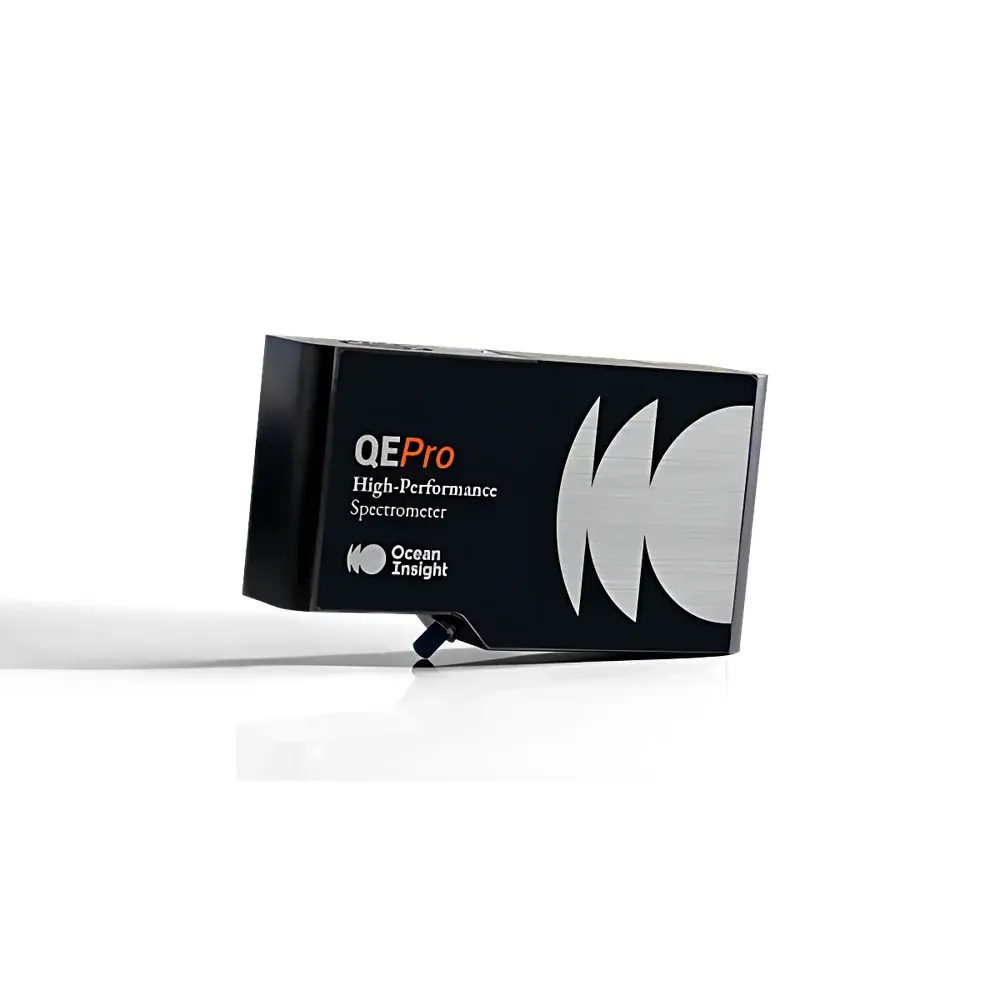
QE Pro Customizable High-Performance Fiber Optic Spectrometer by Ocean Insight
| Brand | Ocean Insight |
|---|---|
| Origin | USA |
| Detector Type | Back-Illuminated CCD |
| Spectral Range | Configurable from 185–1100 nm |
| Resolution | 18-bit ADC |
| Peak Quantum Efficiency | 90% |
| Signal-to-Noise Ratio | 1000:1 (full well, single acquisition) |
| Dynamic Range | 85,000 (typical, at full well capacity) |
| Stray Light | <0.08% at 600 nm |
| Cooling | Thermoelectrically cooled to –15 °C (stabilized ±0.1 °C) |
| Onboard Memory | 15,000 spectra buffer |
| Interface | USB 2.0 / USB 3.0 compatible |
| Slit Options | 5–200 µm (interchangeable) |
| Grating Options | Multiple groove densities and blaze wavelengths available |
| Internal Shutter | Optional for dark current optimization |
Overview
The QE Pro Customizable High-Performance Fiber Optic Spectrometer is a thermoelectrically cooled, back-illuminated CCD-based spectrometer engineered for quantitative spectral measurements under ultra-low-light conditions. Operating on the principle of Czerny-Turner optical bench architecture with optimized light throughput and minimal aberration, the QE Pro delivers high-fidelity spectral data across configurable ranges from deep UV (185 nm) to near-infrared (1100 nm). Its core design emphasizes photon-limited performance—achieving peak quantum efficiency of 90% through a thinned, deep-depletion silicon CCD sensor—and integrates active thermal stabilization to suppress dark current drift and ensure measurement reproducibility over extended integration times. Unlike uncooled or air-cooled alternatives, the QE Pro maintains detector temperature at –15 °C ± 0.1 °C, enabling stable baselines and reliable detection limits critical for fluorescence lifetime studies, low-concentration Raman scattering, and time-resolved luminescence assays.
Key Features
- Back-illuminated, deep-depletion CCD detector with 90% peak quantum efficiency—optimized for UV-VIS-NIR sensitivity
- Thermoelectric cooling system maintaining detector stability at –15 °C with ±0.1 °C regulation for reduced dark noise and enhanced long-integration fidelity
- 18-bit analog-to-digital conversion providing >85,000:1 dynamic range (typical), supporting simultaneous detection of weak and strong spectral features without saturation
- Onboard spectral buffer storing up to 15,000 spectra—enabling high-speed burst acquisition and real-time averaging without host PC latency
- Modular optical configuration: interchangeable slits (5–200 µm), selectable gratings (e.g., 300–2400 grooves/mm), and optional internal mechanical shutter for precise dark reference capture
- Robust aluminum housing with integrated fiber-optic SMA 905 input port and ESD-protected electronics—designed for laboratory, field, and OEM integration environments
Sample Compatibility & Compliance
The QE Pro supports diverse sample interfaces via standard 200–600 µm core optical fibers, liquid light guides, or direct-coupled probe assemblies. It is routinely deployed in regulated analytical workflows compliant with ISO/IEC 17025, ASTM E275 (UV-Vis spectrophotometer verification), and USP (spectrophotometric absorbance validation). When paired with validated calibration sources (NIST-traceable tungsten-halogen and deuterium lamps) and controlled environmental enclosures, the instrument meets GLP and GMP documentation requirements for method transfer and instrument qualification (IQ/OQ/PQ). Its low stray light (<0.08% at 600 nm) satisfies ASTM E387 criteria for high-accuracy absorbance linearity assessment in pharmaceutical QC applications.
Software & Data Management
Ocean Insight’s OceanView spectroscopy software provides full control of acquisition parameters—including integration time (1 ms to 65 s), scan averaging, boxcar smoothing, and real-time baseline correction—with export formats compatible with MATLAB, Python (via OceanOptics’ PyOcean SDK), and LabVIEW. The spectrometer supports FDA 21 CFR Part 11-compliant audit trails when used with OceanView Enterprise Edition, including electronic signatures, user access tiers, and immutable raw-data logging. All firmware and calibration files are digitally signed and version-controlled, ensuring traceability during instrument revalidation per ICH Q2(R2) guidelines.
Applications
- Fluorescence spectroscopy: Quantitative detection of single-molecule emission, quantum dot characterization, and FRET-based biosensors
- Raman spectroscopy: High-sensitivity 785 nm excitation systems for pharmaceutical polymorph identification and carbon nanotube analysis
- DNA sequencing & genomics: Capillary electrophoresis detection and real-time PCR melt-curve analysis
- Environmental monitoring: In-situ dissolved organic matter (DOM) profiling and chlorophyll-a quantification in aquatic systems
- Material science: Thin-film interference analysis, photoluminescence quantum yield (PLQY) measurement, and LED spectral power distribution (SPD) mapping
- OEM integration: Embedded into portable analyzers, process analytical technology (PAT) platforms, and medical diagnostic devices requiring compact, high-stability spectral engines
FAQ
What spectral calibration options are available for the QE Pro?
NIST-traceable factory calibrations are provided for wavelength (±0.2 nm accuracy) and radiometric response (±3% uncertainty). Custom calibrations—including irradiance, absorbance, and quantum efficiency—can be performed upon request.
Can the QE Pro operate in continuous scanning mode for kinetic studies?
Yes—using the onboard buffer and trigger synchronization (TTL input/output), the QE Pro supports continuous acquisition at up to 100 spectra/second for durations exceeding 2.5 minutes without data loss.
Is the QE Pro compatible with third-party fiber probes and accessories?
All standard SMA 905-compatible probes, cuvette holders, integrating spheres, and collimating optics from Ocean Insight and industry-standard vendors (e.g., Avantes, StellarNet) are mechanically and optically interoperable.
How is thermal drift mitigated during long-duration measurements?
The thermoelectric cooler actively regulates detector temperature to –15 °C with ±0.1 °C stability over 8+ hours, reducing dark current drift to <0.005% per hour—verified per ISO 14644 cleanroom-grade thermal testing protocols.
Does the QE Pro support remote operation in automated manufacturing environments?
Yes—through USB 2.0/3.0, Ethernet (via optional USB-Ethernet adapter), or embedded GPIO triggering, the QE Pro integrates seamlessly into SCADA, MES, and PLC-controlled systems with deterministic latency <10 ms.
Related Products




