
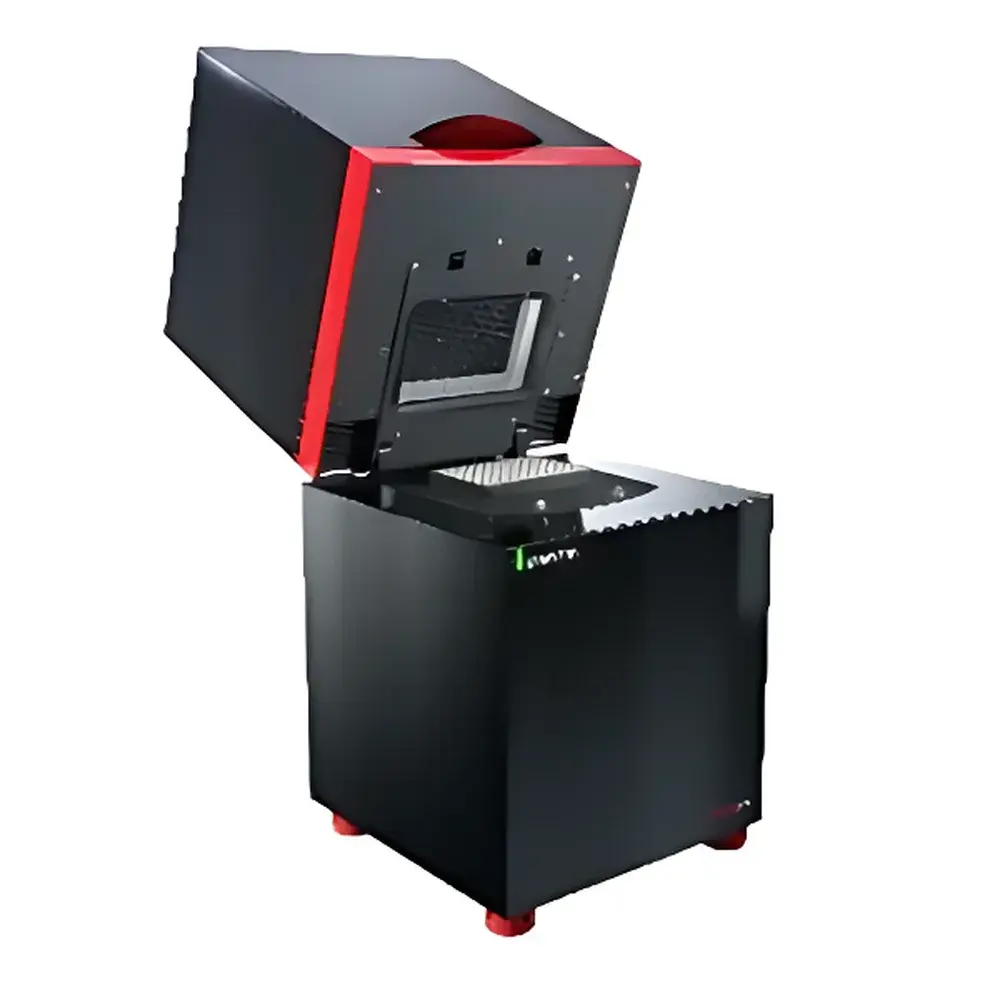
analytikjena qTOWER3 84G Real-Time Fluorescence Quantitative PCR System
| Brand | analytikjena |
|---|---|
| Origin | Germany |
| Model | qTOWER3 84G |
| Instrument Type | Real-Time Fluorescence Quantitative PCR System |
| Sample Capacity | 384-well format |
| Maximum Heating Rate | 4 °C/s |
| Temperature Accuracy | ±0.1 °C |
| Well-to-Well Temperature Uniformity | ±0.15 °C |
| Optical Configuration | 6-channel excitation/emission system (configurable 1–6 channels) |
| Light Source | RGBW high-intensity long-life LEDs (blue, green, red, white) |
| Detector | High-sensitivity channel-type photomultiplier tube (PMT) |
| Detection Method | 16-channel fiber-optic scanning |
| Sensitivity | Single-copy DNA detection |
| Dynamic Range | 10 orders of magnitude |
| Recommended Reaction Volume | 2–30 µL |
| Linear Temperature Gradient | 24-column gradient |
| Thermal Module | Peltier-based with corrosion-resistant surface |
| Hot Lid Temperature | Up to 110 °C with auto-adjusting pressure (up to 30 kg/plate) |
| Noise Level | ≤45 dB(A) |
| Software | MIQE-compliant analysis suite with unlimited installation and lifetime free updates |
| Compliance | Designed for GLP/GMP-aligned workflows |
Overview
The analytikjena qTOWER3 84G is a purpose-built, high-throughput real-time fluorescence quantitative PCR system engineered for precision, reproducibility, and scalability in molecular diagnostics, translational research, and quality-controlled biomanufacturing environments. Unlike retrofitted conventional thermal cyclers, the qTOWER3 84G integrates a dedicated optical architecture and thermally optimized Peltier-based thermal module from first principles. Its measurement principle relies on synchronous fluorescence excitation and emission detection during exponential amplification, enabling absolute quantification via standard curves or relative quantification using ΔΔCt or efficiency-corrected models. The system employs solid-state RGBW LED excitation across a broad spectral range (450–670 nm), eliminating lamp degradation and thermal drift while ensuring consistent photon flux for low-abundance target detection — critical for viral load monitoring, rare mutation screening, and single-cell gene expression profiling.
Key Features
- Six-channel modular optical design: Configurable from 1 to 6 detection channels in-field; supports future expansion without hardware replacement.
- Twelve interchangeable excitation/emission filter sets: Includes FRET-optimized mismatched pairs and specialized filters for high-resolution protein melting curve analysis (e.g., SYPRO Orange applications).
- RGBW LED light source: Delivers stable, non-thermal excitation across visible wavelengths; rated for >20,000 hours of operation with zero warm-up time and no alignment maintenance.
- Channel-type photomultiplier tube (PMT) detection: Provides superior signal-to-noise ratio compared to CCD or CMOS sensors, enabling reliable single-copy DNA detection and discrimination of 1,000 vs. 2,000 plasmid copies.
- 16-channel fiber-optic scanning: Simultaneously acquires fluorescence data from 16 wells per cycle — eliminating well-to-well acquisition delay and ensuring kinetic fidelity without ROX normalization (though optional reference dye correction is supported).
- 24-column linear temperature gradient: Enables empirical optimization of annealing temperatures across a full 384-well plate in a single run — accelerating assay development and validation.
- Intelligent hot lid with adaptive pressure control: Applies up to 30 kg force uniformly across the plate seal, preventing evaporation even in low-volume (2 µL) reactions and ensuring condensation-free cycling.
Sample Compatibility & Compliance
The qTOWER3 84G accepts standard ANSI/SBS-compliant 384-well PCR plates and supports reaction volumes from 2 µL to 30 µL, accommodating both high-density screening and low-input clinical specimens. Its thermal architecture maintains ±0.1 °C accuracy and ±0.15 °C inter-well uniformity across the entire block — meeting ISO/IEC 17025 calibration traceability requirements for accredited testing laboratories. The system is validated for use with common chemistries including hydrolysis probes (TaqMan), intercalating dyes (SYBR Green I), molecular beacons, and scorpions. It complies with core regulatory expectations for instrument qualification under GxP frameworks: documented design verification, temperature mapping reports, and software features aligned with FDA 21 CFR Part 11 (audit trail, electronic signatures, role-based access control) and EU Annex 11.
Software & Data Management
The included qPCRsoft suite is a MIQE (Minimum Information for Publication of Quantitative Real-Time PCR Experiments)-compliant desktop application supporting Windows OS. It offers quantitative analysis (absolute/relative), SNP genotyping, melt curve profiling, amplification efficiency calculation (using LinRegPCR or sigmoidal fitting), and multi-reference normalization. All analysis modules generate structured metadata-rich reports exportable as PDF, CSV, or XML — enabling seamless integration into LIMS via USB or network interfaces. Software licenses are perpetual and unrestricted: installations on multiple workstations require no additional fees, and version upgrades are delivered free of charge for the instrument’s operational lifetime. Audit logs record user actions, parameter changes, and result modifications — satisfying GLP documentation requirements and facilitating internal/external inspections.
Applications
This platform serves demanding applications across academic, clinical, and industrial settings: viral/bacterial pathogen load quantification (e.g., SARS-CoV-2, HPV, MRSA); residual host cell DNA testing in biologics manufacturing; copy number variation (CNV) analysis in oncology panels; miRNA expression profiling with stem-loop RT-qPCR; GMO detection in food safety testing; and CRISPR editing efficiency assessment via T7E1 or RFLP-coupled qPCR. Its sensitivity and dynamic range make it suitable for digital PCR cross-validation studies and NGS library quantification where precise input normalization is essential.
FAQ
Is the qTOWER3 84G compatible with third-party reagents and consumables?
Yes — it supports all major commercial master mixes, probe chemistries, and ANSI/SBS-standard 384-well plates without proprietary lock-in.
Does the system support remote monitoring or cloud-based data backup?
While the base configuration operates offline for security-sensitive environments, raw data files (Ct values, melt profiles, amplification curves) can be exported programmatically for ingestion into institutional cloud storage or ELN systems.
What validation documentation is provided upon installation?
Customers receive a comprehensive IQ/OQ protocol package, temperature uniformity maps, optical performance verification reports, and software validation summary per ISO 13485 and GAMP5 guidelines.
Can the instrument perform high-resolution melt (HRM) analysis?
Yes — its precise thermal control (0.01 °C resolution), narrow-band filter options, and PMT-based detection enable sub-degree melt peak discrimination for heteroduplex analysis and methylation-sensitive assays.
Is service and technical support available globally?
analytikjena provides direct manufacturer-backed service contracts, on-site engineer dispatch, and 24/7 remote diagnostics support through authorized regional service centers.



