
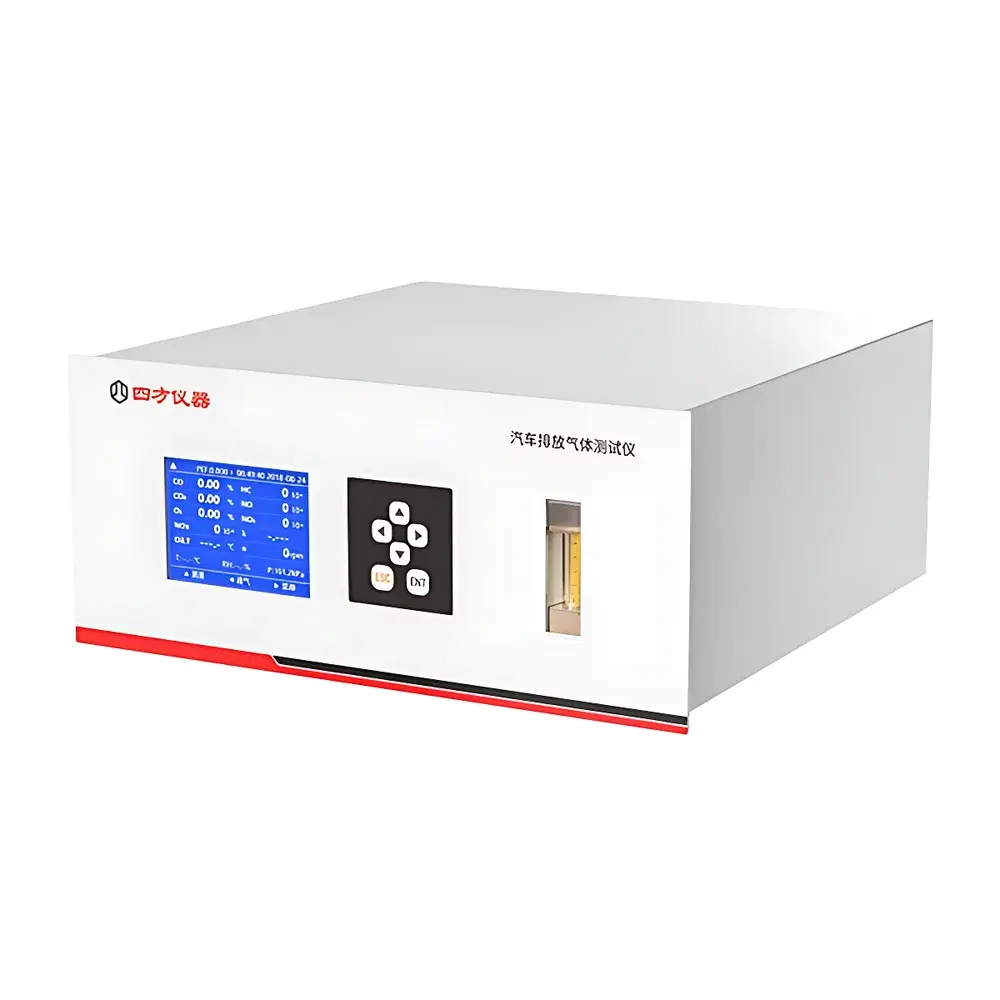
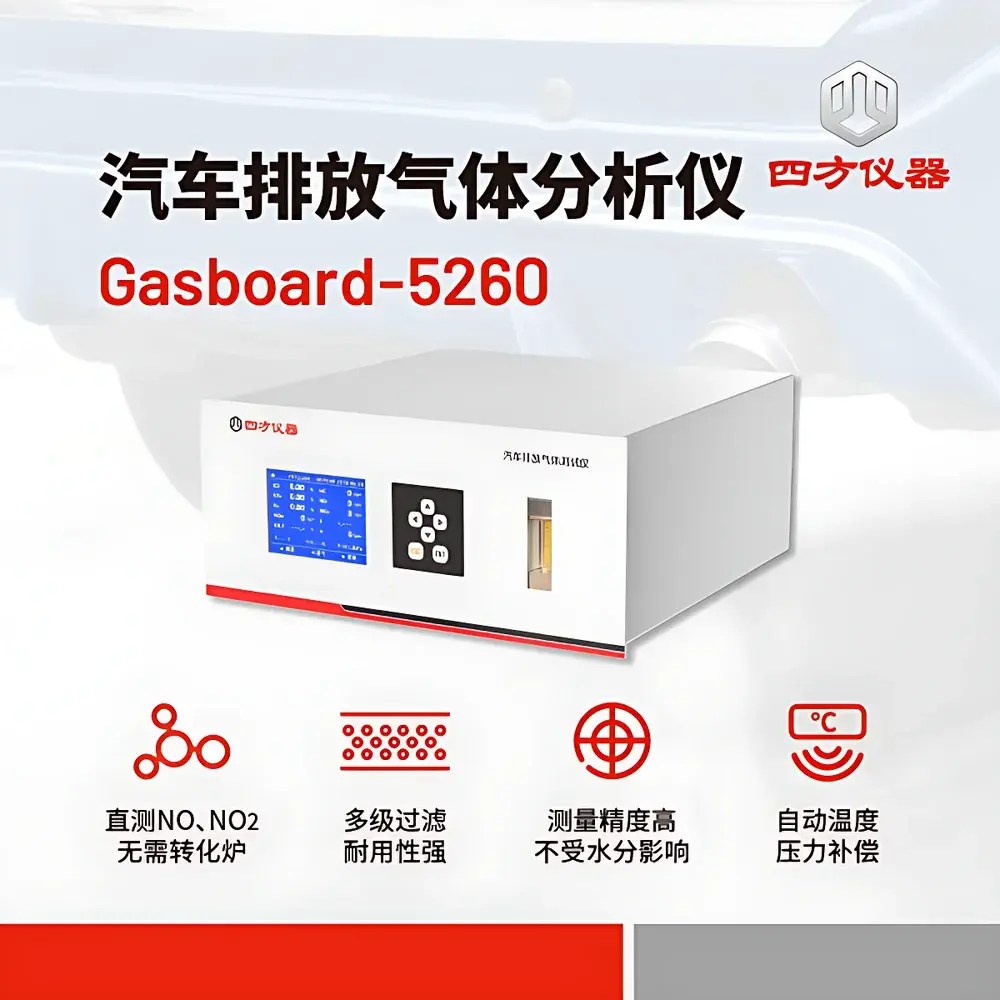
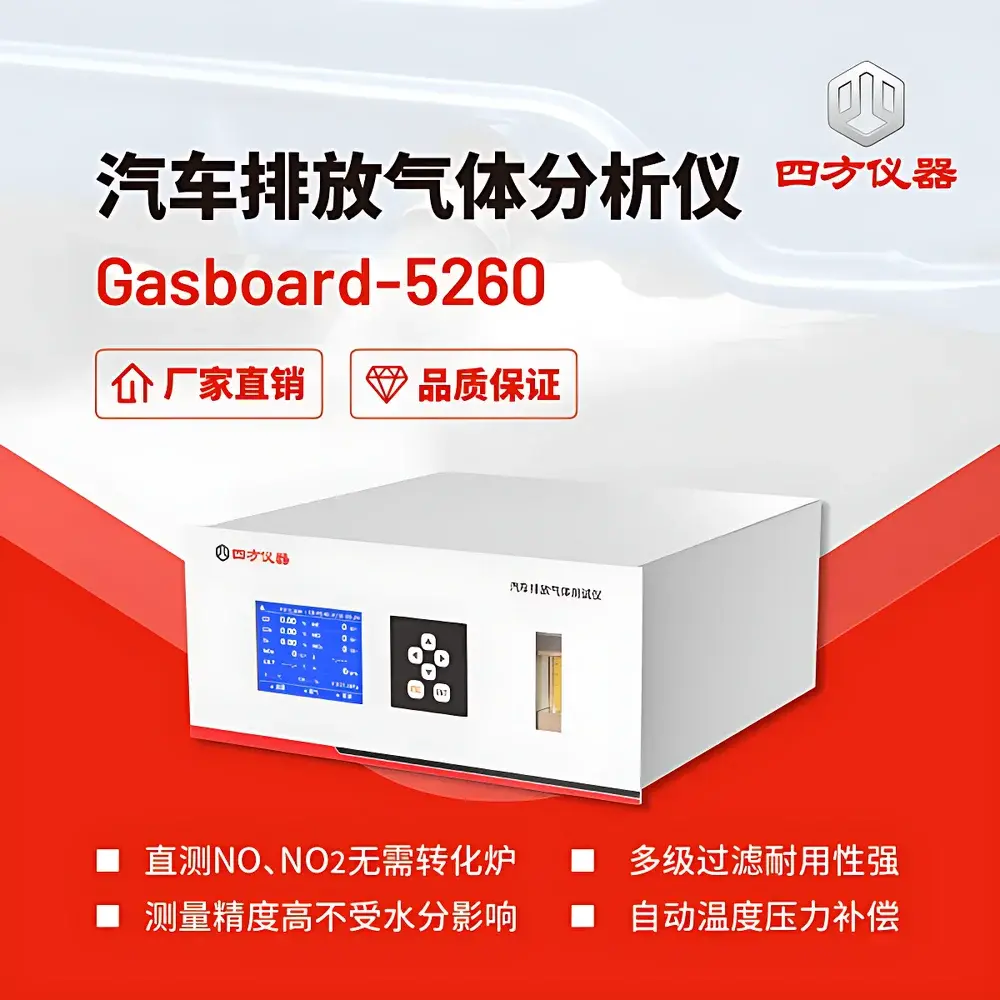
CUBIC INSTRUMENTS Gasboard-5260 Automotive Exhaust Gas Analyzer
| Brand | CUBIC INSTRUMENTS |
|---|---|
| Model | Gasboard-5260 |
| Detection Principle | Microflow Dual-Chamber IR (NO), NDUV (NO₂), NDIR (HC, CO, CO₂), Electrochemical (O₂) |
| Measured Gases | HC, NO, NO₂, CO, CO₂, O₂ |
| Accuracy | Compliant with JJG 688–2017 Class 00 & GB 18285–2018 |
| Response Time (T₉₀) | HC/CO/CO₂ ≤ 8 s |
| Resolution | NO/NO₂ = 1 ppm |
| Warm-up Time | 30 min |
| Power Supply | 100–240 VAC, 150 W |
| Communication Interface | RS-485 / RS-232 |
Overview
The CUBIC INSTRUMENTS Gasboard-5260 is a high-precision, on-line automotive exhaust gas analyzer engineered for regulatory compliance testing and continuous emission monitoring in vehicle inspection lanes, manufacturing QA environments, and accredited third-party laboratories. It employs a multi-physical detection architecture: microflow dual-chamber infrared sensing for NO, non-dispersive ultraviolet (NDUV) absorption for NO₂, non-dispersive infrared (NDIR) for hydrocarbons (HC), carbon monoxide (CO), and carbon dioxide (CO₂), and long-life electrochemical cells for oxygen (O₂). This hybrid optical–electrochemical platform eliminates the need for catalytic NOx converters—reducing system complexity, calibration drift, and maintenance intervals. The instrument is fully aligned with China’s national mandatory standards GB 18285–2018 (Limits and Measurement Methods for Pollutants from Gasoline Vehicles) and JJG 688–2017 (Verification Regulation for Exhaust Gas Analyzers), certified to Class 00 accuracy requirements for metrological traceability in official inspection settings.
Key Features
- Direct, simultaneous measurement of NO and NO₂ without thermal or chemical NOx conversion—enabling stable, low-drift operation over extended service life
- Dual-chamber microflow IR sensor design with temperature-compensated optical filtering, mitigating performance degradation from ambient thermal fluctuations and component aging
- Multi-stage particulate and moisture filtration system upstream of the optical path, enhancing long-term reliability in real-world garage and inspection lane conditions
- Embedded signal processing algorithms performing real-time linearization, cross-sensitivity correction, and baseline stabilization for improved repeatability
- Automatic temperature and barometric pressure compensation applied to all concentration outputs, ensuring consistent volumetric reporting across varying environmental conditions
- Standard RS-485 and RS-232 interfaces for integration into centralized inspection management systems; optional analog voltage outputs available upon configuration
- Front-panel interface with backlit LCD display supporting bilingual (English/Chinese) operation menus and real-time parameter visualization
Sample Compatibility & Compliance
The Gasboard-5260 is validated for use with raw, diluted, and conditioned exhaust streams from gasoline-fueled internal combustion engines operating under idle, fast-idle, and steady-state load conditions. Its gas-handling architecture accommodates sample temperatures up to 180 °C and dew points up to 90 °C when equipped with integrated heated sampling lines (optional). All measurement channels meet the metrological performance criteria specified in JJG 688–2017 Class 00, including zero drift ≤ ±1.5 ppm (NO/NO₂), span drift ≤ ±2.0% of full scale over 24 h, and repeatability ≤ ±1.0% RSD. The analyzer supports GLP-aligned data integrity practices via time-stamped audit logs, user-access control levels, and non-volatile memory retention of calibration history—facilitating readiness for ISO/IEC 17025 accreditation audits.
Software & Data Management
The analyzer operates with embedded firmware supporting configurable averaging periods (1–10 s), auto-zero cycles, and scheduled span verification routines. Raw sensor outputs are timestamped and stored locally in non-volatile memory (≥10,000 records). PC-based configuration and data export are enabled via the proprietary Gasboard Control Suite (Windows-compatible), which provides CSV export, trend plotting, pass/fail flagging per GB 18285–2018 thresholds, and customizable report templates compliant with provincial inspection authority formatting requirements. The system architecture is compatible with external database ingestion via MODBUS RTU over RS-485, enabling interoperability with LIMS platforms and automated test record generation per ISO 17025 Clause 7.7.
Applications
- Regulatory emissions testing in MVI (Motor Vehicle Inspection) stations and DEP (Department of Environmental Protection)-accredited facilities
- In-line exhaust diagnostics during engine development, powertrain calibration, and durability validation at OEM R&D centers
- Quality assurance screening in assembly plants for pre-delivery emission verification
- Field service support for fleet maintenance depots requiring rapid, repeatable exhaust composition analysis
- Academic and governmental research on aftertreatment efficiency, catalyst aging, and alternative fuel combustion characteristics
- Third-party certification labs conducting type-approval testing per UN ECE Regulation 83 and GB 18352.x series
FAQ
Does the Gasboard-5260 require periodic NOx converter replacement?
No. The analyzer uses direct NDUV detection for NO₂ and patented dual-chamber IR for NO, eliminating catalytic converters entirely.
Is the device suitable for use with ethanol-blended or flex-fuel vehicles?
Yes. The NDIR and NDUV optical paths are chemically inert and unaffected by oxygenated fuel combustion byproducts; measurement accuracy remains within specification across E10–E85 blends.
Can the analyzer be integrated into an existing inspection line PLC system?
Yes. Standard MODBUS RTU over RS-485 enables seamless read/write communication with Allen-Bradley, Siemens, and Mitsubishi PLCs without middleware.
What is the recommended calibration frequency under daily operational use?
Initial calibration verification is required before first use; subsequent full calibration is recommended every 90 days or after 500 test cycles, whichever occurs first—per JJG 688–2017 Annex B.
Does the instrument support automatic air–fuel ratio (λ) calculation?
Yes. Using measured O₂, CO, CO₂, and HC values, the embedded algorithm computes λ per SAE J1930 and outputs it alongside raw gas concentrations in real time.
Related Products







