
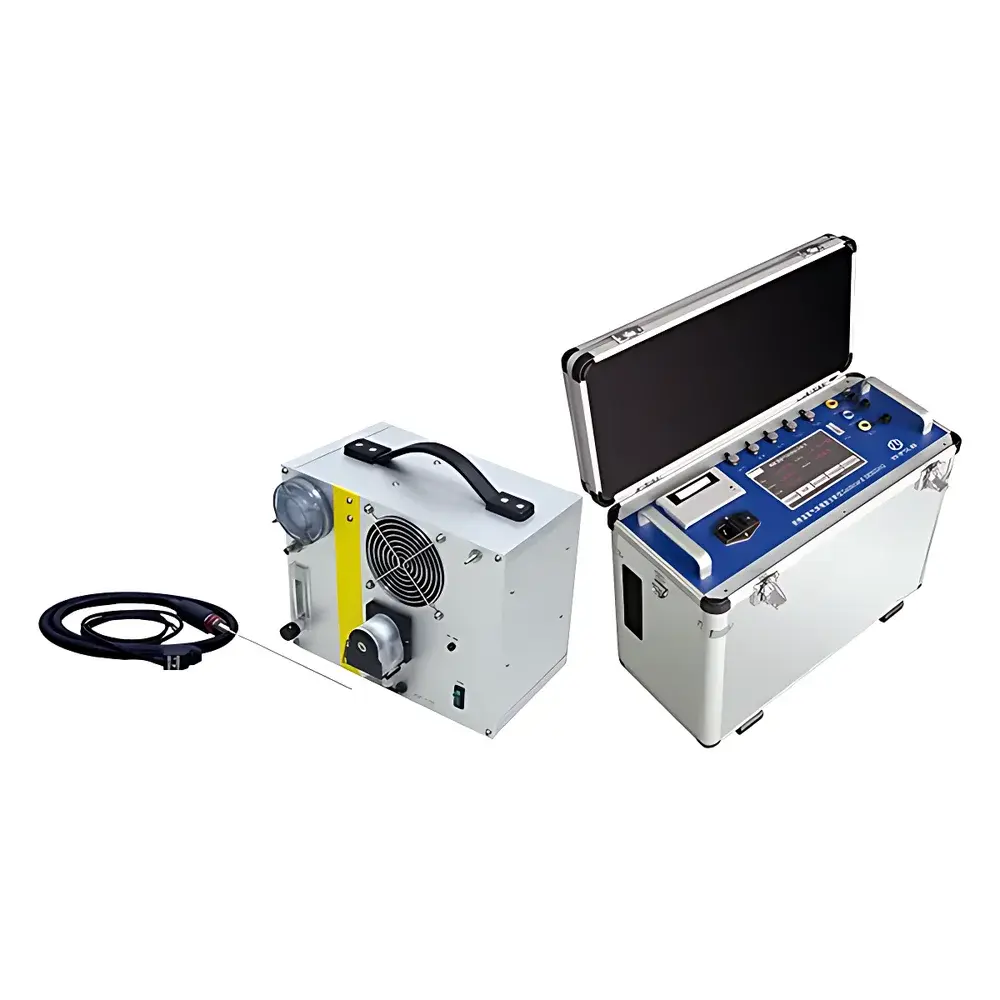
CUBIC INSTRUMENTS Gasboard-3800GHG Portable Multi-Gas Greenhouse Gas Analyzer
| Brand | CUBIC INSTRUMENTS |
|---|---|
| Origin | Hubei, China |
| Model | Gasboard-3800GHG |
| Instrument Type | Portable |
| Measured Gases | CO₂, CH₄, N₂O, CO, O₂ |
| Measurement Principle | Micro-flow NDIR (CO₂/CH₄/N₂O/CO), Dual-beam NDIR (CO₂/CO, high-range), Electrochemical (O₂) |
| Range (CO₂) | 0–500 ppm / 0–20% / 0–100% (configurable) |
| Range (CH₄/N₂O) | 0–1000 ppm |
| Range (CO) | 0–200 ppm / 0–5000 ppm / 0–5% |
| Range (O₂) | 0–25% |
| Accuracy | ±1% F.S. (micro-flow NDIR), ±2% F.S. (dual-beam NDIR & ECD) |
| Repeatability | ≤±1% |
| Response Time (T90) | <25 s |
| Flow Rate | 0.7–1.2 L/min |
| Inlet Pressure | 2–50 kPa |
| Output | USB, analog (4–20 mA), printer interface |
| Power | 100–240 VAC, 150 W |
| Self-diagnostic Function | Yes |
Overview
The CUBIC INSTRUMENTS Gasboard-3800GHG is a field-deployable, multi-parameter greenhouse gas (GHG) analyzer engineered for regulatory-grade emissions monitoring and process control in industrial and environmental applications. It employs three complementary sensing modalities—micro-flow non-dispersive infrared (NDIR), dual-beam NDIR, and electrochemical detection—to simultaneously quantify CO₂, CH₄, N₂O, CO, and O₂ with metrological rigor. Its core innovation lies in the patented micro-flow NDIR architecture (PCT/CN2018100767), which integrates a half-chamber reference design to eliminate baseline drift induced by thermal fluctuations, humidity, or optical aging. Unlike conventional single-beam or dual-chamber NDIR systems, this configuration enables real-time differential absorption measurement within a monolithic optical path—enhancing long-term stability and enabling sub-ppm resolution at low-concentration ranges (e.g., 0–500 ppm CO₂). The instrument complies with fundamental performance requirements outlined in ISO 14064-3 for GHG quantification verification and supports traceable calibration protocols aligned with EPA Method 3A and EN 15267-3 for continuous emission monitoring systems (CEMS).
Key Features
- Simultaneous, real-time measurement of up to five gases: CO₂, CH₄, N₂O, CO, and O₂—each optimized via sensor-specific technology selection.
- Micro-flow NDIR modules deliver ±1% F.S. accuracy for CO₂, CH₄, N₂O, and CO across low-range configurations (e.g., 0–500 ppm), with 1 ppm resolution and immunity to cross-interference from water vapor and common combustion byproducts.
- Dual-beam NDIR channels provide robust high-range CO₂ (up to 100%) and CO (up to 5%) measurement at ±2% F.S. accuracy, suitable for flue gas ducts and post-combustion streams.
- Electrochemical O₂ sensor ensures stable, linear response over 0–25% range with ±2% F.S. accuracy and minimal temperature dependence.
- Integrated heated sampling train—including thermostatically controlled probe, particulate filter, and condensate trap—maintains sample integrity under variable ambient conditions and prevents dew-point-related condensation artifacts.
- Onboard diagnostics continuously monitor sensor health, optical alignment, flow consistency, and zero/span stability—generating audit-ready logs compliant with GLP data integrity standards.
Sample Compatibility & Compliance
The Gasboard-3800GHG is validated for use with hot, humid, and particulate-laden flue gases from fossil-fueled and industrial combustion sources. Its inlet pressure tolerance (2–50 kPa) and programmable flow control (0.7–1.2 L/min) accommodate both extractive and dilution-sampling configurations. All gas modules meet IEC 61000-6-2/6-3 for electromagnetic compatibility and are rated IP54 for field portability. While not certified to UL/CSA safety standards out-of-box, its architecture supports integration into Class I, Division 2 hazardous locations when deployed with appropriate barrier systems. Data output formats (Modbus RTU, analog 4–20 mA) align with ISA-84 and IEC 61511 functional safety frameworks for emissions reporting infrastructure.
Software & Data Management
The analyzer interfaces natively with CUBIC’s proprietary GasVision™ desktop software (Windows-based), supporting automated calibration scheduling, multi-point span validation, and time-stamped concentration logging at user-defined intervals (1 s to 60 min). Raw sensor outputs are stored with metadata including ambient temperature, barometric pressure, and diagnostic flags—enabling full traceability per FDA 21 CFR Part 11 requirements when configured with electronic signature and audit trail modules. Export options include CSV, Excel, and XML formats compatible with third-party platforms such as PI System, Ignition SCADA, and EPA’s CDX portal. Firmware updates are delivered via secure HTTPS and verified using SHA-256 checksums.
Applications
- Continuous emissions monitoring (CEM) at coal-, gas-, and biomass-fired power plants, particularly for Tier 2 GHG reporting under EU ETS and U.S. EPA GHGRP Subpart D.
- Process optimization and fugitive emission screening in cement kilns, nitric acid plants, and ammonia synthesis units where N₂O abatement is mandated.
- Verification of carbon capture unit performance (e.g., amine scrubber outlet CO₂ purity, CH₄ slip in biogas upgrading).
- Mobile source testing—including landfill gas flares, wastewater treatment off-gases, and agricultural combustion stacks—using battery-powered operation (optional external LiFePO₄ pack).
- Research-grade flux measurements in eddy-covariance towers when paired with calibrated mass flow controllers and meteorological sensors.
FAQ
What calibration standards are required for field deployment?
Certified gas mixtures traceable to NIST SRMs (e.g., CO₂ in N₂, CH₄ in air) are recommended for initial setup and periodic verification. Zero gas (high-purity N₂) and span gases matching target concentration ranges must be used for two-point calibration.
Can the instrument operate unattended for extended periods?
Yes—when powered via AC mains and installed with active cooling, it supports 72-hour continuous logging with internal memory (8 GB) and optional remote telemetry via Ethernet or 4G LTE module.
Is the micro-flow NDIR technology susceptible to interference from SO₂ or NOₓ?
No—the spectral filtering and chamber geometry minimize spectral overlap; laboratory validation per ISO 6145-7 confirms interference errors <0.3% F.S. for SO₂ up to 500 ppm and NOₓ up to 200 ppm.
How is moisture handled in high-humidity samples?
The integrated heated sampling line maintains sample temperature >120°C upstream of the sensor block; combined with the micro-flow detector’s inherent water-vapor insensitivity, this eliminates condensation-induced signal attenuation without requiring permeation dryers.
Does the device support regulatory reporting formats such as EPA QA/QC documentation?
Yes—GasVision™ generates QA/QC summary reports compliant with EPA PS-16 and EN 14181 QAL2 requirements, including precision checks, drift assessments, and calibration certificate templates.
Related Products







