
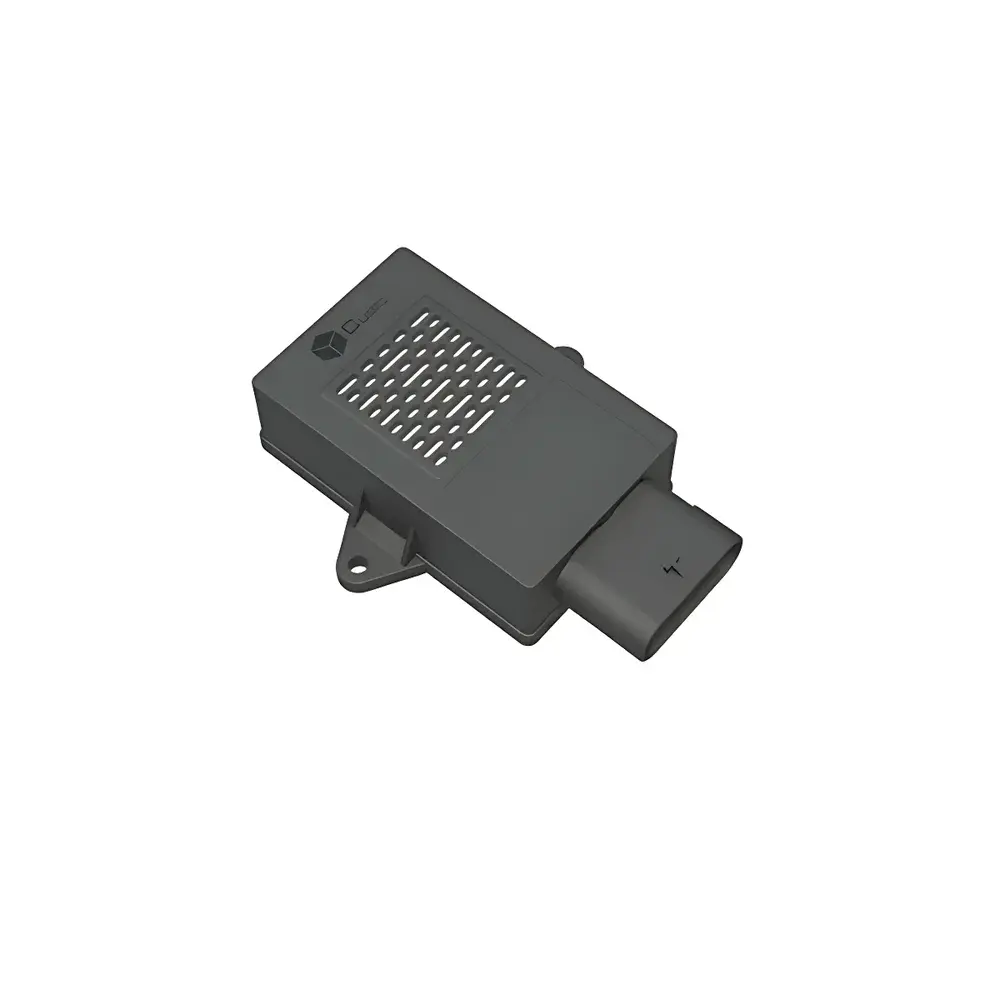
Cubic ATRS-1010-H2 Thermal Conductivity Hydrogen Gas Sensor
| Brand | Cubic |
|---|---|
| Origin | Hubei, China |
| Model | ATRS-1010-H2 |
| Detection Principle | Thermal Conductivity (TC) |
| Target Gas | H₂ |
| Range | 0–4 %vol |
| Resolution | 0.01 %vol |
| Accuracy | ±(0.1 %vol + 10% of reading) |
| Response Time (T90) | ≤20 s |
| Data Refresh Rate | ≤1 s |
| Output Interface | TTL UART |
| Operating Temperature | −20 °C to +60 °C |
| Operating Humidity | 0–99 %RH (non-condensing) |
| Storage Conditions | −40 °C to +95 °C, 0–99 %RH (non-condensing) |
| Operating Pressure | 80–120 kPa |
| Ingress Protection | IP54 |
| Supply Voltage | 4.5–5.5 VDC (nominal +5 VDC) |
| Average Current Consumption | ≤100 mA |
| Design Lifetime | >15 years |
Overview
The Cubic ATRS-1010-H2 Thermal Conductivity Hydrogen Gas Sensor is an engineered solution for continuous, real-time hydrogen (H₂) concentration monitoring in safety-critical environments. It operates on the fundamental physical principle of thermal conductivity differential measurement: hydrogen exhibits a thermal conductivity approximately seven times greater than that of air (~0.18 W/m·K vs. ~0.026 W/m·K), enabling reliable discrimination and quantification within binary or quasi-binary gas mixtures. Unlike catalytic bead or electrochemical sensors, this device requires no oxygen, exhibits zero cross-sensitivity to CO, CH₄, or common VOCs, and remains stable in inert or reducing atmospheres—making it uniquely suited for battery thermal runaway detection in sealed EV battery packs and lithium-ion energy storage systems (ESS). Its robust design supports integration into embedded safety architectures where fail-safe early warning—typically at H₂ concentrations ≥0.5 %vol—is required to trigger thermal management intervention or evacuation protocols per UL 9540A and IEC 62933-3-2 guidelines.
Key Features
- Thermal conductivity-based detection with inherent immunity to poisoning, aging drift, or oxygen dependency
- High-resolution measurement capability (0.01 %vol) across a linear 0–4 %vol range—covering both leak detection thresholds and pre-ignition accumulation zones (LEL of H₂ is 4.0 %vol)
- T90 response time ≤20 seconds under standard conditions (25 °C, 1 atm), validated per ISO 16000-23 for rapid event capture
- Low-power operation (≤100 mA avg. at +5 VDC) compatible with battery-backed or energy-harvesting monitoring nodes
- IP54-rated enclosure ensuring operational integrity in industrial indoor environments subject to dust ingress and occasional water splashing
- Extended service life exceeding 15 years under specified operating conditions, supported by accelerated lifetime testing per MIL-STD-810H Method 502.7
- TTL-level UART serial interface (3.3 V logic compatible) for direct integration with microcontroller units (MCUs), PLCs, or edge gateways without level-shifting circuitry
Sample Compatibility & Compliance
The ATRS-1010-H2 is optimized for use in dry, non-corrosive gas streams containing H₂ in air, nitrogen, argon, or CO₂ backgrounds. It is not intended for use in high-humidity condensing environments, aggressive acid/base vapors (e.g., HF, Cl₂), or particulate-laden exhaust streams without upstream filtration. The sensor complies with RoHS Directive 2011/65/EU and meets EMC immunity requirements per IEC 61000-4-2 (ESD), -4-3 (Radiated RF), and -4-4 (EFT). While not intrinsically safe certified, its low-energy design enables integration into Class I, Division 2 (CID2) or ATEX Zone 2-compliant systems when deployed within appropriately rated enclosures and current-limiting circuitry. Calibration traceability follows NIST-traceable reference gas standards (ISO 6141), and routine verification aligns with ISO 17025-accredited laboratory practices.
Software & Data Management
The sensor outputs ASCII-formatted data frames via UART at configurable baud rates (default 9600 bps), including timestamped H₂ concentration, internal temperature, and diagnostic flags (e.g., heater fault, communication timeout). Firmware supports command-driven calibration offset adjustment and zero/span verification sequences. When integrated into larger monitoring platforms, data streams comply with Modbus RTU over serial or MQTT/JSON payloads for cloud ingestion. Audit trails—including configuration changes, calibration events, and sensor health logs—can be maintained in accordance with FDA 21 CFR Part 11 requirements when paired with validated host software and electronic signature controls. Raw output supports post-processing for trend analysis, rate-of-rise detection, and predictive failure modeling using industry-standard tools (e.g., Python Pandas, MATLAB Signal Processing Toolbox).
Applications
- Early-stage thermal runaway detection in electric vehicle traction battery modules and stationary ESS cabinets
- Hydrogen leakage monitoring in PEM fuel cell systems, electrolyzer enclosures, and hydrogen refueling stations
- Process gas purity verification in semiconductor fab nitrogen purge lines and metallurgical annealing atmospheres
- Occupational exposure monitoring in laboratories, R&D facilities, and hydrogen production pilot plants
- OEM integration into smart fire alarm panels, building management systems (BMS), and industrial safety controllers
FAQ
Does the ATRS-1010-H2 require periodic calibration?
Yes—recommended calibration interval is every 6 months under continuous operation, or prior to critical deployment, using certified 1.0 %vol H₂/N₂ standard gas per ISO 6141.
Can it operate in high-humidity environments?
It functions within 0–99 %RH (non-condensing); however, prolonged exposure above 85 %RH may affect long-term baseline stability—use of desiccant filters or environmental housing is advised.
Is the sensor affected by ambient temperature fluctuations?
Internal temperature compensation is implemented via integrated Pt1000 thermistor; performance specifications assume operation within −20 °C to +60 °C as stated in datasheet Section 4.2.
What is the maximum cable length between sensor and host controller?
For TTL UART operation at 9600 bps, maximum recommended unshielded cable length is 3 meters; shielded twisted-pair cabling extends this to 10 meters with proper grounding.
How is sensor health monitored during operation?
The UART protocol includes real-time status codes indicating heater resistance deviation, signal saturation, and communication integrity—enabling automated diagnostics and predictive maintenance scheduling.







