
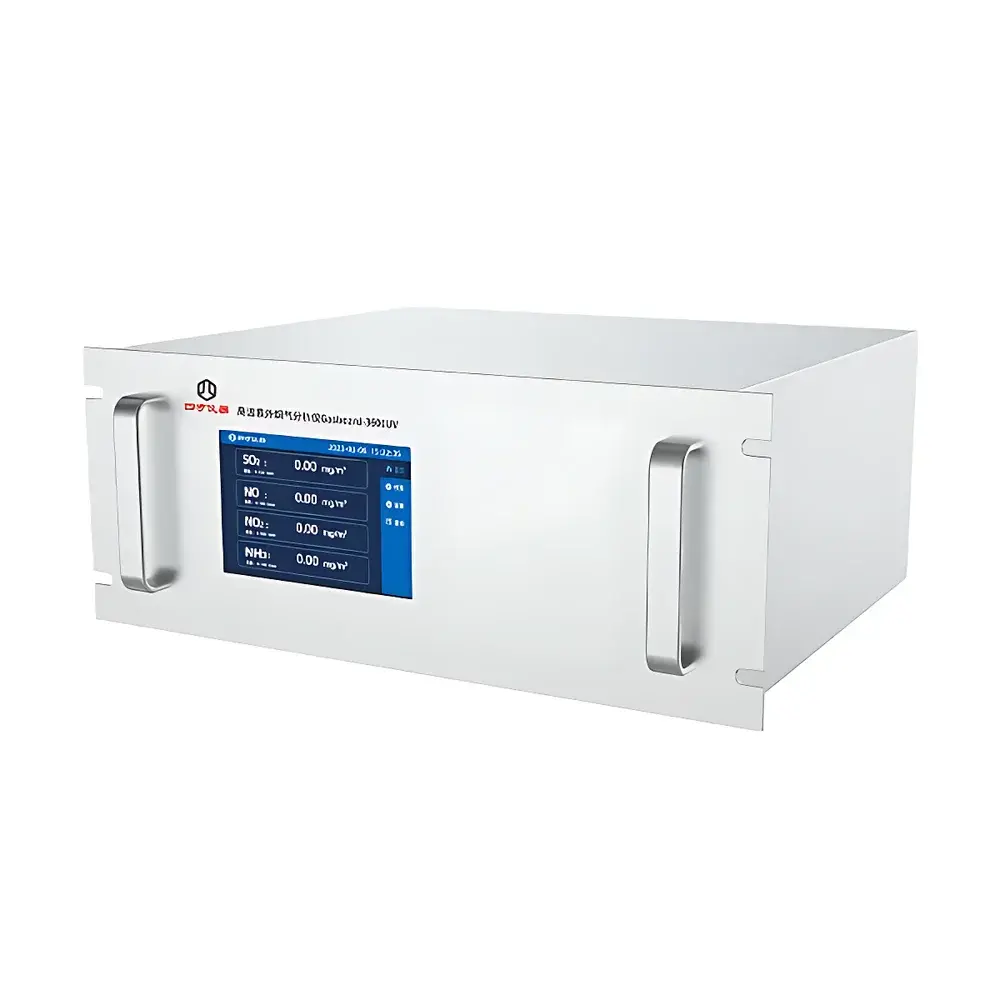
CUBIC INSTRUMENTS Gasboard-3600UV High-Temperature UV Differential Optical Absorption Spectroscopy (UV-DOAS) Flue Gas Analyzer
| Brand | CUBIC INSTRUMENTS |
|---|---|
| Origin | Hubei, China |
| Model | Gasboard-3600UV |
| Measurement Principle | UV-DOAS |
| Measured Gases | SO₂, NO, NO₂ |
| Range | 0–500 mg/m³ (each) |
| Accuracy | ≤±2% F.S. |
| Repeatability | ≤1% |
| Response Time | ≤30 sec @ T90 |
| Detection Limit | 0.01 mg/m³ (SO₂/NO/NO₂) |
| Sample Method | Hot-Wet Extraction |
| Optical Path | Multi-reflection long-path cell |
| Light Source | Pulsed Xenon Lamp |
| Measurement Chamber Temp. | 120–190 °C (adjustable) |
| Zero Drift | ≤2% F.S./24 h |
| Span Drift | ≤2% F.S./24 h |
| Communication | RS-232 / RS-485 |
| Power Supply | 220 VAC / 50 Hz |
Overview
The CUBIC INSTRUMENTS Gasboard-3600UV is a high-temperature, in-situ capable flue gas analyzer engineered for continuous, real-time quantification of sulfur dioxide (SO₂), nitric oxide (NO), and nitrogen dioxide (NO₂) in hot, humid, particulate-laden exhaust streams from industrial combustion sources. Unlike conventional cold-dry extractive systems—which require condensation, drying, and subsequent chemical conversion steps—the Gasboard-3600UV employs ultraviolet differential optical absorption spectroscopy (UV-DOAS) coupled with hot-wet sampling to analyze raw flue gas directly at elevated temperatures (120–190 °C). This eliminates phase-change losses—particularly critical for SO₂ solubility—and preserves the true gas-phase composition throughout the measurement path. The instrument’s optical architecture features a multi-reflection, long-path absorption cell (effective path length >1.5 m), enabling sub-ppb-equivalent detection limits (0.01 mg/m³) without catalytic or thermal conversion hardware. Its solid-state pulsed xenon light source provides spectral stability across the 190–400 nm range, with an operational lifetime exceeding 5 years under continuous duty.
Key Features
- Full hot-wet operation: Entire sample path—including probe, heated line, and optical cell—is maintained above dew point, preventing condensation-induced analyte loss and minimizing maintenance intervals.
- UV-DOAS spectroscopic engine: Simultaneously resolves overlapping absorption signatures of SO₂, NO, and NO₂ using high-resolution spectral deconvolution—eliminating cross-interference from H₂O vapor, CO₂, and particulate scattering.
- Self-cleaning optical measurement chamber: Modular gas cell design allows field-accessible mechanical and purge-based cleaning, ensuring long-term signal fidelity in high-dust environments.
- No moving parts in optical train: Solid-state light source, fixed grating spectrometer, and static multi-reflection cell deliver exceptional resistance to mechanical shock and vibration—critical for stack-mounted or mobile monitoring applications.
- Real-time dual NO/NO₂ quantification: Direct spectral discrimination avoids reliance on external NOₓ converters, removing associated calibration drift, temperature sensitivity, and molybdenum-catalyst degradation concerns.
- Configurable temperature control: Measurement chamber setpoint adjustable between 120 °C and 190 °C to match process conditions and optimize signal-to-noise ratio across varying moisture and aerosol loads.
Sample Compatibility & Compliance
The Gasboard-3600UV is validated for use in stationary source emission monitoring (SSEM) applications per national and international regulatory frameworks, including China’s HJ 75–2017 and HJ 76–2017 technical specifications for continuous emission monitoring systems (CEMS). Its hot-wet methodology aligns with ISO 12039:2000 (determination of SO₂ and NOₓ in flue gases) and ASTM D6522–20 (standard test method for determination of nitrogen oxides in emissions from stationary sources). The analyzer meets EN 15267-3:2017 requirements for automated measuring systems and supports audit-ready data logging compliant with GLP and GMP principles. All firmware and configuration parameters are timestamped and logged with immutable records—facilitating traceability during regulatory inspections or QA/QC audits.
Software & Data Management
The embedded firmware supports dual communication protocols (RS-232 and RS-485 Modbus RTU) for seamless integration into SCADA, DCS, or centralized CEMS platforms. Local display provides real-time concentration traces, diagnostic status, and alarm flags (e.g., low lamp intensity, temperature deviation, flow interruption). Data export includes CSV-formatted time-series files with UTC timestamps, measurement uncertainty estimates, and system health metadata. Optional remote access module enables secure HTTPS-based web interface for configuration, trend visualization, and firmware updates—fully compatible with IT security policies requiring TLS 1.2+ encryption and role-based user authentication.
Applications
- Coal-, biomass-, and waste-fired power plants: Continuous SO₂ and NOₓ compliance reporting under national emission standards.
- Cement kilns and glass furnaces: High-temperature, high-dust flue gas monitoring where traditional extractive analyzers suffer frequent clogging and calibration drift.
- Steel sintering and coke oven batteries: Real-time NO₂/NO ratio tracking for optimized denitrification control and SCR catalyst performance evaluation.
- Waste incineration facilities: Monitoring of acid gas species under variable moisture and halogen load conditions without sample conditioning artifacts.
- Research and development labs: Validation reference for sensor-based portable monitors or modeling studies requiring high-fidelity, unconditioned flue gas composition data.
FAQ
Does the Gasboard-3600UV require zero/span calibration gas cylinders?
Yes—periodic verification using certified SO₂, NO, and NO₂ standard gases is required per regulatory guidelines (e.g., HJ 76–2017 mandates bi-weekly span checks). However, the hot-wet architecture significantly reduces frequency of zero-air purging due to minimal baseline drift.
Can the instrument measure additional gases beyond SO₂, NO, and NO₂?
The UV-DOAS spectral engine supports post-firmware expansion for Cl₂, NH₃, HCl, and O₃ within the same 190–400 nm range—subject to optical path optimization and validation per application-specific matrix.
Is the system suitable for outdoor stack mounting?
The analyzer is rated IP54 for enclosure protection and operates reliably in ambient temperatures from −20 °C to +50 °C. For direct stack flange mounting, optional weatherproof housing and extended heated probe kits are available.
How is data integrity ensured during power interruptions?
Non-volatile memory retains all configuration, calibration history, and last 72 hours of 1-second resolution data—even during complete AC loss. Internal RTC maintains accurate timestamps across restart cycles.
What maintenance is required beyond routine calibration?
Annual inspection of quartz windows, xenon lamp intensity verification, and flow path leak testing are recommended. No consumables (e.g., filters, dryers, scrubbers) are required due to the absence of cold condensation stages.







