
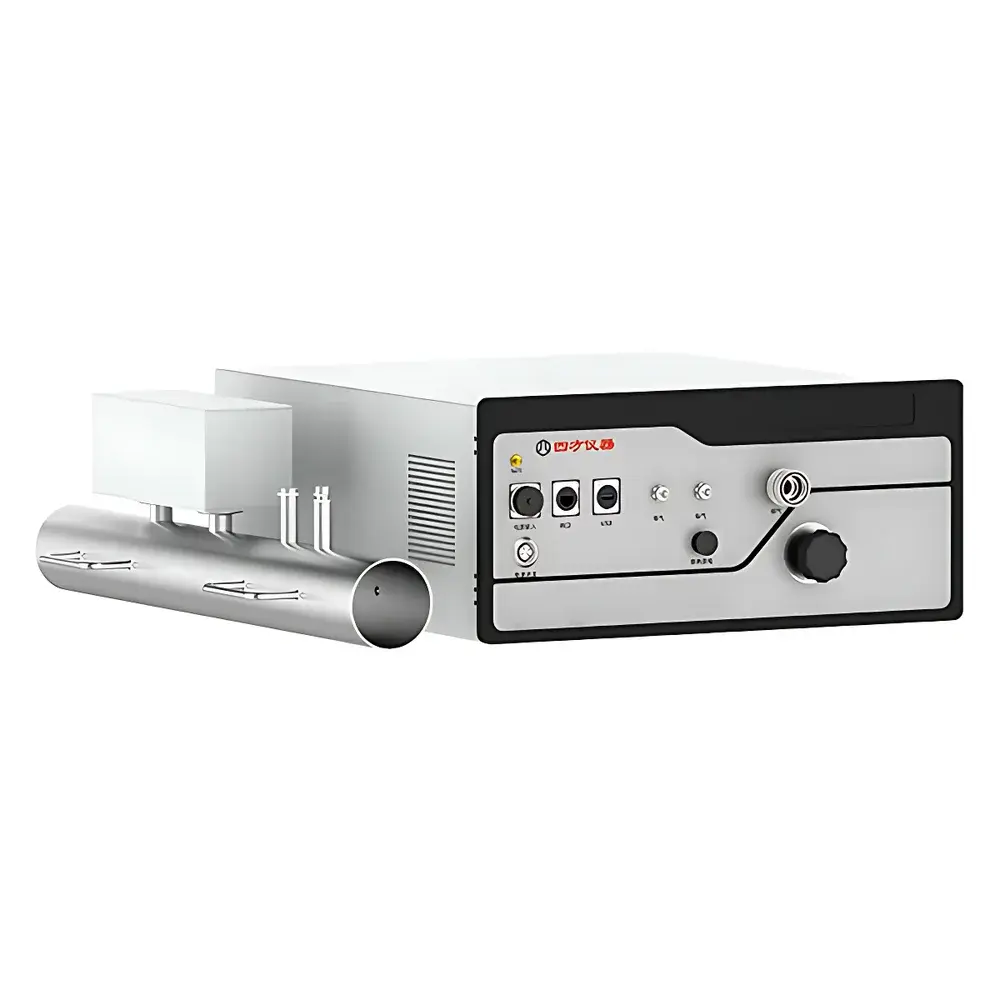
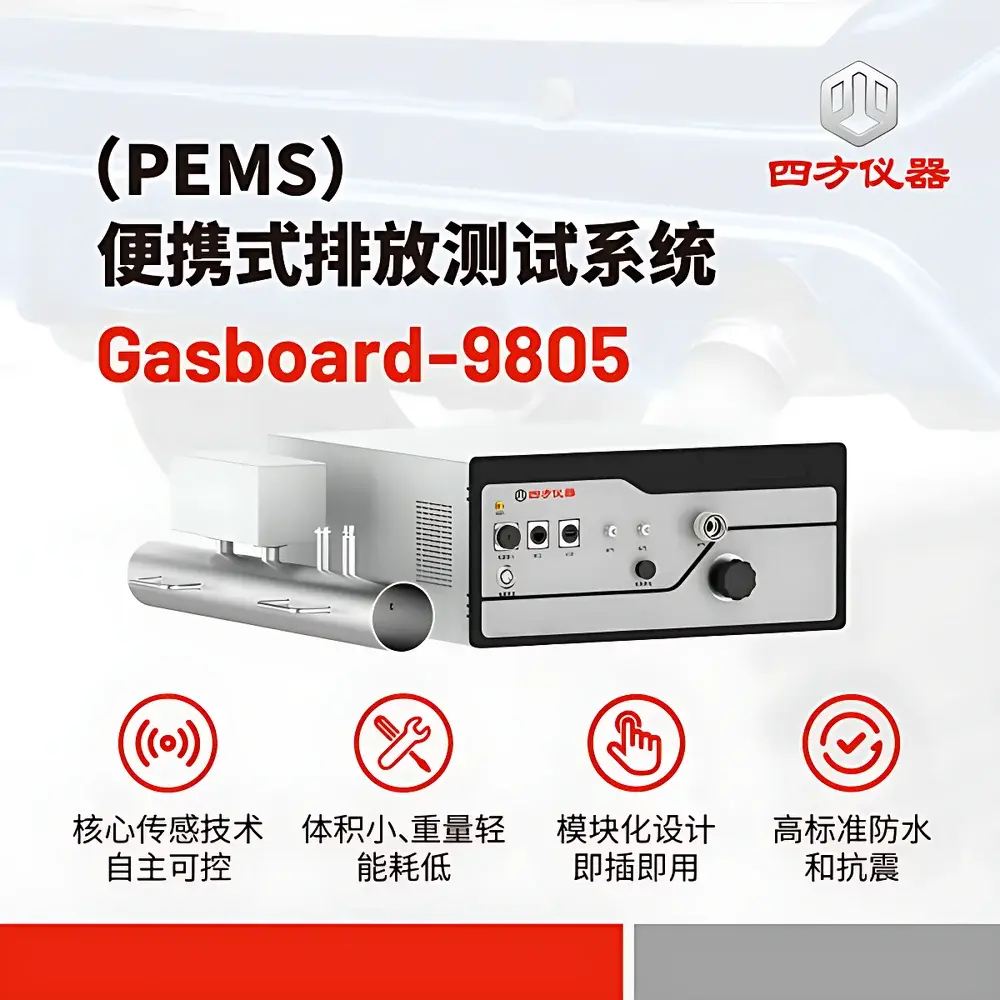
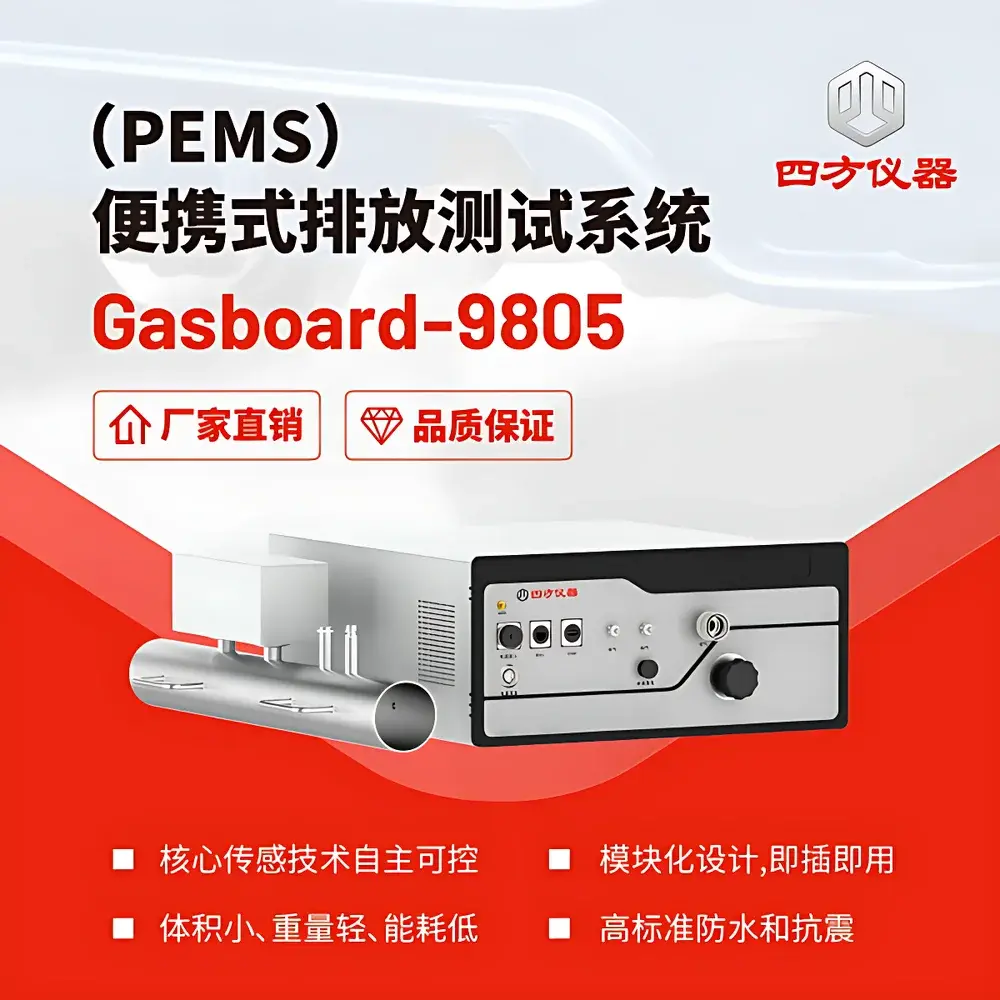
CUBIC INSTRUMENTS Gasboard-9805 Portable Real-Driving Emissions (RDE) Measurement System
| Brand | CUBIC INSTRUMENTS |
|---|---|
| Origin | Hubei, China |
| Model | Gasboard-9805* |
| Instrument Type | Portable |
| Measurement Principles | NDIR (CO, CO₂), NDUV (NO, NO₂), HFID (THC), Corona Discharge CPC (PN), Electrochemical/NDIR (NH₃/N₂O) |
| Measured Gases | CO, CO₂, NO, NO₂, NOₓ, O₂, THC, NH₃, N₂O, PN (≥10 nm or ≥23 nm) |
| Max. Permissible Error | ≤±2.0% of Reading Span (RS) or ≤±0.3% of Full Scale (FS) |
| Zero Drift | ≤±1% FS / 8 h |
| Span Drift | ≤±1% FS / 8 h |
| Repeatability | ≤±0.5% FS |
| Operating Temperature | −10 to +45 °C |
| Relative Humidity | ≤90% RH |
| Altitude Range | 0–3000 m |
| Exhaust Flow Range | 10–600 kg/h or 100–2000 kg/h |
| Exhaust Temp. Range | −5 to +500 °C |
| Battery Life | >8 h (Li-ion) |
Overview
The CUBIC INSTRUMENTS Gasboard-9805 is a fully integrated, portable real-driving emissions (RDE) measurement system engineered for regulatory-compliant on-road testing of light- and heavy-duty vehicles. It implements a multi-sensor architecture grounded in internationally recognized analytical principles: non-dispersive infrared (NDIR) spectroscopy for CO and CO₂; non-dispersive ultraviolet (NDUV) absorption for NO and NO₂; flame ionization detection (HFID) calibrated to carbon-equivalent units for total hydrocarbons (THC); electrochemical or tunable diode laser-based detection for NH₃ and N₂O; and corona discharge-based condensation particle counting (CPC) for particulate number (PN) concentration with selectable lower detection limits (10 nm or 23 nm). The system simultaneously acquires exhaust gas concentrations, exhaust mass flow (via heated thermal mass flowmeter), exhaust temperature, GPS-derived vehicle kinematics (speed, acceleration, altitude), ambient meteorological parameters (pressure, temperature, humidity), and standardized OBD-II data streams. Designed to meet the technical requirements of UN Regulation No. 83, EU Commission Regulation (EU) 2016/427, 2016/646, and 2017/1151—as well as EPA 40 CFR Part 1065 and ISO 20884—the Gasboard-9805 supports both certification-grade RDE testing and in-use conformity monitoring under real-world driving conditions.
Key Features
- Modular, plug-and-play architecture enabling rapid configuration for diverse test protocols—including WLTC, US06, SC03, and custom drive cycles—without hardware rework.
- Robust mechanical design certified to IP65 ingress protection and MIL-STD-810G shock/vibration standards, ensuring metrological stability across extreme road conditions, temperature gradients, and high-humidity environments.
- Integrated lithium-ion power system delivering ≥8 hours of continuous operation at full sensor load, with hot-swappable battery modules and optional vehicle DC input (12/24 V).
- Onboard real-time calculation engine compliant with RDE data evaluation logic: calculates cumulative mass emissions (g/km), identifies cold-start and hot-start phases, applies boundary conditions (e.g., speed, gradient, ambient temperature), and flags invalid segments per regulatory thresholds.
- Fully autonomous calibration verification: built-in zero/span check routines using certified reference gases (optional onboard gas cylinder module), traceable to NIST or PTB standards.
- Embedded touchscreen HMI with guided workflow interface—supporting pre-test setup, live parameter visualization, automatic fault logging, and post-test report generation in PDF/CSV formats aligned with EU RDE Annex VIII and EPA RDE reporting templates.
Sample Compatibility & Compliance
The Gasboard-9805 is validated for use with gasoline, diesel, LPG, CNG, and hybrid powertrains meeting Euro 6d, China 6b, and Tier 3 emission standards. Its exhaust sampling system employs heated sample lines (maintained at ≥190 °C) and a heated probe to prevent condensation and adsorption losses of semi-volatile compounds (e.g., ammonium nitrate, organic aerosols). All gas analyzers undergo periodic verification against certified calibration gases per ISO 17025-accredited procedures. The system’s software architecture supports audit trails, electronic signatures, and data integrity controls aligned with FDA 21 CFR Part 11 and EU Annex 11 requirements for regulated environmental testing. Hardware and firmware comply with CE marking directives (EMC 2014/30/EU, RoHS 2011/65/EU), and its measurement uncertainty budget has been characterized per ISO/IEC Guide 98-3 (GUM) for all primary pollutants.
Software & Data Management
The proprietary RDE-Studio software suite provides end-to-end data lifecycle management—from test planning and vehicle parameter mapping to post-processing, statistical validation, and regulatory submission. Raw time-series data (10 Hz resolution minimum) are stored in HDF5 format with embedded metadata (GPS timestamps, sensor status flags, calibration history). The software implements automated drift correction algorithms using concurrent zero/span measurements and applies temperature/pressure compensation per ISO 20884 Annex D. Export modules generate compliant reports including: (i) trip summary tables with distance-weighted g/km results; (ii) second-by-second emissions profiles synchronized with GPS trajectory maps; (iii) statistical summaries of CO₂-specific fuel consumption and pollutant correlation matrices. All data exports include digital signatures and immutable hash verification to satisfy GLP/GMP audit requirements.
Applications
- Regulatory RDE certification testing for type approval under EU, U.S., Chinese, Indian, and South Korean vehicle emission frameworks.
- In-use compliance verification for fleet operators, national inspection programs, and roadside enforcement agencies.
- Powertrain development and aftertreatment system optimization—enabling correlation of catalyst light-off behavior, SCR ammonia slip, DPF regeneration events, and GPF filtration efficiency with dynamic driving inputs.
- Urban air quality studies linking vehicle-specific emission factors to traffic microenvironments using georeferenced RDE datasets.
- Validation of remote sensing device (RSD) measurements through co-located mobile platform comparisons.
- Academic research on real-world NOₓ/PM trade-offs, cold-start VOC speciation, and low-speed urban cycle emissions gaps.
FAQ
What regulatory standards does the Gasboard-9805 directly support?
It meets the technical specifications of UN R83, EU 2016/427, 2016/646, 2017/1151, EPA 40 CFR Part 1065, ISO 20884, and China GB 18352.6–2016 for RDE testing.
Can the system measure both gaseous pollutants and particulate number in a single run?
Yes—simultaneous acquisition of CO, CO₂, NOₓ, O₂, THC, NH₃, N₂O, and PN (with 10 nm or 23 nm cutoff) is performed with time-synchronized sampling and unified data timestamping.
Is the exhaust flow measurement traceable to national standards?
The thermal mass flowmeter is factory-calibrated using NIST-traceable gravimetric flow standards and includes in-field verification capability via built-in pressure/temperature compensation algorithms per ISO 5167.
How is data security and integrity ensured during field deployment?
All measurements are cryptographically signed at acquisition; audit logs record user actions, calibration events, and system faults; data export packages include SHA-256 checksums and digital certificates compliant with IEC 62443-3-3.
Does the system support third-party integration with vehicle CAN bus networks?
Yes—it features dual CAN 2.0B interfaces supporting SAE J1939, ISO 15765, and OEM-specific protocols for direct OBD-II and powertrain controller data ingestion without external gateways.
Related Products







