
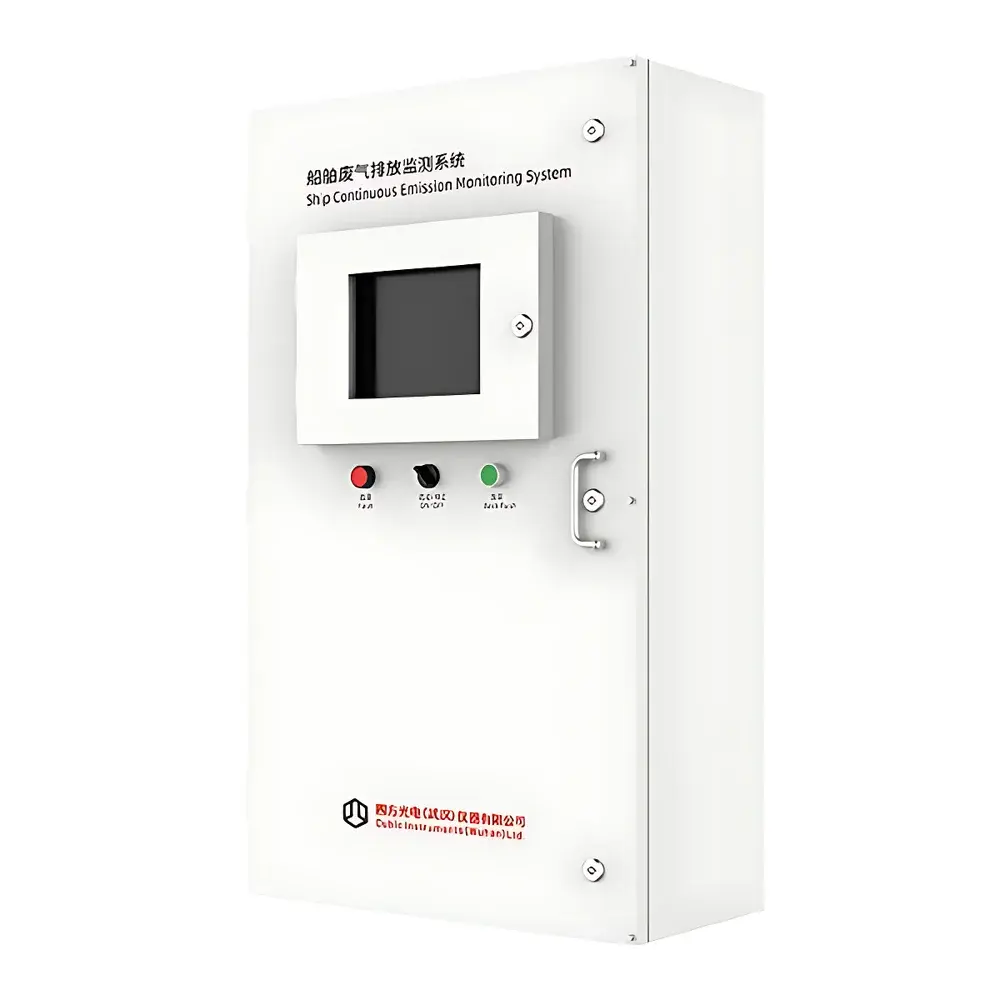


CUBIC INSTRUMENTS Gasboard-9085 Marine Exhaust Emission Monitoring System
| Brand | CUBIC INSTRUMENTS |
|---|---|
| Origin | Hubei, China |
| Model | Gasboard-9085 |
| Principle | UV-DOAS / NDIR / ECD / CIDR |
| Type | Online Continuous Emission Monitoring System (CEMS) |
| Measurement Range | SO₂: 0–500 ppm |
| NO | 0–1000 ppm |
| CO | 0–10000 ppm |
| CO₂ | 0–25% vol |
| HC | 0–10000 ppm |
| O₂ | 0–25% vol |
| Response Time | ≤30 s |
| Accuracy | ±2% F.S. |
| Zero/Full-Scale Drift | ≤2% F.S./24 h |
| Repeatability | SO₂, CO₂, CH₄, N₂O, HC, O₂ |
| Sample Flow Rate | 6 L/min |
| Dew Point Output | ≤5 °C |
| Filtration | 5 µm → 0.1 µm dual-stage particulate filtration |
| Compliance | MARPOL Annex VI, GB 15097–2016, GD01–2011 |
Overview
The CUBIC INSTRUMENTS Gasboard-9085 Marine Exhaust Emission Monitoring System is an integrated, rack-mounted continuous emission monitoring system (CEMS) engineered for real-time, multi-component gas analysis of marine diesel engine exhaust streams. It operates on a hybrid optical and electrochemical detection architecture: UV Differential Optical Absorption Spectroscopy (UV-DOAS) for SO₂ and NO; Non-Dispersive Infrared (NDIR) spectroscopy for CO₂, CO, and hydrocarbons (HC); Electrochemical Detection (ECD) for O₂; and optionally, Catalytic Infrared (CIDR) for enhanced HC speciation. Designed to meet the stringent environmental compliance requirements of international maritime operations, the system delivers trace-level quantification under dynamic operational conditions—including vessel motion, ambient temperature fluctuations up to 55 °C, and relative humidity exceeding 95% RH. Its modular architecture supports both single-point and multi-point cyclic sampling configurations, enabling simultaneous monitoring across main engines, auxiliary generators, and exhaust gas cleaning systems (EGCS).
Key Features
- Robust pre-conditioning subsystem: Integrated KNF diaphragm sampling pump (6 L/min flow rate), TF3000 particulate filter (5 µm), dual-pump electronic condenser (dew point ≤5 °C), and sub-micron final filter (0.1 µm) ensure consistent sample integrity in high-humidity, high-particulate marine exhaust environments.
- Distributed control architecture: Industrial-grade OMRON PLC core with fail-safe relay logic automates sample acquisition, condensate drainage, fault diagnostics, and calibration sequence execution—minimizing manual intervention and ensuring 24/7 unattended operation.
- Multi-technology gas analysis module: Independently configurable sensor bays accommodate UV-DOAS, NDIR, ECD, and optional CIDR analyzers—enabling flexible deployment for regulatory reporting (e.g., SO₂/NOₓ ratio tracking) or process optimization (e.g., combustion efficiency via O₂/CO correlation).
- Environmental resilience: IP65-rated enclosure, vibration-damped mounting, and thermal management design comply with IEC 60945 marine equipment standards for installation in engine rooms, funnel casings, or deck-mounted enclosures.
- Interoperable data interface: RS485 (Modbus RTU), 4–20 mA analog outputs, Ethernet (TCP/IP), and optional wireless LTE support seamless integration into shipboard automation systems (e.g., Class-approved CMS platforms) and shore-side data lakes.
Sample Compatibility & Compliance
The Gasboard-9085 is validated for direct measurement of hot, wet, and particulate-laden exhaust gases from low-speed two-stroke and medium-speed four-stroke marine diesel engines operating on heavy fuel oil (HFO), marine diesel oil (MDO), or LNG. All gas measurement channels are calibrated per ISO 12039 (SO₂/NOₓ), ISO 4037 (CO/CO₂), and EN 50104 (O₂). The system satisfies mandatory verification criteria under MARPOL Annex VI Regulation 13 and Regulation 14, as well as Chinese national standard GB 15097–2016 and China Classification Society guideline GD01–2011. Data logging meets IMO MEPC.259(67) requirements for minimum 30-day storage with tamper-proof timestamps, and audit trails comply with GLP-aligned record retention protocols.
Software & Data Management
The embedded CEMS Control Suite provides browser-based configuration, real-time trend visualization, alarm management (threshold, rate-of-change, and fault-state triggers), and automated report generation (hourly/daily/weekly summaries compliant with IMO DCS format). Raw sensor outputs and diagnostic logs are stored locally on industrial-grade SD card (≥32 GB) with write-cycle redundancy. Optional cloud synchronization enables remote firmware updates, cross-vessel fleet analytics, and third-party verification via secure API endpoints. All data handling conforms to IEC 62443-3-3 cybersecurity principles, and audit logs capture user actions, calibration events, and system reboots in alignment with ISO/IEC 17025 traceability requirements.
Applications
- Regulatory compliance monitoring for Tier III NOₓ and EEDI/EEXI reporting on vessels operating in ECAs and NECA zones.
- Performance validation of selective catalytic reduction (SCR) and exhaust gas recirculation (EGR) systems.
- Real-time combustion efficiency assessment via O₂–CO–CO₂ stoichiometric correlation during load transitions.
- Post-treatment verification for scrubber systems (wet/dry/hybrid), including SO₂ removal efficiency calculation and slurry pH correlation.
- Onboard R&D for alternative fuels (LNG, methanol, ammonia), supporting emissions factor derivation under IMO GHG Strategy pathways.
FAQ
Does the Gasboard-9085 support remote calibration and zero/span verification?
Yes—via Modbus or web interface, users can initiate automated zero-air and span-gas sequences using onboard solenoid valves and certified reference gases (ISO 6141-compliant). Calibration logs include operator ID, gas certificate number, and uncertainty budget.
Is the system certified for use on class-approved vessels?
The Gasboard-9085 has undergone type approval testing per IEC 60092-201 (marine electrical equipment) and holds preliminary acceptance documentation from CCS, DNV, and LR for integration into Class-certified monitoring architectures.
Can it measure NH₃ slip from SCR systems?
NH₃ is not part of the standard configuration, but the UV-DOAS module can be factory-upgraded to include 190–220 nm spectral range for NH₃ detection at sub-ppm levels upon request.
What maintenance intervals are recommended for the pre-conditioning unit?
TF3000 filter replacement every 3 months; electronic condenser maintenance (pump tubing, coolant refill) every 6 months; 0.1 µm final filter replacement every 2 months under continuous HFO operation.
How does the system handle interference from H₂O vapor and CO₂ cross-sensitivity in NO measurement?
UV-DOAS employs multi-wavelength fitting algorithms with H₂O and CO₂ spectral compensation libraries, validated per ASTM D6522–22 for matrix robustness in high-CO₂ exhaust streams (up to 18% vol).
Related Products







