
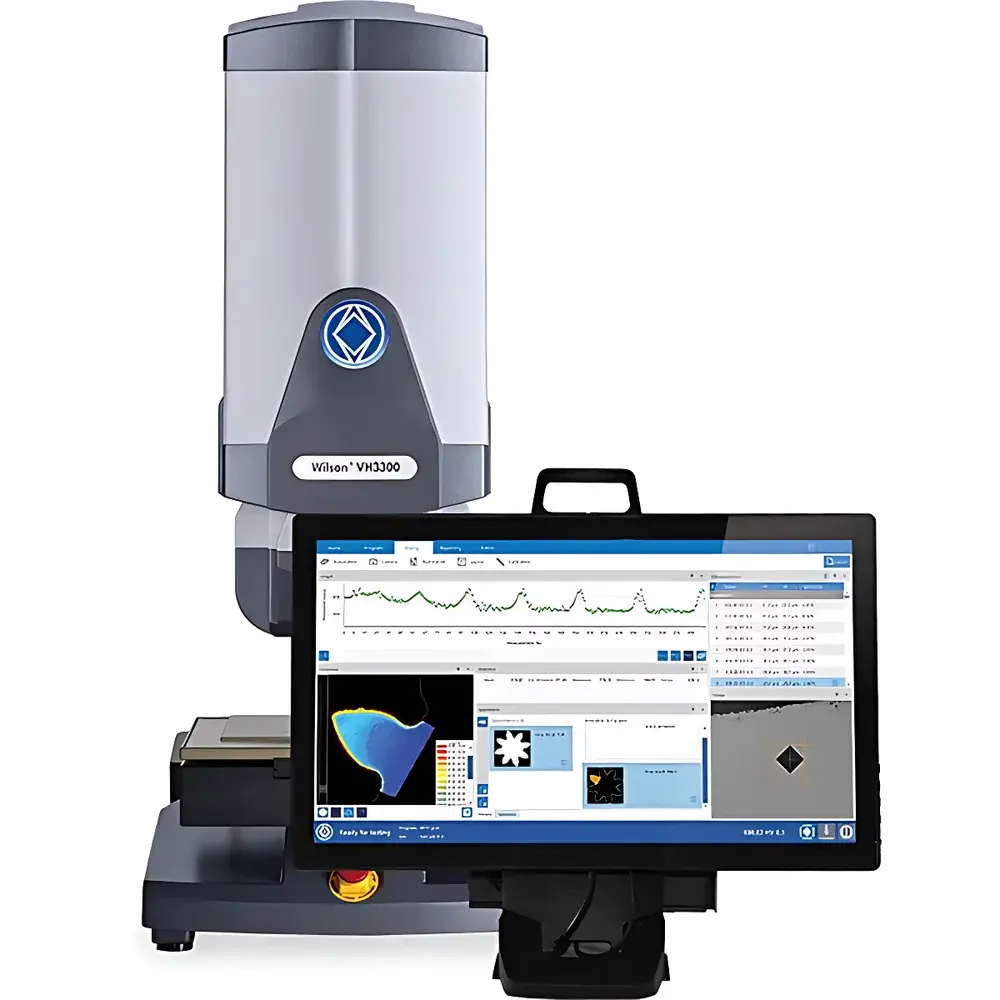
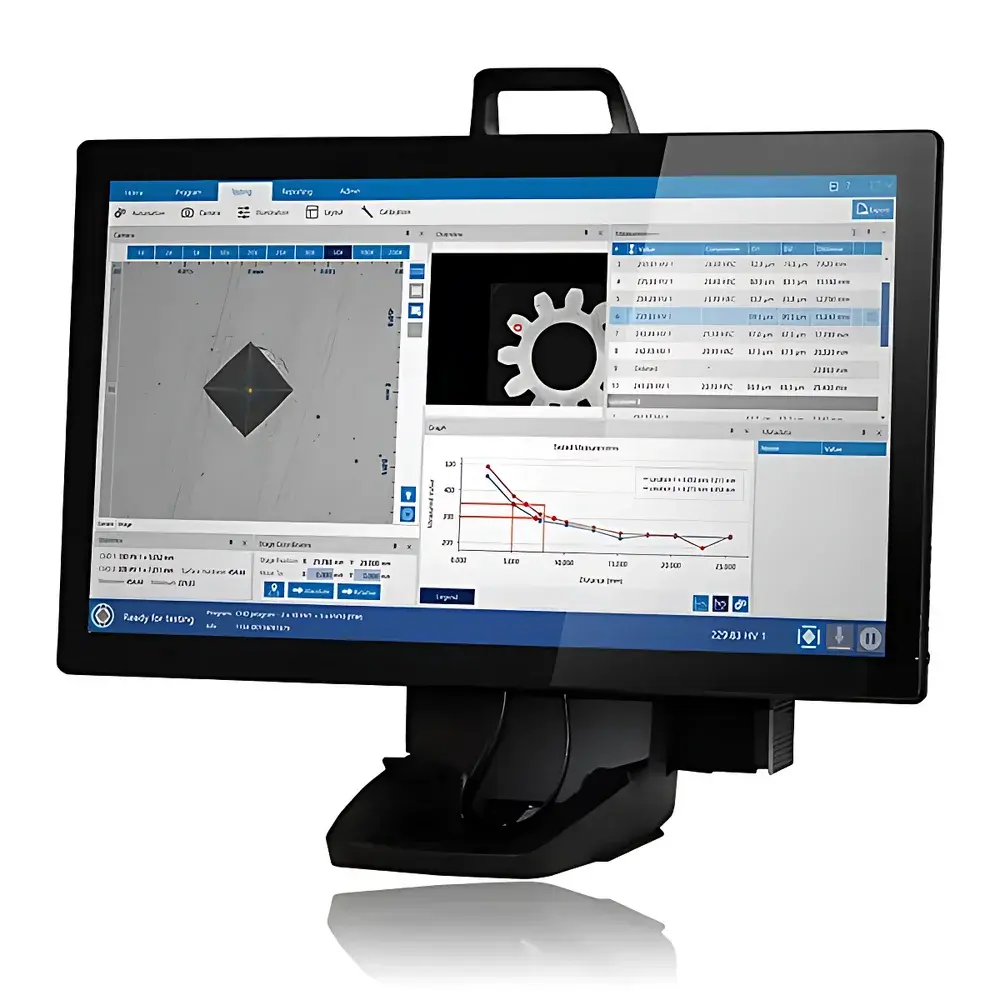
Wilson DiaMet Hardness Testing Software
| Brand | Wilson Hardness |
|---|---|
| Origin | Germany |
| Manufacturer Type | Manufacturer |
| Origin Category | Imported |
| Model | Wilson DiaMet |
| Instrument Type | Vickers Hardness Tester |
| Hardness Scales Supported | Vickers, Knoop, Brinell (hardware-dependent) |
| Compatible Hardware | Wilson VH3100, Wilson VH3300 (introduced 2015) |
| Focus Mode | Auto-focus with manual override |
| Illumination Control | Automatic and manual adjustment |
| Measurement Modes | Manual or fully automated indentation analysis |
| Specimen Stage Control | Automated positioning for CHD, line, circle, matrix, and custom multi-sample protocols |
| Multi-Specimen Capability | Yes, concurrent testing of multiple specimens |
| Panoramic Imaging | Supported only with panoramic objective lens |
| Data Export Formats | Printer, PDF, Excel |
| Touch Interface | Optimized capacitive touchscreen UI |
Overview
Wilson DiaMet is a purpose-built hardness testing software platform engineered for precision, repeatability, and operational efficiency in metallurgical and materials quality control laboratories. Designed exclusively for integration with Wilson’s automated microhardness testers—including the VH3100 and VH3300 series—the software implements a deterministic image-based measurement architecture grounded in ISO 6507-1 (Vickers), ISO 4545-1 (Knoop), and ISO 6506-1 (Brinell) metrological frameworks. It leverages high-resolution digital imaging, real-time contrast optimization, and sub-pixel edge detection algorithms to quantify indentation geometry under standardized load dwell times and optical magnifications. The system operates within a closed-loop control environment where stage positioning, illumination intensity, focus validation, and indentation analysis are coordinated to minimize operator dependency and inter-test variability—critical for GLP-compliant reporting and audit-ready data integrity.
Key Features
- Four-Click Test Execution: A streamlined workflow reduces test initiation to four intuitive touchscreen interactions—load specimen, select test method, define parameters, and execute—eliminating complex menu navigation and reducing training time for new operators.
- Sub-5-Second Auto-Focus & Measurement Cycle: Proprietary autofocus convergence logic combined with parallelized image acquisition and real-time centroid calculation achieves full indentation detection and hardness calculation in ≤5 seconds per indent, significantly accelerating throughput in high-volume QC environments.
- Collision-Avoidance Protocol: Integrated position-sensing feedback from Z-axis encoders and dynamic load-cell monitoring prevents mechanical contact between indenter tip and objective lens or specimen surface during approach, protecting both consumables and optics while minimizing unscheduled maintenance.
- Adaptive Illumination Engine: Software-controlled LED intensity modulation responds to specimen reflectivity and surface finish in real time, ensuring optimal contrast across diverse materials—from polished steel to as-cast aluminum—without manual recalibration.
- Touch-Optimized Human-Machine Interface: A responsive, gesture-aware 10.1″ capacitive touchscreen interface features scalable icons, haptic feedback on critical actions, and context-sensitive soft keys aligned with ASTM E384 and ISO 1463 workflows.
Sample Compatibility & Compliance
Wilson DiaMet supports standardized hardness testing across metallic alloys, ceramics, thin films, and coated substrates. Its measurement algorithms comply with traceable calibration requirements defined in ISO/IEC 17025-accredited laboratories. All hardness values are reported with uncertainty budgets calculated per GUM (Guide to the Expression of Uncertainty in Measurement) principles. The software enforces mandatory parameter logging—including test force, dwell time, magnification, and environmental temperature—for full compliance with FDA 21 CFR Part 11 when deployed in regulated pharmaceutical or medical device manufacturing settings. Audit trails record user identity, timestamp, parameter changes, and result modifications with immutable cryptographic hashing.
Software & Data Management
Data management follows a hierarchical structure: raw images, calibrated force/distance metadata, and final hardness values are stored in an encrypted SQLite database with configurable retention policies. Export modules generate ANSI/A4-compliant PDF reports containing annotated indentation images, statistical summaries (mean, SD, CV%), and pass/fail status against user-defined specification limits. Excel exports preserve all metadata fields—including individual indent coordinates and measurement confidence scores—for downstream SPC analysis using Minitab or JMP. Optional network deployment enables centralized license management and remote firmware/software updates via HTTPS-secured channels.
Applications
Wilson DiaMet is routinely deployed in aerospace component verification (e.g., turbine blade case-hardened layers), automotive powertrain material qualification (gear tooth case depth profiling), semiconductor packaging intermetallic layer assessment, and biomedical implant coating adhesion validation. Its CHD (Case Hardness Depth) module generates continuous hardness gradients along linear traverses with interpolation resolution down to 1 µm, supporting EN 10365 and ASTM E92 cross-sectional analysis requirements. Matrix and circular array protocols facilitate grain-scale heterogeneity mapping in duplex stainless steels and additively manufactured Ti-6Al-4V parts.
FAQ
Is Wilson DiaMet compatible with non-Wilson hardware platforms?
No. DiaMet is a proprietary software suite certified exclusively for use with Wilson VH3100 and VH3300 microhardness testers.
Does the software support multi-user role-based access control?
Yes. Administrators can assign roles (Operator, Supervisor, QA Auditor) with granular permissions for test execution, report generation, parameter editing, and audit trail review.
Can panoramic stitching be performed without a dedicated panoramic objective?
No. Panoramic scanning and image mosaic generation require the optional 2× panoramic objective lens; standard 10×–100× objectives do not support this feature.
How is measurement repeatability validated during software installation?
A NIST-traceable reference block (e.g., Wilson Standard SRM 2820) is used to perform a 10-indent repeatability study; results must meet ≤2% coefficient of variation per ASTM E10 and ISO 6507-2 criteria before system release.
Is offline data analysis possible after export?
Yes. Raw image files (.tiff) and structured metadata (.csv) retain full geometric and illumination parameters, enabling retrospective reanalysis using third-party image processing tools without loss of metrological context.



