
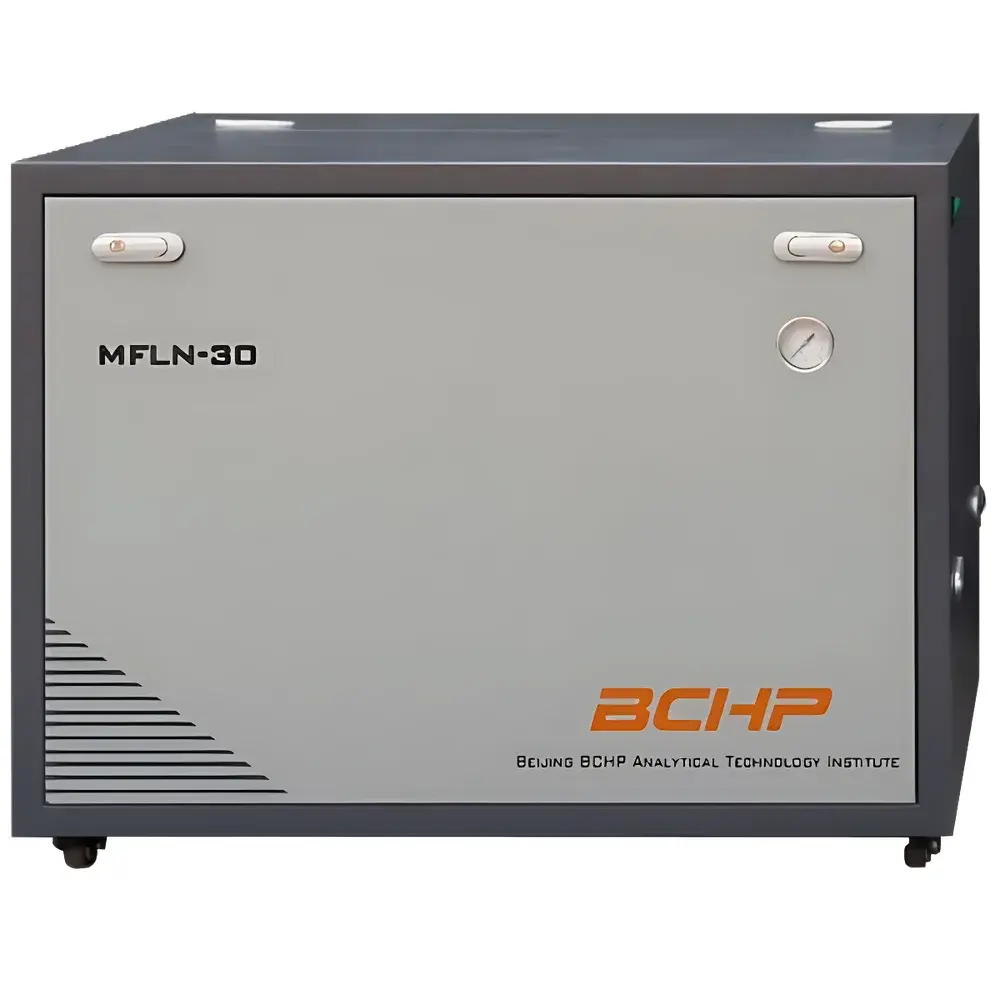
Zhonghuipu MFLN-30 Membrane-Based Nitrogen Generator for LC/MS Applications
| Brand | Zhonghuipu |
|---|---|
| Origin | Beijing, China |
| Manufacturer Type | Direct Manufacturer |
| Instrument Type | Nitrogen Generator |
| Nitrogen Generation Principle | Hollow-Fiber Membrane Separation |
| Output Flow Rate | 35 L/min @ 100 psi (customizable up to 60 L/min) |
| Output Pressure | 100 psi |
| Nitrogen Purity | Up to 99.5% |
| Dew Point | < −55 °C |
| Particulate Filtration | < 0.01 µm |
| Oil & Moisture Carryover | None |
| Phthalate-Free | Yes |
| Noise Level | < 55 dB(A) |
| Power Supply | 220 V / 50 Hz, 6 A |
| Dimensions (L×W×H) | 90 × 60 × 70 cm |
| Weight | 110 kg |
| Interface | Φ6 mm push-to-connect fitting (field-replaceable) |
Overview
The Zhonghuipu MFLN-30 is a dedicated membrane-based nitrogen generator engineered for continuous, on-demand supply of high-purity nitrogen gas to liquid chromatography–mass spectrometry (LC/MS) systems. It employs hollow-fiber membrane separation technology—where compressed air is passed across asymmetric polymeric membranes that selectively permeate oxygen, water vapor, CO₂, and other trace gases while retaining nitrogen molecules—to deliver a stable, dry, and chemically inert nitrogen stream. Unlike pressure swing adsorption (PSA) systems, the MFLN-30 offers inherently pulse-free flow, minimal maintenance intervals, and no need for regeneration cycles or valve sequencing, making it ideal for integration with sensitive electrospray ionization (ESI) and atmospheric pressure chemical ionization (APCI) sources requiring consistent gas quality and pressure stability. Its design prioritizes operational continuity, meeting the 24/7 uptime expectations of high-throughput analytical laboratories operating under GLP or regulated QC environments.
Key Features
- Robust dual-stage compression architecture utilizing two Thomas 2755 high-pressure oil-free compressors—certified for laboratory-grade reliability and extended service life.
- Hollow-fiber membrane modules sourced from UBE (Japan) or AIRRANE (South Korea), delivering nitrogen purity up to 99.5% at reduced flow rates (e.g., ≤25 L/min), with stable ≥99.0% purity maintained across the full 35 L/min nominal output range.
- Multi-stage filtration system including coalescing pre-filters, activated carbon beds, and a final SMC (Japan) ultra-fine particulate filter (<0.01 µm) ensuring removal of aerosols, hydrocarbons, and submicron contaminants.
- Integrated dew point suppression achieving < −55 °C (measured per ISO 8573-1:2010 Class 2.2.1), eliminating condensation risk in mass spec interface lines and preventing detector drift.
- Passive acoustic isolation housing and vibration-dampened mounting minimize operational noise to <55 dB(A) at 1 m—compliant with ISO 7779 and suitable for shared lab spaces.
- Modular aluminum-alloy pressure vessels (weld-free construction) for air receiver and buffer tanks, resistant to internal corrosion and compliant with ASME BPVC Section VIII Div. 1 design principles.
- Front-access service layout with standardized consumables (coalescer cartridges, carbon filters, membrane modules) enabling field replacement in <15 minutes without specialized tools.
Sample Compatibility & Compliance
The MFLN-30 is validated for use with all major LC/MS platforms requiring nitrogen as nebulizing, drying, or collision gas—including Thermo Fisher Scientific TSQ series, Waters Xevo TQ-S, Agilent 6470/6495, and Shimadzu LCMS-8060 systems. Its output meets ASTM D6352–22 specifications for instrument-grade nitrogen and satisfies critical requirements outlined in USP Analytical Instrument Qualification for gas supply subsystems. The absence of phthalates, lubricants, and residual moisture ensures compatibility with ICH Q5C biopharmaceutical stability testing protocols and supports FDA 21 CFR Part 11–compliant data integrity when paired with validated LC/MS software. All electrical components conform to IEC 61010-1:2012 safety standards for laboratory equipment.
Software & Data Management
While the MFLN-30 operates as a standalone hardware unit with no embedded microcontroller or digital interface, its analog monitoring outputs (4–20 mA pressure and flow signals) are compatible with third-party building management systems (BMS) or lab-wide environmental monitoring platforms (e.g., Siemens Desigo, Emerson DeltaV). Optional analog-to-digital conversion modules enable integration into ELN/LIMS workflows for automated gas usage logging, preventive maintenance scheduling, and audit-ready calibration records—supporting GLP/GMP traceability requirements. All mechanical setpoints (e.g., outlet pressure regulation, thermal cutoff thresholds) are manually calibrated using NIST-traceable gauges during IQ/OQ qualification.
Applications
- LC/MS mobile phase nebulization and desolvation in pharmaceutical impurity profiling and pharmacokinetic studies.
- Collision-induced dissociation (CID) gas supply in tandem MS (MS/MS) acquisition methods.
- Gas chromatography–mass spectrometry (GC/MS) auxiliary make-up gas for electron capture detectors (ECD).
- Blank solvent purging and system equilibration in high-resolution mass spectrometry (HRMS) workflows.
- Long-term unattended operation in central utility rooms serving multiple LC/MS bays within core analytical facilities.
FAQ
What is the expected lifetime of the hollow-fiber membrane module under continuous operation?
Typical service life exceeds 15,000 hours (≈1.7 years at 24/7 duty cycle) when inlet air meets ISO 8573-1 Class 2.2.2 specifications (dew point ≤ −40 °C, ≤0.1 ppm oil aerosol). Replacement intervals are verified via periodic purity monitoring using inline electrochemical sensors.
Can the MFLN-30 be integrated with an existing lab air compressor system?
Yes—the unit accepts clean, dry, oil-free compressed air input (6–10 bar, ISO 8573-1 Class 1.2.1 recommended). Integration requires a dedicated pressure-regulated feed line with coalescing pre-filtration; Zhonghuipu provides interface schematics and commissioning support.
Does the generator require annual recalibration?
No scheduled recalibration is required. However, users must perform semi-annual verification of outlet purity (via handheld Zirconia O₂ analyzer) and dew point (using chilled-mirror hygrometer) as part of routine PQ documentation per ISO/IEC 17025.
Is the MFLN-30 compatible with nitrogen-sensitive detectors such as ECD or NPD?
Yes—its < −55 °C dew point, <0.01 µm particulate retention, and confirmed phthalate-free output meet the stringent gas quality thresholds specified in ASTM D4057 and EPA Method 8270 for electron-capture detection.



