
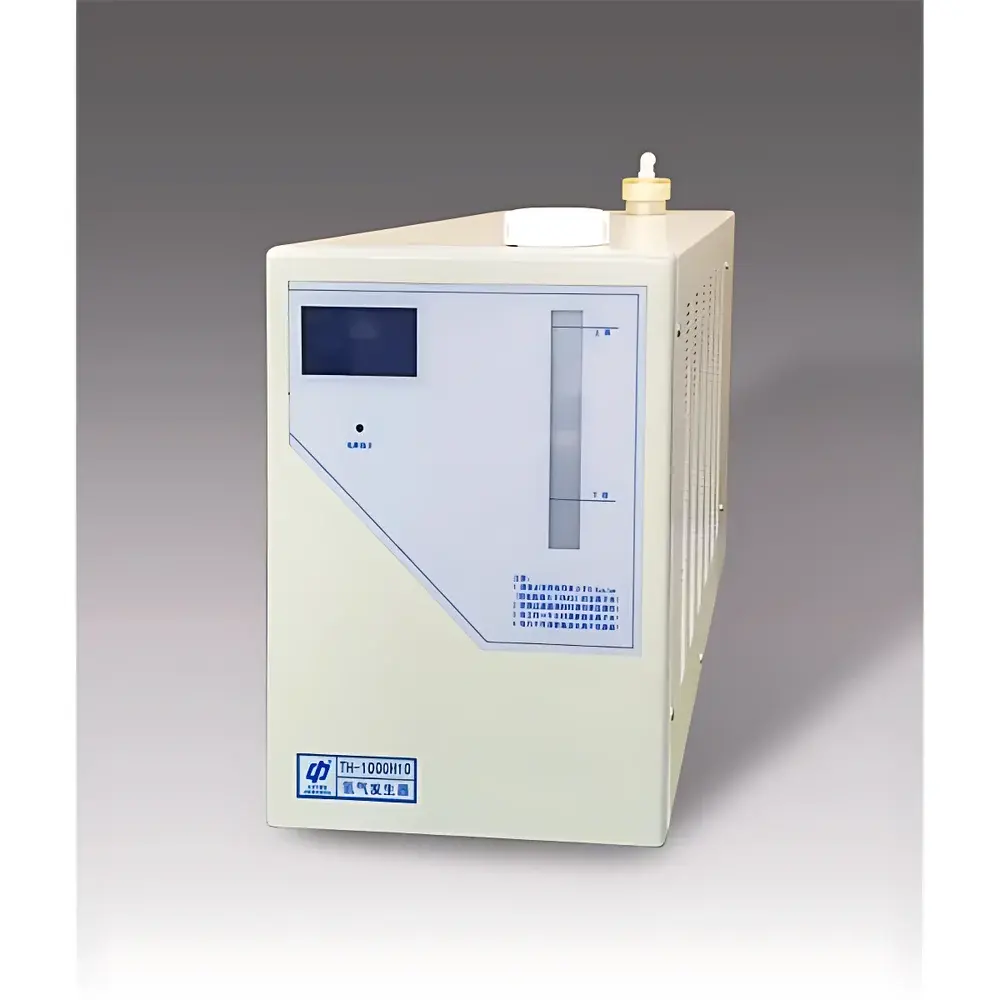
Zhonghuipu TH-1000H10 High-Pressure Hydrogen Generator
| Brand | Zhonghuipu |
|---|---|
| Origin | Beijing, China |
| Manufacturer Type | Direct Manufacturer |
| Model | TH-1000H10 |
| Hydrogen Generation Principle | Pure Water Electrolysis via SPE Membrane |
| Output Flow Rate | 0–1000 mL/min |
| Output Pressure | 0–10 MPa (100 kg/cm²) |
| Hydrogen Purity | 99.999% |
| Power Consumption | 450 W |
| Dimensions (W×D×H) | 550 × 245 × 400 mm |
| Net Weight | ~30 kg |
| Pressure Stability | < 0.01 MPa |
| Input Power | 220 V ±10%, 50 Hz |
| Certifications | CE |
Overview
The Zhonghuipu TH-1000H10 High-Pressure Hydrogen Generator is an engineered solution for laboratories requiring on-demand, ultra-high-purity hydrogen gas at elevated pressures—up to 10 MPa (100 kg/cm²)—without reliance on compressed gas cylinders. It employs solid polymer electrolyte (SPE) membrane technology to perform pure water electrolysis, eliminating the need for caustic potassium hydroxide (KOH) or sodium hydroxide (NaOH) solutions. This electrochemical process generates hydrogen directly from deionized water with high current efficiency and minimal maintenance overhead. The system is designed for continuous, unattended operation in analytical, catalytic, and high-pressure synthesis applications where gas purity, pressure stability, and operational safety are critical. Its CE-marked architecture complies with essential health, safety, and environmental protection requirements under EU Directive 2014/30/EU (EMC) and 2014/35/EU (LVD).
Key Features
- SPE-based proton exchange membrane electrolysis using ultra-pure deionized water—no alkaline electrolytes required.
- Integrated pressure regulation and flow control enabling precise, real-time adjustment across the full 0–1000 mL/min range.
- Stainless-steel construction for all wetted components—including gas–water separators, particulate filters, and pressure vessels—to ensure compatibility with high-pressure hydrogen and long-term corrosion resistance.
- Low-sulfur silicone O-rings and fluoropolymer-sealed valves minimize trace sulfur contamination, supporting stringent purity requirements for GC carrier gas and catalytic feedstock applications.
- Automated water-level monitoring with fail-safe shutdown logic to prevent dry-electrolysis damage and extend membrane lifetime beyond 8,000 operating hours.
- Pressure stability maintained within ±0.01 MPa under dynamic load conditions, verified per ISO 8573-1:2010 Class 1 for gaseous contaminants.
- Compact footprint (550 × 245 × 400 mm) and integrated casters support flexible benchtop integration in fume hoods or controlled-environment labs.
Sample Compatibility & Compliance
The TH-1000H10 delivers hydrogen meeting ISO 8573-1:2010 Class 1 specifications for particle, moisture, and oil content—critical for sensitive instrumentation such as gas chromatographs (GC), hydrogenation reactors, and fuel cell test stations. Its 99.999% purity level satisfies ASTM D7622-21 requirements for high-purity hydrogen used in trace-level analysis and semiconductor-grade process gas supply. All internal materials comply with USP Class VI biocompatibility standards, and the system supports GLP/GMP documentation workflows through optional audit-trail logging modules. Pressure vessel design adheres to PED 2014/68/EU Annex I essential safety requirements for Group 1 fluids (hydrogen, Category IV).
Software & Data Management
While the base TH-1000H10 operates via front-panel digital interface with LED status indicators and tactile push-button controls, it supports RS-232 and optional Ethernet connectivity for integration into centralized lab management systems. Firmware enables time-stamped event logging—including pressure excursions, power interruptions, and auto-shutdown triggers—for regulatory traceability. When paired with third-party SCADA or LIMS platforms, the generator provides real-time telemetry (flow, pressure, temperature, runtime) compliant with FDA 21 CFR Part 11 electronic record requirements when configured with user authentication and digital signature protocols.
Applications
- Carrier gas supply for capillary GC and GC-MS systems requiring stable, high-purity hydrogen at 30–60 psi (0.2–0.4 MPa) or higher backpressure.
- Feedstock gas for high-pressure catalytic hydrogenation reactors operating up to 10 MPa in pharmaceutical intermediate synthesis.
- Reducing atmosphere generation in thermal analysis (TGA-DSC) and sintering furnaces requiring low-oxygen, high-purity H₂ environments.
- Calibration gas standard preparation for hydrogen sensors and leak detectors requiring certified 99.999% purity reference points.
- On-site hydrogen supply for PEM fuel cell testing rigs, where pressure-matched delivery eliminates need for external boost compressors.
FAQ
What type of water is required for optimal operation?
Deionized water with resistivity ≥15 MΩ·cm and total organic carbon (TOC) < 50 ppb is recommended. Pre-filtration through a 0.22 µm membrane is advised if particulates exceed ISO 8573-1 Class 3 limits.
Does the system require periodic electrolyte replacement?
No. The SPE membrane is a solid-state, non-consumable component; only deionized water replenishment is needed. No KOH refills, neutralization, or waste disposal procedures apply.
Can the TH-1000H10 be integrated into an automated reaction platform?
Yes—via analog 0–10 V or 4–20 mA pressure/flow feedback signals and digital I/O for remote start/stop and fault signaling, enabling synchronization with PLC-controlled synthesis workstations.
Is routine calibration required for hydrogen purity verification?
The generator’s purity is inherently determined by membrane selectivity and operational parameters—not sensor-based measurement. However, users may validate output purity annually using GC-TCD with a molecular sieve column per ASTM D1946-22.
What safety certifications does the unit hold?
CE marking per EMC and LVD directives; pressure components conform to PED 2014/68/EU; electrical insulation meets IEC 61010-1:2010 for laboratory equipment.



