
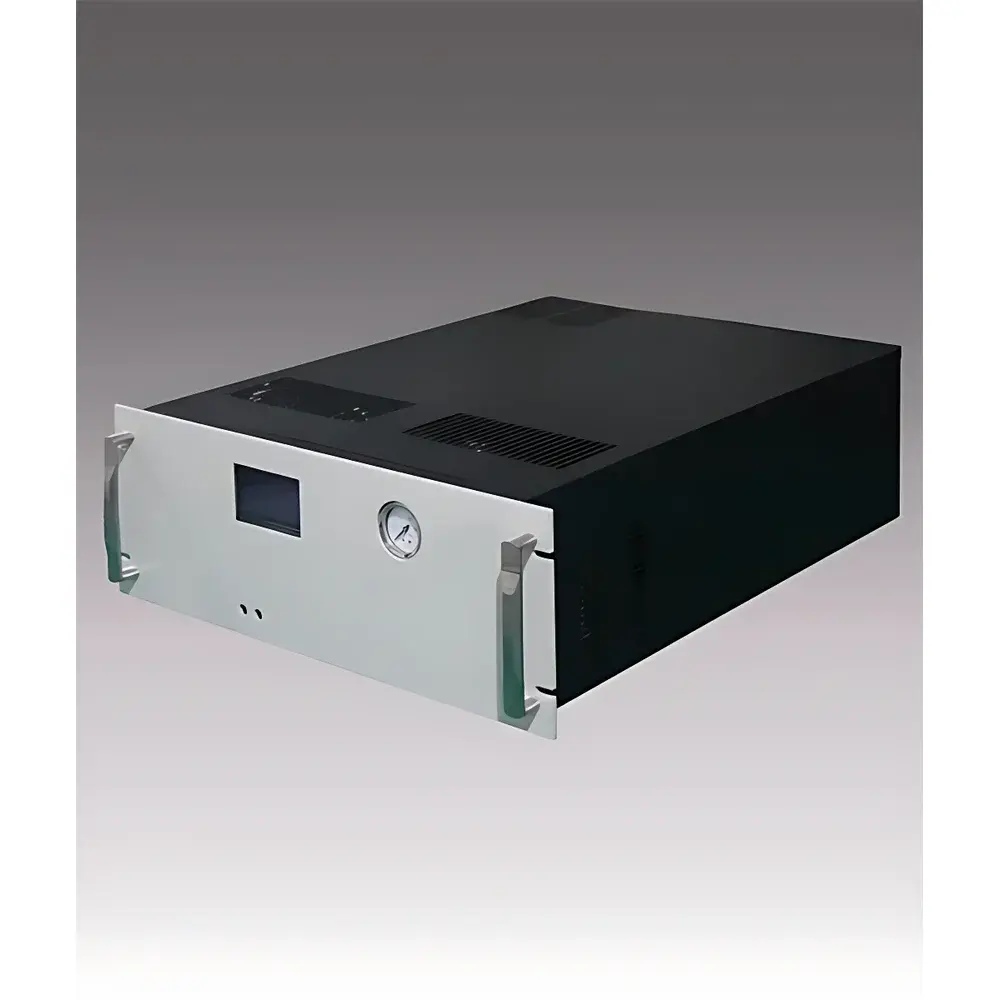
Zhonghuipu ZA-10L Rack-Mounted Zero Air Generator
| Brand | Zhonghuipu |
|---|---|
| Origin | Beijing, China |
| Manufacturer Type | Direct Manufacturer |
| Model | ZA-10L |
| Output Flow | 0–10 L/min @ 30 psig |
| Output Pressure | 0.2–0.8 MPa (air-supplied inlet pressure required, no built-in compressor) |
| Hydrocarbon Content | <20 ppb |
| Dew Point | −40 °C |
| NO/NO₂/NOₓ/SO₂/O₃/H₂S | <0.5 ppb |
| CO | <25 ppb |
| Particulate Size | <0.01 µm |
| Power Supply | 220 V ±10%, 50–60 Hz |
| Power Consumption | 200 W (average) |
| Dimensions (W×D×H) | 450 × 430 × 177 mm |
| Net Weight | ~18 kg |
Overview
The Zhonghuipu ZA-10L is a rack-mounted zero air generator engineered for high-purity ambient air purification in analytical laboratories, environmental monitoring stations, and calibration facilities. It employs catalytic oxidation at elevated temperatures—using a proprietary multi-metallic noble metal catalyst—to quantitatively convert hydrocarbons and carbon monoxide into CO₂ and H₂O. This core purification mechanism ensures trace-level removal of reactive gaseous contaminants without introducing volatile byproducts or residual catalyst leachates. The system operates as an air-supplied purifier (not self-pressurizing), requiring an external compressed air source meeting ISO 8573-1 Class 2:2:2 specifications (oil-free, particle-filtered, dew-point controlled). Its design targets compliance with stringent background gas requirements for chemiluminescence NOx analyzers, UV photometric ozone calibrators, FTIR reference cells, and GC carrier gas conditioning—where sub-ppb reactivity and thermal stability are non-negotiable.
Key Features
- High-efficiency catalytic oxidation reactor operating at >350 °C, optimized for complete CO and C1–C4 hydrocarbon conversion with <99.99% efficiency across the full 0–10 L/min flow range.
- Dual-stage drying architecture: integrated membrane dryer (or optional PSA desiccant module) achieves consistent −40 °C dew point at rated flow—critical for preventing condensation-induced drift in optical and electrochemical sensors.
- Multi-stage particulate filtration: sintered stainless-steel prefilter + ultra-low penetration air (ULPA) membrane filter (<0.01 µm retention) to eliminate aerosol carryover from upstream compression systems.
- Integrated NOx and inorganic sulfur removal stage using selective adsorption media, validated per EPA Method TO-15 Appendix B protocols for inert gas purity verification.
- Embedded microcontroller with real-time status monitoring (catalyst temperature, inlet pressure, outlet dew point), fault logging, and configurable alarm thresholds—supports remote diagnostics via RS232 serial interface.
- Rack-mount form factor (19″, 3U height) enables seamless integration into centralized gas supply cabinets or mobile calibration trailers without floor-space compromise.
Sample Compatibility & Compliance
The ZA-10L delivers zero air certified to meet or exceed the purity benchmarks defined in ISO 8573-1:2010 Class 0 (for particles and oil), ASTM D6216-21 Annex A1 (for hydrocarbon specification), and US EPA 40 CFR Part 53 Appendix A3 (for ambient air monitor calibration gases). Its output is compatible with all major trace-gas analyzers requiring ultra-low-reactivity diluent or span gas—including Thermo Fisher Scientific 42i/43i series, Horiba APNA-370, and Ecotech EC9850. All internal wetted materials conform to ASTM F2214 (non-reactive elastomers) and USP Class VI biocompatibility standards. The unit supports GLP/GMP-aligned operation through time-stamped event logs and password-protected configuration access—facilitating audit readiness under FDA 21 CFR Part 11 when paired with validated data acquisition software.
Software & Data Management
While the ZA-10L operates autonomously via front-panel LCD interface, its RS232 port enables bidirectional communication with host laboratory information management systems (LIMS) or SCADA platforms. Standard Modbus RTU protocol support allows integration into automated calibration workflows, enabling scheduled zero-air purging cycles synchronized with instrument validation protocols. Logged parameters—including cumulative runtime, catalyst thermal history, and pressure differentials across filter stages—are exportable as CSV files for trend analysis and preventive maintenance planning. No proprietary software installation is required; terminal emulation tools (e.g., PuTTY, Tera Term) suffice for configuration and diagnostics.
Applications
- Primary and transfer standard calibration of ambient air quality monitors (NOx, O3, SO2, CO) per US EPA EQOA and EU EN 14625 requirements.
- Zero-gas supply for cavity ring-down spectroscopy (CRDS) and off-axis ICOS systems demanding <10 ppb hydrocarbon interference limits.
- Carrier and makeup gas conditioning for gas chromatography–mass spectrometry (GC-MS) systems performing ultra-trace VOC analysis (e.g., TO-17, TO-15).
- Background gas for Fourier-transform infrared (FTIR) spectrometers used in stack emission testing and atmospheric simulation chambers.
- Instrument purge gas for semiconductor metrology tools requiring inert, particle-free airflow during wafer handling and chamber conditioning.
FAQ
Does the ZA-10L include an integrated air compressor?
No. It requires externally supplied clean, oil-free compressed air at 0.2–0.8 MPa. An upstream ISO 8573-1 Class 2:2:2 air source is mandatory for optimal performance.
What maintenance intervals are recommended for the catalyst and filters?
Catalyst lifetime exceeds 15,000 hours under continuous operation at ≤10 L/min; replacement is indicated only upon sustained CO/hydrocarbon breakthrough (>30 ppb). Particulate and membrane dryers require inspection every 6 months; ULPA filter replacement is advised annually or after 8,000 operating hours.
Can the ZA-10L be configured for continuous unattended operation?
Yes. Its embedded controller supports automatic restart after power interruption, overtemperature shutdown with thermal reset delay, and pressure-loss lockout—enabling 7×24 deployment in central utility rooms or remote monitoring sites.
Is the −40 °C dew point guaranteed at maximum flow?
Yes. Performance validation per ISO 8573-3 confirms −40 °C dew point at 10 L/min, 30 psig, and inlet air ≤25 °C/60% RH—verified using chilled-mirror hygrometry traceable to NIST SRM 2623a.



