
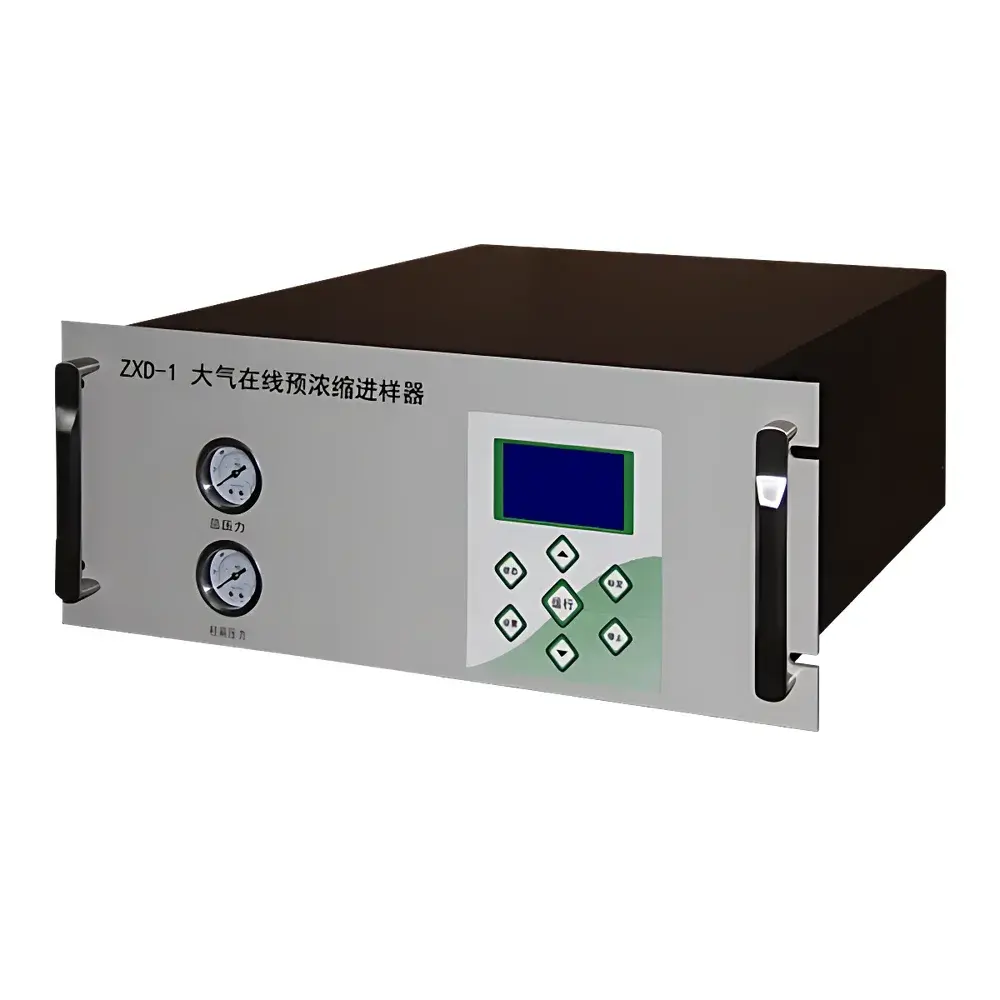
Zhonghuipu ZXD-1 Dual-Cryogenic Trap Online Air Concentrator
| Brand | Zhonghuipu |
|---|---|
| Origin | Beijing, China |
| Manufacturer Type | Manufacturer |
| Product Category | Domestic |
| Model | ZXD-1 |
| Automation Level | Fully Automatic |
| Valve Injection Zone Temperature Range | 50–240 °C (customizable to 330 °C), Temperature Control Accuracy: ±1 °C |
| Transfer Line Temperature Range | 40–230 °C, Temperature Control Accuracy: ±1 °C |
| Cryogenic Trap Temperature Range | −35 to 400 °C |
| Flash Desorption Heating Rate | >50 °C/s |
| Enrichment Time | 0–60 min |
| Injection Time | 0–10 min |
| Interval Time | 0–60 min |
| Sampling Time | 0–60 min |
| Sampling Flow Rate | 16–160 mL/min |
| RSD | ≤2.5% |
| Power Consumption | 450 W |
| Dimensions | 550 × 484 × 222 mm (5U rack-mount chassis) |
Overview
The Zhonghuipu ZXD-1 Dual-Cryogenic Trap Online Air Concentrator is a fully automated, laboratory-grade preconcentration system engineered for unattended, high-fidelity volatile organic compound (VOC) analysis in ambient air and boundary monitoring applications. It operates on the principle of cryogenic trapping followed by rapid thermal desorption—enabling quantitative enrichment of trace-level VOCs prior to injection into gas chromatography (GC) or GC–mass spectrometry (GC–MS) systems. Designed specifically for continuous, time-resolved environmental monitoring, the ZXD-1 supports compliance with regulatory frameworks including EPA TO-15, ASTM D6196, and ISO 16017-1 for ambient air VOC profiling. Its dual-trap architecture eliminates analytical downtime by allowing one trap to sample while the other undergoes desorption and bake-out—a critical capability for uninterrupted 24/7 operation at fenceline or ambient monitoring stations.
Key Features
- Dual cryogenic traps with independent temperature control (−35 °C to 400 °C), enabling true non-stop sampling and analysis cycles.
- Semiconductor-based cooling system—compact, maintenance-free, and free of liquid nitrogen or mechanical compressors.
- Fully heated sample pathway: transfer line (40–230 °C, ±1 °C) and six-port valve zone (50–240 °C, ±1 °C; optional 330 °C configuration), eliminating cold spots and minimizing adsorptive losses of reactive or polar compounds.
- High-inertness, de-activated fused-silica or SilcoNert®-treated stainless-steel tubing throughout the entire flow path to prevent carryover, catalytic degradation, or surface-mediated artifact formation.
- Motor-driven high-temperature six-way valve with integrated heating chamber—ensuring reproducible switching timing and thermal stability under extended duty cycles.
- Programmable method parameters: enrichment (0–60 min), flash desorption (>50 °C/s), injection (0–10 min), interval (0–60 min), and sampling duration (0–60 min), all configurable via intuitive on-device LCD interface.
- Rack-mount 5U chassis (550 × 484 × 222 mm) optimized for integration into centralized air monitoring cabinets or mobile laboratory platforms.
Sample Compatibility & Compliance
The ZXD-1 is validated for the quantitative recovery of C2–C12 hydrocarbons, oxygenates (e.g., acetone, methanol), nitrogen-containing compounds (e.g., acrylonitrile), sulfur species (e.g., methanethiol), halogenated VOCs (e.g., vinyl chloride, 1,2-dichloroethane), and aromatic compounds (e.g., benzene, xylenes, trimethylbenzenes). It meets performance criteria specified in U.S. EPA Method TO-15 for ozone precursor (PAMS-57) monitoring and supports multi-component calibration across dynamic concentration ranges (sub-ppt to low-ppb). All thermal zones are independently monitored and logged with timestamped temperature profiles—supporting GLP/GMP data integrity requirements. The system’s firmware records full audit trails for method changes, run logs, and error events, facilitating FDA 21 CFR Part 11-compliant deployment when paired with validated chromatographic data systems.
Software & Data Management
While the ZXD-1 features an embedded Chinese-language LCD interface for local operation and diagnostics, it provides universal TTL/RS-232 and relay-trigger outputs for seamless synchronization with third-party GC controllers and chromatography data systems (CDS) from Agilent, Thermo Fisher, Shimadzu, and PerkinElmer. Optional Ethernet or USB-to-serial adapters enable remote parameter setting, real-time status monitoring, and event-triggered data logging via custom SCADA or LIMS integrations. All temperature setpoints, timing sequences, and valve actuation events are timestamped and exportable as CSV for QA/QC review and regulatory reporting.
Applications
- Continuous ambient air monitoring for ozone precursors (PAMS-57) at urban, rural, and industrial sites.
- Fenceline VOC monitoring per EPA OTM-40 and EU Industrial Emissions Directive (IED) requirements.
- Indoor air quality (IAQ) assessment in occupational health and building commissioning studies.
- Method development and validation for trace-level VOC analysis in regulatory laboratories accredited to ISO/IEC 17025.
- Mobile lab deployments requiring robust, low-power (<450 W), rack-mountable preconcentration without cryogen dependency.
FAQ
Does the ZXD-1 support unattended 7-day operation?
Yes—the dual-trap architecture and programmable cycle timing allow for fully autonomous operation with no manual intervention required between runs.
Can the system be integrated with GC–MS platforms from non-Chinese manufacturers?
Yes—standard TTL trigger outputs and RS-232 communication ensure compatibility with major GC vendors’ auto-sampler and oven start commands.
Is the trap material suitable for highly reactive sulfur or nitrogen compounds?
Yes—traps are packed with graphitized carbon black and/or Tenax TA, and all wetted surfaces use ultra-low-bleed, silanized stainless steel or fused silica to minimize catalytic decomposition.
What validation documentation is provided?
Factory calibration certificates, temperature uniformity reports, RSD verification data (≤2.5% for target PAMS analytes), and electrical safety compliance (GB 4793.1 / IEC 61010-1) are included.
Is remote firmware update supported?
Firmware updates require local USB connection; however, operational parameters and method files can be uploaded/downloaded remotely via serial or Ethernet interface.
Related Products




