
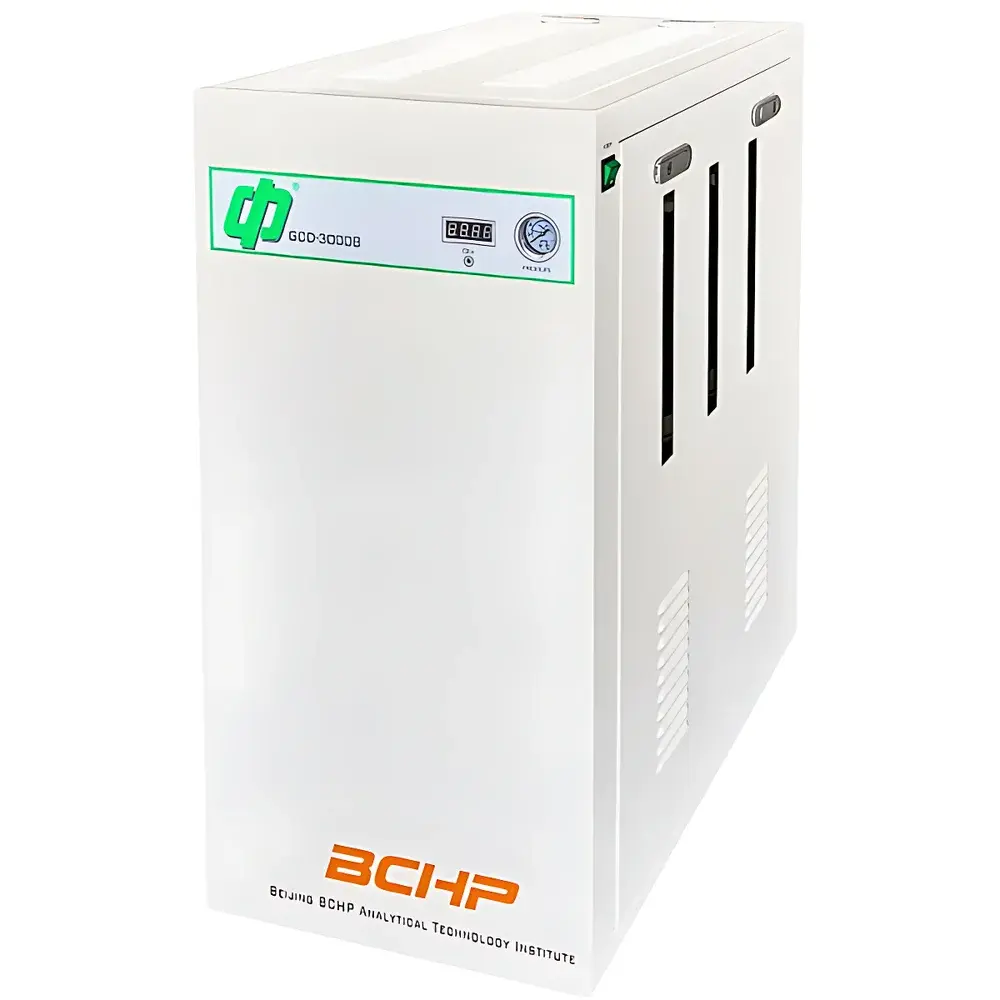
Zhonghuipu GCD-3000B Alkaline Electrolysis Hydrogen Generator
| Brand | Zhonghuipu |
|---|---|
| Origin | Beijing, China |
| Manufacturer Type | Direct Manufacturer |
| Model | GCD-3000B |
| Hydrogen Generation Principle | Alkaline Electrolysis |
| Output Flow Rate | 0–3000 mL/min |
| Output Pressure | 0–0.4 MPa |
| Hydrogen Purity | 99.999% |
| Power Consumption | 1300 W |
| Dimensions (D×W×H) | 600 × 450 × 950 mm |
| Net Weight | 67 kg |
| Operating Temperature | 1–40 °C |
| Relative Humidity | < 85 % RH |
| Input Power | 220 V ±10 %, 50 Hz |
Overview
The Zhonghuipu GCD-3000B is a benchtop alkaline electrolysis hydrogen generator engineered for continuous, on-demand production of high-purity hydrogen gas in analytical and industrial laboratory environments. It operates on the principle of water electrolysis in a concentrated potassium hydroxide (KOH) solution, where direct current decomposes deionized water into stoichiometric hydrogen and oxygen gases at the cathode and anode, respectively. The evolved hydrogen is subjected to multi-stage purification—including membrane-based moisture separation, catalytic oxygen scavenging, and dual-bed adsorption (activated carbon and molecular sieve)—to achieve a certified purity of 99.999 % (5.0 grade), with total hydrocarbon content < 0.1 ppmv and oxygen residual < 0.5 ppmv. Designed for integration into centralized gas supply systems, the GCD-3000B delivers stable flow (0–3000 mL/min) and regulated pressure (up to 0.4 MPa) without reliance on high-pressure cylinders—eliminating logistical constraints, safety hazards associated with compressed gas storage, and batch-to-batch variability inherent in cylinder-sourced hydrogen.
Key Features
- Intelligent pressure- and flow-regulated operation: Fully automated control system maintains constant output pressure or flow rate via real-time feedback from integrated pressure transducers and mass flow sensors; no manual adjustment required.
- Low-moisture hydrogen delivery: Integrated hydrophobic membrane separator reduces dew point to ≤ –40 °C (at 0.4 MPa), followed by dual-stage desiccant and oxygen-removal cartridges containing pre-activated copper-based catalysts—no field activation or regeneration needed.
- Fail-safe architecture: Equipped with overpressure relief valve, electrolyte level monitoring, temperature cutoff (≥ 85 °C), automatic anti-backflow alkaline barrier, and hydrogen leak detection interlock compliant with IEC 61000-6-2/6-4 EMC standards.
- Modular service design: Electrolysis cell, purification module, and power supply are independently replaceable; mean time between failures (MTBF) exceeds 15,000 hours under continuous operation at rated load.
- Energy-efficient operation: Optimized electrode geometry and low-resistance KOH circulation path minimize voltage overpotential; typical specific energy consumption is 5.2 kWh/Nm³ H₂ at full load.
Sample Compatibility & Compliance
The GCD-3000B is compatible with all standard hydrogen-dependent instrumentation, including gas chromatographs (GC), GC–MS systems, Fourier-transform infrared (FTIR) spectrometers requiring purge gas, and fuel cell test stations. Its output meets ISO 8573-1:2010 Class 1.2.1 for particulate, water, and oil contamination, and complies with ASTM D7612–22 specifications for hydrogen used in analytical carrier gas applications. For regulated environments, the unit supports audit-ready operational logs (time-stamped start/stop events, pressure/flow history, alarm records) and can be configured to meet GLP/GMP documentation requirements per FDA 21 CFR Part 11 when paired with validated data acquisition software.
Software & Data Management
The generator features an embedded ARM Cortex-M7 controller with RS-485 Modbus RTU interface and optional Ethernet/IP connectivity. Local operation is managed via a 4.3-inch TFT LCD touchscreen with multilingual UI (English, German, Chinese). Remote monitoring and parameter configuration are supported through Zhonghuipu’s HydroLink™ PC software (Windows 10/11), which enables real-time telemetry export (CSV/Excel), scheduled maintenance alerts, and firmware updates. All operational data—including cumulative runtime, total H₂ volume produced, and fault event timestamps—are stored in non-volatile memory with retention >10 years.
Applications
- Carrier and fuel gas supply for capillary GC and GC–TCD/FID detectors in petrochemical QA/QC labs.
- Reducing atmosphere generation for semiconductor wafer annealing and thin-film deposition processes.
- On-site hydrogen feed for PEM fuel cell performance testing and durability evaluation.
- Centralized hydrogen distribution in multi-instrument core facilities—scalable via parallel installation with master–slave synchronization.
- Research-grade hydrogen source for catalysis studies, isotopic labeling, and hydride synthesis where trace O₂ or H₂O contamination must be minimized.
FAQ
What type of water feed is required?
Deionized water with resistivity ≥ 15 MΩ·cm and silica < 10 ppb is mandatory; integrated conductivity sensor triggers audible/visual alarms if feed quality falls below specification.
Can the unit operate unattended for extended periods?
Yes—designed for 24/7 operation with automatic shutdown on low electrolyte level, overtemperature, or loss of feed water; remote alarm notification via dry-contact relay or Modbus register is configurable.
Is hydrogen purity verified by third-party certification?
Each unit ships with a factory calibration certificate (traceable to NIM, China) confirming 99.999 % purity via online gas chromatography (Agilent 7890B with TCD and molecular sieve column); optional annual recalibration services available.
How often must consumables be replaced?
Oxygen scavenger cartridge: 12 months or 10,000 L H₂ (whichever occurs first); desiccant cartridge: 18 months under typical lab conditions; KOH electrolyte: replenished automatically via level-controlled dosing—full replacement recommended every 36 months.
Does the GCD-3000B support integration with building management systems (BMS)?
Yes—Modbus RTU protocol enables seamless integration with Siemens Desigo, Honeywell EBTS, or Schneider EcoStruxure platforms for centralized gas infrastructure monitoring and predictive maintenance scheduling.
Related Products



