
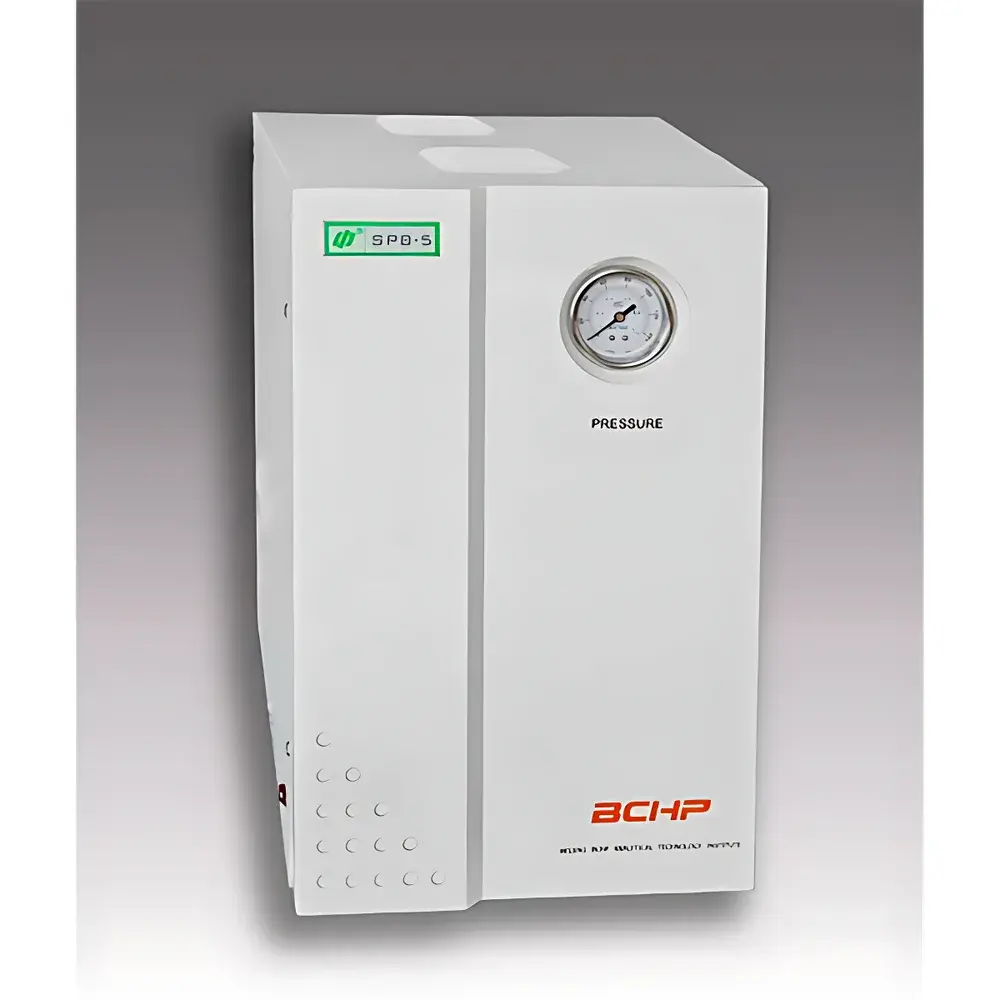
Zhonghuipu SPB-5 Pure Oil-Free Fully Automatic Air Generator
| Brand | Zhonghuipu |
|---|---|
| Origin | Beijing, China |
| Manufacturer Type | Direct Manufacturer |
| Model | SPB-5 |
| Output Flow Rate | 0–2000 mL/min at 0.4 MPa |
| Output Pressure | 0–0.4 MPa |
| Dew Point | < −10 °C |
| Pressure Stability | < 0.003 MPa |
| Power Consumption | 330 W |
| Input Voltage | 220 V ±10% |
| Dimensions (W×D×H) | 450 × 250 × 420 mm |
| Net Weight | ~24 kg |
| Operating Ambient | 5–40 °C, RH ≤85% |
| Construction Material | 304 Stainless Steel Components |
| Safety Features | Thermal Protector, Overcurrent Protection, Pressure Relief Valve |
| Optional Hydrocarbon Removal Module | High-Temperature Catalytic Oxidation with Noble Metal Catalysts |
Overview
The Zhonghuipu SPB-5 Pure Oil-Free Fully Automatic Air Generator is an engineered solution for laboratories requiring continuous, stable, and contaminant-free compressed air—particularly as a carrier, purge, or combustion gas source for analytical instrumentation including gas chromatographs (GC), GC–MS systems, nitrogen–phosphorus detectors (NPD), flame photometric detectors (FPD), and elemental analyzers. Unlike oil-lubricated compressors, the SPB-5 employs a Thomas-brand oil-free rocking-piston compressor, eliminating hydrocarbon carryover and ensuring compliance with stringent instrumental gas purity requirements. Its core architecture integrates pressure stabilization, multi-stage desiccant drying via pressure swing adsorption (PSA), and final particulate filtration using imported Japanese granular filters. The system delivers air with a dew point below −10 °C and pressure fluctuations under ±0.003 MPa—critical parameters for minimizing baseline noise and retention time drift in chromatographic applications.
Key Features
- Oil-free compression technology: Thomas 330 W rocking-piston compressor ensures zero hydrocarbon contamination and eliminates routine oil changes or filter replacements associated with lubricated units.
- Dual-stage pressure regulation: Integrated precision regulators maintain output pressure stability within ±0.003 MPa, enhancing detector signal integrity and method reproducibility.
- PSA-based drying system: Self-regenerating desiccant beds operate continuously without consumable replacement, supporting unattended 7×24 operation with consistent dew point performance (< −10 °C).
- Stainless steel construction: Critical wetted components—including air reservoir, internal piping, and filter housings—are fabricated from ASTM A240 304 stainless steel to resist corrosion and ensure long-term structural integrity.
- Comprehensive safety architecture: Thermal cut-off switches, overcurrent protection relays, and ASME-certified pressure relief valves provide layered fail-safe operation under overload, stall, or overpressure conditions.
- Modular hydrocarbon removal interface: Standard预留 port enables integration of an optional high-temperature catalytic oxidation module (operating up to 400 °C) using Pt/Pd/Rh catalysts to oxidize residual C1–C6 hydrocarbons into CO₂ and H₂O—meeting ultra-high-purity air specifications for trace-level analysis.
Sample Compatibility & Compliance
The SPB-5 is designed to supply instrument-grade air meeting ISO 8573-1:2010 Class 2:2:2 (solid particles ≤0.1 µm, dew point −10 °C, oil content < 0.01 mg/m³) when operated within specified ambient conditions (5–40 °C, RH ≤85%). It complies with IEC 61010-1 for laboratory electrical safety and incorporates grounding continuity, double insulation, and thermal management per EN 60335-1. While not certified to FDA 21 CFR Part 11, its stable output supports GLP/GMP-aligned workflows where audit-ready gas supply documentation is maintained externally. No regulatory certification is claimed for medical or breathing-air use.
Software & Data Management
The SPB-5 operates as a standalone hardware unit with no embedded microcontroller, firmware, or digital interface. All operational parameters—including pressure, flow, and temperature—are monitored via analog gauges and mechanical sensors. This design prioritizes electromagnetic compatibility (EMC), long-term reliability, and immunity to software obsolescence or cybersecurity vulnerabilities. Users integrate it into existing lab infrastructure via standard 6.35 mm (¼″) push-to-connect fittings and maintain calibration records manually. For laboratories implementing electronic lab notebooks (ELN) or LIMS, output verification logs (e.g., daily dew point checks, pressure stability tests) may be entered as structured metadata.
Applications
- Carrier and make-up gas for capillary GC and GC–MS systems requiring low-hydrocarbon, low-moisture air.
- Purge gas for headspace samplers, thermal desorption units, and autosampler wash stations.
- Combustion support gas for FID, FPD, and NPD detectors—where consistent stoichiometry depends on stable pressure and dryness.
- Instrumental air for FTIR spectrometer purge lines, laser cavity cooling, and particle counters.
- Benchtop air source for cleanroom tools, precision pneumatic actuators, and leak-testing fixtures in QA/QC labs.
FAQ
Does the SPB-5 require periodic desiccant replacement?
No. The PSA drying system uses self-regenerating molecular sieves; no consumable desiccant cartridges need scheduled replacement.
Can the unit be mounted vertically or installed in a cabinet?
It is designed for benchtop horizontal placement only. Adequate ventilation (≥10 cm clearance on all sides) is required for heat dissipation from the compressor and motor windings.
Is the output air suitable for mass spectrometry applications?
Yes—provided the optional hydrocarbon removal module is installed and validated. Base-unit output meets general GC requirements but may require additional purification for high-sensitivity MS ion sources.
What maintenance is required beyond routine visual inspection?
Annual verification of pressure regulator hysteresis, safety valve setpoint, and filter housing integrity is recommended. No lubrication or internal servicing is necessary.
Does the SPB-5 support remote monitoring or analog output signals?
No. It is a purely electromechanical device with no digital communication ports, 4–20 mA outputs, or IoT connectivity.



