
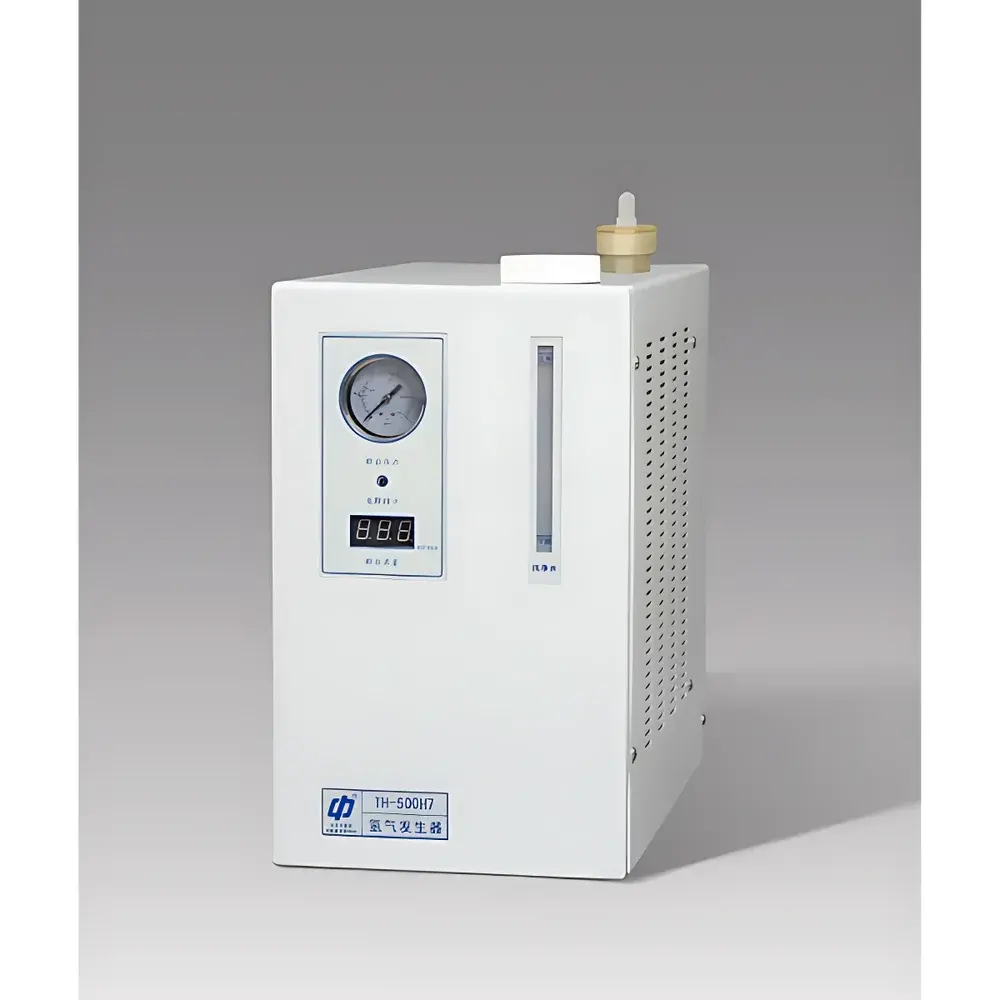
Zhonghuipu TH-500H7 High-Pressure Hydrogen Generator
| Brand | Zhonghuipu |
|---|---|
| Origin | Beijing, China |
| Manufacturer Type | Direct Manufacturer |
| Model | TH-500H7 |
| Hydrogen Generation Principle | Pure Water Electrolysis (SPE Proton Exchange Membrane) |
| Output Flow Rate | 0–500 mL/min |
| Output Pressure | 0–7 MPa (70 kgf/cm²) |
| Hydrogen Purity | 99.999% |
| Pressure Stability | < 0.01 MPa |
| Power Supply | 220 V ±10%, 50 Hz |
| Power Consumption | 250 W |
| Dimensions (W×D×H) | 400 × 360 × 220 mm |
| Net Weight | 24 kg |
| Certification | CE |
Overview
The Zhonghuipu TH-500H7 High-Pressure Hydrogen Generator is an engineered solution for laboratories requiring on-demand, ultra-high-purity hydrogen gas at elevated pressures—up to 7 MPa (70 bar)—without reliance on compressed gas cylinders. It employs solid polymer electrolyte (SPE) proton exchange membrane technology to perform pure water electrolysis, eliminating the need for caustic potassium hydroxide (KOH) or sodium hydroxide (NaOH) solutions common in traditional alkaline electrolyzers. This design ensures intrinsic safety, reduced maintenance, and consistent gas quality compliant with analytical-grade requirements. The generator delivers hydrogen at a continuously adjustable flow rate from 0 to 500 mL/min, with pressure stability maintained within ±0.01 MPa under dynamic load conditions—critical for applications such as high-pressure catalytic hydrogenation, fuel cell testing, and hydride generation atomic absorption spectroscopy (HG-AAS). Its compact footprint (400 × 360 × 220 mm) and integrated thermal management support benchtop deployment in ISO Class 5–7 cleanrooms or standard analytical labs.
Key Features
- SPE-based electrolysis using imported perfluorosulfonic acid (PFSA) proton exchange membrane for high ionic conductivity and long-term operational stability
- Zero-alkali operation: deionized water (≥1 MΩ·cm resistivity) serves as the sole consumable—no hazardous chemical handling or disposal required
- Full stainless steel wetted path construction (316L SS), including gas–liquid separation chamber, particulate filters, and pressure-regulated outlet manifold
- Low-sulfur silicone O-rings and fluoropolymer-coated internal seals minimize trace sulfur contamination—essential for sulfur-sensitive detectors (e.g., pulsed flame photometric detection, PFPD)
- Integrated digital pressure and flow control via closed-loop PID regulation; real-time setpoint adjustment via front-panel interface or remote analog/digital I/O
- Automated water-level monitoring with fail-safe shutdown: electrolyzer cell de-energizes within 2 seconds of detecting low water level, preventing dry-run damage
- CE-certified electromagnetic compatibility (EMC) and electrical safety (EN 61000-6-3, EN 61000-6-4, EN 61010-1), suitable for use in regulated environments
Sample Compatibility & Compliance
The TH-500H7 is designed for continuous, unattended operation in GLP- and GMP-aligned laboratories. Its 99.999% hydrogen purity meets ASTM D7606–22 specifications for ultrahigh-purity carrier and reactant gases used in gas chromatography (GC) and GC–MS systems. The absence of hydrocarbon, oxygen, nitrogen, moisture, and halogen impurities ensures compatibility with palladium- or platinum-based catalysts and prevents poisoning in hydrogenation reactors. All pressure-bearing components conform to PED 2014/68/EU directives, and the system’s mechanical integrity has been validated through hydrostatic testing at 1.5× maximum working pressure (10.5 MPa). Optional integration with external gas analyzers (e.g., residual oxygen sensors, dew point meters) supports IQ/OQ validation protocols per ISO/IEC 17025 and FDA 21 CFR Part 11-compliant data logging.
Software & Data Management
While the TH-500H7 operates autonomously via its embedded microcontroller, it provides RS-485 Modbus RTU and 0–10 V analog output interfaces for integration into centralized lab automation platforms (e.g., LabVantage, Thermo Fisher SampleManager LIMS). Operational parameters—including real-time pressure, flow, cell voltage, coolant temperature, and cumulative runtime—are timestamped and exportable in CSV format. Audit trails record all user-initiated events (e.g., start/stop commands, setpoint changes, alarm acknowledgments), satisfying ALCOA+ data integrity principles. Firmware updates are performed via secure USB port with SHA-256 signature verification, ensuring traceability and version control in regulated workflows.
Applications
- High-pressure heterogeneous catalysis studies (e.g., Fischer–Tropsch synthesis, ammonia decomposition kinetics)
- Fuel cell stack testing under realistic operating pressures (up to 7 MPa anode feed)
- Hydrogen-driven reduction reactions in flow chemistry systems (e.g., nitro-to-amine conversions)
- Carrier gas supply for GC-FID, GC-TCD, and GC-PDHID with sub-ppb oxygen/moisture interference thresholds
- In-situ X-ray absorption spectroscopy (XAS) sample environments requiring stable, contaminant-free reducing atmospheres
- Calibration gas generation for hydrogen sensors deployed in explosion-proof industrial zones (ATEX Zone 1/21)
FAQ
What type of water is required for optimal performance?
Deionized water with resistivity ≥1 MΩ·cm (equivalent to ASTM Type II or ISO 3696 Grade 2) is mandatory. Tap water, distilled water, or water containing >50 ppb total organic carbon (TOC) will degrade membrane lifespan and compromise purity.
Can the TH-500H7 be operated continuously for 24/7 applications?
Yes—the system is rated for continuous duty (IEC 60034-1 S1 rating) with thermal protection and automatic cooldown cycles. Mean time between failures (MTBF) exceeds 12,000 hours under nominal load (300 mL/min at 5 MPa).
Is remote monitoring supported via Ethernet or Wi-Fi?
The base model includes RS-485 and analog outputs only. An optional Ethernet-to-Modbus gateway module enables TCP/IP communication and SNMP-based network health reporting.
How often does the SPE membrane require replacement?
Under proper water quality and operating conditions, the membrane service life exceeds 15,000 hours. Replacement is recommended when cell voltage rises >15% above initial baseline at fixed current density (e.g., >2.1 V @ 10 A/m²).
Does the generator include built-in gas purification beyond the membrane?
Yes—a dual-stage post-electrolysis purification train comprises a heated palladium-doped molecular sieve (for O₂ removal) and a desiccant cartridge (for H₂O removal), both replaceable as field-serviceable modules with documented calibration certificates.



