
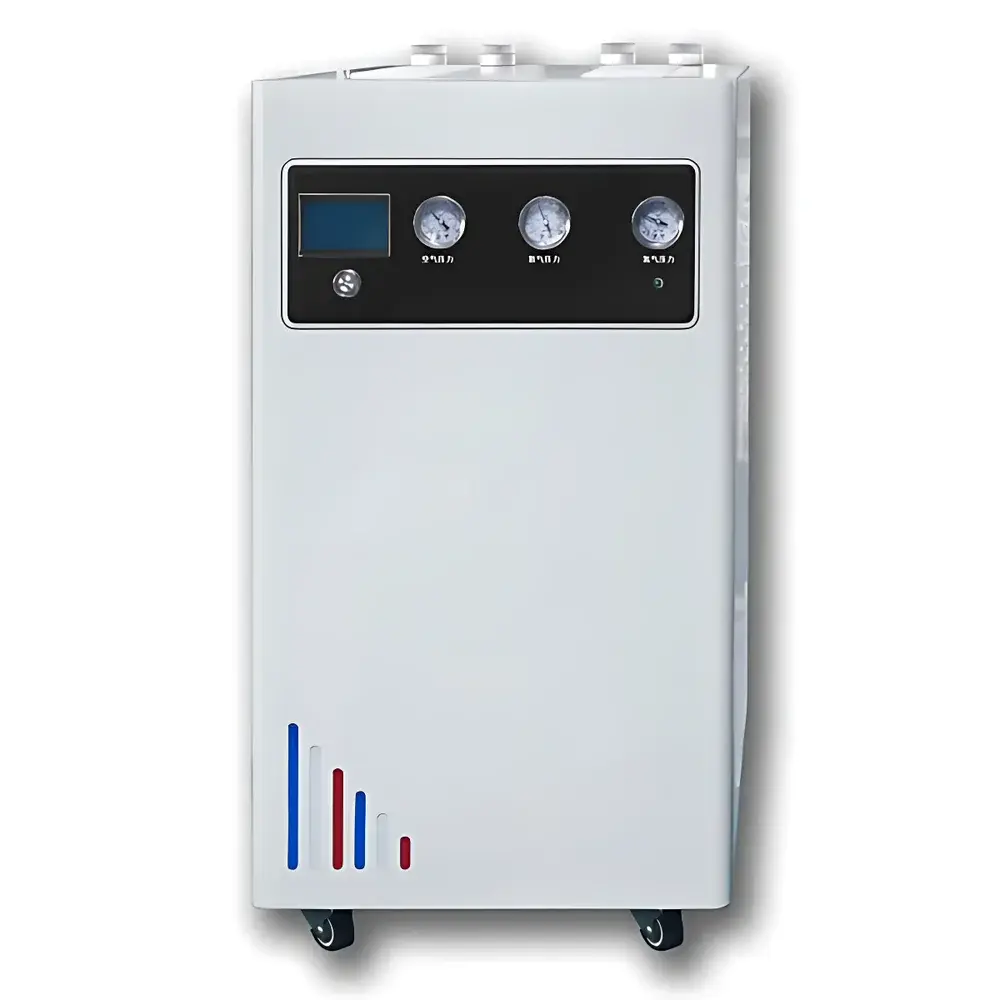
Zhonghuipu NHA-1300 Integrated Hydrogen-Nitrogen-Air Gas Generator
| Brand | Zhonghuipu |
|---|---|
| Origin | Beijing, China |
| Manufacturer Type | OEM Manufacturer |
| Model | NHA-1300 |
| Nitrogen Purity | 99.999% |
| Nitrogen Flow Rate | 0–150 mL/min |
| Nitrogen Output Pressure | 0–0.4 MPa |
| Hydrogen Purity | 99.999% |
| Hydrogen Flow Rate | 0–300 mL/min |
| Hydrogen Output Pressure | 0–0.4 MPa |
| Air Flow Rate | 0–1.5 L/min |
| Air Output Pressure | 0–0.4 MPa |
| Power Supply | 220 V ±10%, 50 Hz |
| Peak Power Consumption | 750 W |
| Operating Temperature | 5–35 °C |
| Relative Humidity | <85% RH |
| Dimensions (W×D×H, excluding casters) | 430 × 580 × 725 mm |
| Net Weight | ~52 kg |
Overview
The Zhonghuipu NHA-1300 Integrated Hydrogen-Nitrogen-Air Gas Generator is an engineered solution for laboratories requiring simultaneous, on-demand supply of high-purity carrier, fuel, and combustion-support gases for gas chromatography (GC) systems. It eliminates dependency on high-pressure cylinders by integrating three independent gas generation modules—pressure-swing adsorption (PSA) nitrogen, PEM-based electrolytic hydrogen, and membrane-dried compressed air—within a single robust chassis. Designed for continuous 7×24 operation, the unit delivers consistent gas quality compliant with ASTM D6866 and ISO 8573-1 Class 1 requirements for particulate, moisture, and hydrocarbon content. Its modular architecture enables independent monitoring and control of each gas stream, ensuring traceability and stability critical for GC-FID, GC-ECD, and GC-TCD configurations. All internal gas pathways are constructed from electropolished stainless steel to prevent leaching or outgassing, and the system operates without external water or air feed—making it ideal for centralized lab environments where infrastructure flexibility is constrained.
Key Features
- Triple-gas output (N₂, H₂, air) from a single footprint—reducing spatial demand and eliminating inter-device pressure synchronization issues.
- Nitrogen module employs dual-tower PSA technology with imported Japanese carbon molecular sieve (CMS), delivering 99.999% purity at up to 150 mL/min; includes SMC 0.01 µm particulate filtration and integrated dew point suppression.
- Hydrogen module utilizes transition-metal-catalyzed alkaline electrolysis with intelligent liquid-level sensing and auto-refill capability—compatible with standard tap water and supported by optional 15 L external reservoir for ≥30 days of unattended operation per detector.
- Air module integrates Thomas-brand oil-free scroll compressor and SMC hollow-fiber membrane dryer, achieving ≤−40 °C pressure dew point without desiccant replacement or scheduled maintenance.
- Embedded microcontroller continuously monitors flow, pressure, temperature, and leak integrity across all three streams; triggers automatic shutdown upon H₂ leakage detection or compressor thermal overload.
- Full-height caster-mounted frame (430 × 580 × 725 mm) enables repositioning within fume hoods or GC instrument clusters without disassembly.
Sample Compatibility & Compliance
The NHA-1300 is validated for direct integration with all major GC platforms—including Agilent, Thermo Fisher, Shimadzu, and PerkinElmer—supporting both single- and multi-detector configurations. Its nitrogen output meets USP and ISO 8573-1:2010 Class 1 specifications for GC carrier gas applications involving polar columns (e.g., DB-WAX, HP-INNOWAX) and electron capture detectors (ECD). Hydrogen output satisfies ASTM D1945 requirements for fuel gas in FID systems, while dried air complies with ICH Q5C guidelines for oxidant supply in flame ionization and nitrogen-phosphorus detectors. The unit’s electrical design conforms to IEC 61010-1 safety standards, and its firmware architecture supports audit trail logging for GLP/GMP environments under FDA 21 CFR Part 11 readiness (when paired with compliant LIMS interfaces).
Software & Data Management
While the NHA-1300 operates via embedded real-time controller without proprietary software dependency, its digital I/O interface (RS-232/485 optional) enables integration into laboratory-wide monitoring networks. Status parameters—including individual gas flow rates, pressure setpoints, compressor duty cycles, and fault logs—are accessible via ASCII protocol for ingestion into SCADA or ELN systems. All operational events (e.g., auto-refill activation, pressure deviation alarms, thermal cutoffs) are timestamped and stored locally for ≥30 days. No cloud connectivity or vendor-specific drivers are required, preserving data sovereignty and simplifying validation documentation for regulated QC/QA workflows.
Applications
- Carrier gas supply for capillary GC analysis of volatile organic compounds (VOCs), residual solvents, and environmental pollutants.
- Fuel gas source for flame ionization detectors (FID) and thermal conductivity detectors (TCD) in pharmaceutical stability testing and impurity profiling.
- Make-up and auxiliary gas for electron capture detectors (ECD) in pesticide residue and halogenated compound analysis.
- Combustion-support air for nitrogen-phosphorus detectors (NPD) and flame photometric detectors (FPD).
- Standby gas source during cylinder changeover in clinical toxicology and forensic GC labs operating under CLIA or ISO/IEC 17025 accreditation.
FAQ
Does the NHA-1300 require external compressed air or deionized water?
No. It incorporates a built-in Thomas oil-free compressor and operates with standard municipal water (conductivity <500 µS/cm); no external air line or DI water system is needed.
Can nitrogen and hydrogen outputs be used simultaneously at maximum flow?
Yes. The system’s thermal management and power regulation allow concurrent operation at full rated flow for all three gases without performance degradation or safety compromise.
Is the unit suitable for cleanroom or ISO Class 5 environments?
The stainless-steel gas path, zero-oil compression, and sub-micron filtration meet ISO 14644-1 particle count requirements when installed with appropriate exhaust venting and inlet HEPA prefiltration.
What maintenance intervals are recommended?
Annual CMS replacement for nitrogen module; biannual inspection of electrolyte level sensors and membrane dryer integrity; no scheduled maintenance for compressor or air dryer under normal operating conditions.
How is regulatory compliance documented for audit purposes?
Factory calibration certificates, material declarations (RoHS/REACH), electrical safety reports (IEC 61010), and gas purity test reports (per ISO 8573-1) are supplied with each unit; IQ/OQ protocols available upon request.
Related Products



