
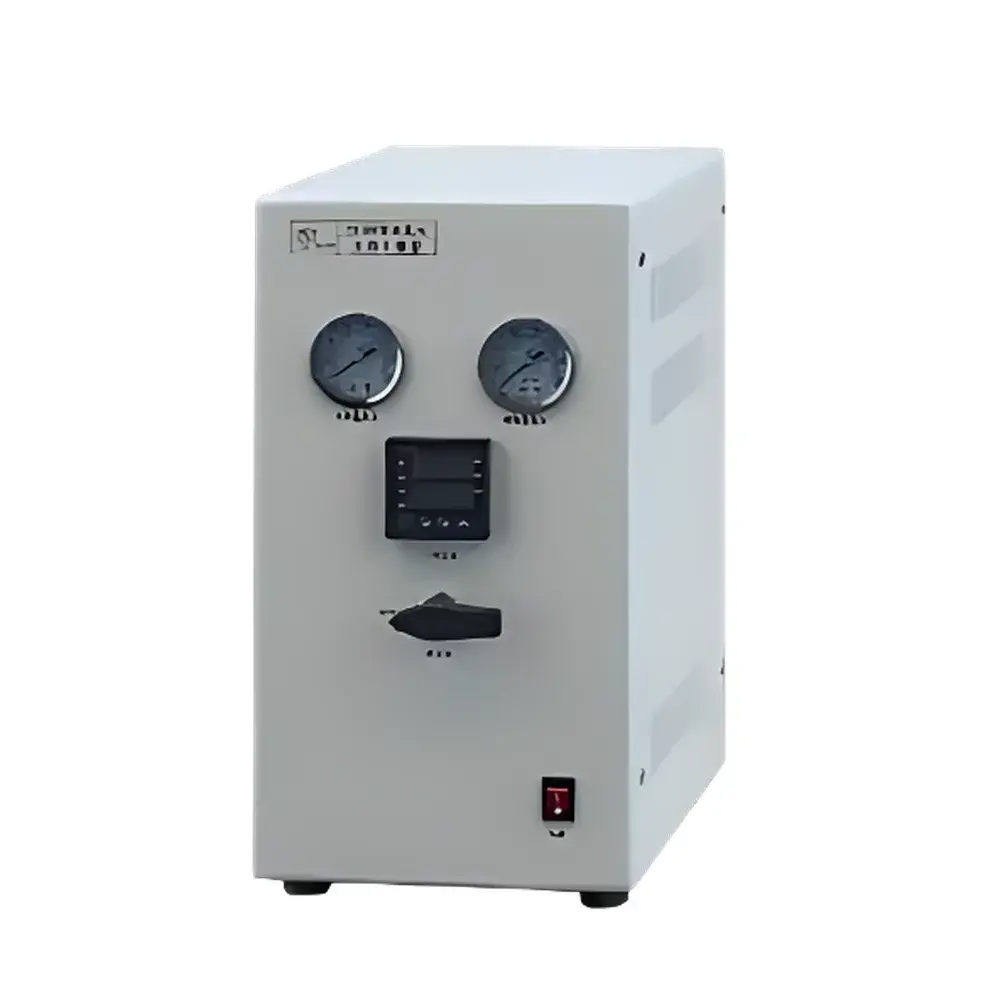
Zhonghuipu Pd-300 Palladium Membrane Hydrogen Purifier
| Brand | Zhonghuipu |
|---|---|
| Origin | Beijing, China |
| Manufacturer Type | Direct Manufacturer |
| Country of Origin | China |
| Model | Pd-300 |
| Hydrogen Feed Purity | ≥99.0% |
| Ultra-High-Purity H₂ Output Purity | ≥99.99999% |
| Feed Gas Pressure Range | 0–1.0 MPa |
| Product Gas Pressure Range | 0–0.6 MPa |
| Power Supply | 220 V ±10%, 50–60 Hz |
| Power Consumption | 250 W |
| Operating Membrane Temperature | 350 °C |
| Ambient Operating Temperature | 1–40 °C |
| Ambient Relative Humidity | ≤85% RH |
| Dimensions (W×D×H) | 340 × 200 × 360 mm |
| Net Weight | 6 kg |
Overview
The Zhonghuipu Pd-300 Palladium Membrane Hydrogen Purifier is a compact, thermally stabilized gas purification system engineered for continuous generation of ultra-high-purity hydrogen (≥99.99999% v/v) from technical-grade feed gas (≥99.0% H₂). It leverages the selective permeability of a high-temperature palladium–silver (Pd–Ag) alloy membrane—a well-established principle in membrane separation science—where only molecular hydrogen dissociates, diffuses through the lattice, and recombines on the permeate side, while all other gaseous impurities (e.g., N₂, O₂, CH₄, CO, H₂O, CO₂, hydrocarbons) are quantitatively rejected. This solid-state, catalyst-free separation mechanism eliminates consumables, moving parts, or adsorbent beds, delivering inherently stable, drift-free output ideal for demanding analytical applications requiring long-term baseline integrity.
Key Features
- High-selectivity Pd–Ag composite membrane operating at precisely controlled 350 °C, optimized for maximum H₂ flux and long-term thermal-mechanical stability
- Integrated PID temperature control with dual-zone heating and real-time thermocouple feedback to maintain ±2 °C uniformity across the membrane surface
- Stainless steel 316L wetted-path construction compliant with ISO 8573-1 Class 1 for particulate and hydrocarbon content; leak-tight design verified to ≤1×10⁻⁹ mbar·L/s He
- Independent pressure regulation on both feed and product sides via stainless steel diaphragm regulators with digital pressure transducers (0–1.0 MPa feed, 0–0.6 MPa product)
- Low-power thermal architecture (250 W nominal) enabling benchtop deployment without external cooling or dedicated HVAC support
- Compact footprint (340 × 200 × 360 mm) and lightweight design (6 kg net) suitable for fume hoods, GC instrument carts, or ISO Class 5 cleanroom peripheries
Sample Compatibility & Compliance
The Pd-300 accepts hydrogen-rich streams containing up to 1% non-hydrogen contaminants—including nitrogen, oxygen, carbon monoxide, methane, water vapor, and trace hydrocarbons—without performance degradation or membrane poisoning under specified operating conditions. It is compatible with common hydrogen supply sources such as electrolyzers, cylinder banks (Grade 4.5–5.0), and reformer off-gas. The unit conforms to IEC 61000-6-2 (immunity) and IEC 61000-6-4 (emissions) for laboratory electromagnetic environments. While not certified to UL/CSA standards out-of-box, its electrical architecture complies with EN 61010-1 safety requirements for laboratory equipment. Documentation supports alignment with GLP and GMP data integrity expectations when integrated into validated analytical workflows (e.g., USP , ASTM D7165, ISO/IEC 17025).
Software & Data Management
The Pd-300 operates in fully autonomous mode with local analog/digital status indicators (temperature, inlet/outlet pressure, power-on LED). No embedded firmware or proprietary software is required for basic operation. For integration into centralized lab infrastructure, optional 4–20 mA analog outputs (temperature, outlet pressure) and dry-contact alarm relays (over-temperature, low-flow, power fault) enable connection to SCADA, LIMS, or building management systems. All operational parameters meet traceability requirements for audit-ready environments: temperature setpoint and actual readings are logged internally (non-volatile memory) with UTC timestamping, supporting 21 CFR Part 11–compliant record retention when paired with validated third-party data acquisition software.
Applications
- Carrier and fuel gas supply for GC-FID, GC-TCD, GC-MS, and GC×GC systems requiring sub-ppb oxygen and moisture levels
- Calibration gas generation for residual gas analyzers (RGAs) and quadrupole mass spectrometers in UHV systems
- Hydrogenation reaction feedstock purification in catalytic screening reactors (e.g., microkinetic studies)
- Reference gas source for electrochemical sensor validation and hydrogen sensor calibration labs
- On-site ultra-pure H₂ generation for semiconductor process tool purge lines (where Grade 6.0 purity is mandated)
FAQ
What feed gas quality is required to achieve ≥99.99999% H₂ output?
Feed gas must contain ≥99.0% H₂ by volume and be free of sulfur compounds (e.g., H₂S, mercaptans), halogens, or heavy metals that irreversibly poison Pd membranes. Particulates must be removed upstream using a 0.1 µm coalescing filter.
Can the Pd-300 operate continuously for extended periods?
Yes—designed for 24/7 operation with no scheduled maintenance intervals under nominal load; membrane lifetime exceeds 15,000 hours at 350 °C with clean feed gas.
Is external cooling required?
No—the unit employs passive convection and thermal shielding; ambient temperature must remain between 1 °C and 40 °C with ≤85% RH non-condensing.
How is hydrogen purity verified?
Output purity is validated via helium ionization detection (HID) or pulsed discharge helium ionization detection (PDHID) configured for sub-ppb O₂/Ar/N₂/CH₄ sensitivity; certificate of analysis is generated per ISO 17025-accredited interlaboratory comparison protocols.
Does the system support remote monitoring?
Analog I/O and relay interfaces allow integration with industrial PLCs or lab automation platforms; Ethernet or USB connectivity is not natively supported but may be added via third-party signal converters compliant with Modbus RTU or BACnet MS/TP.



