
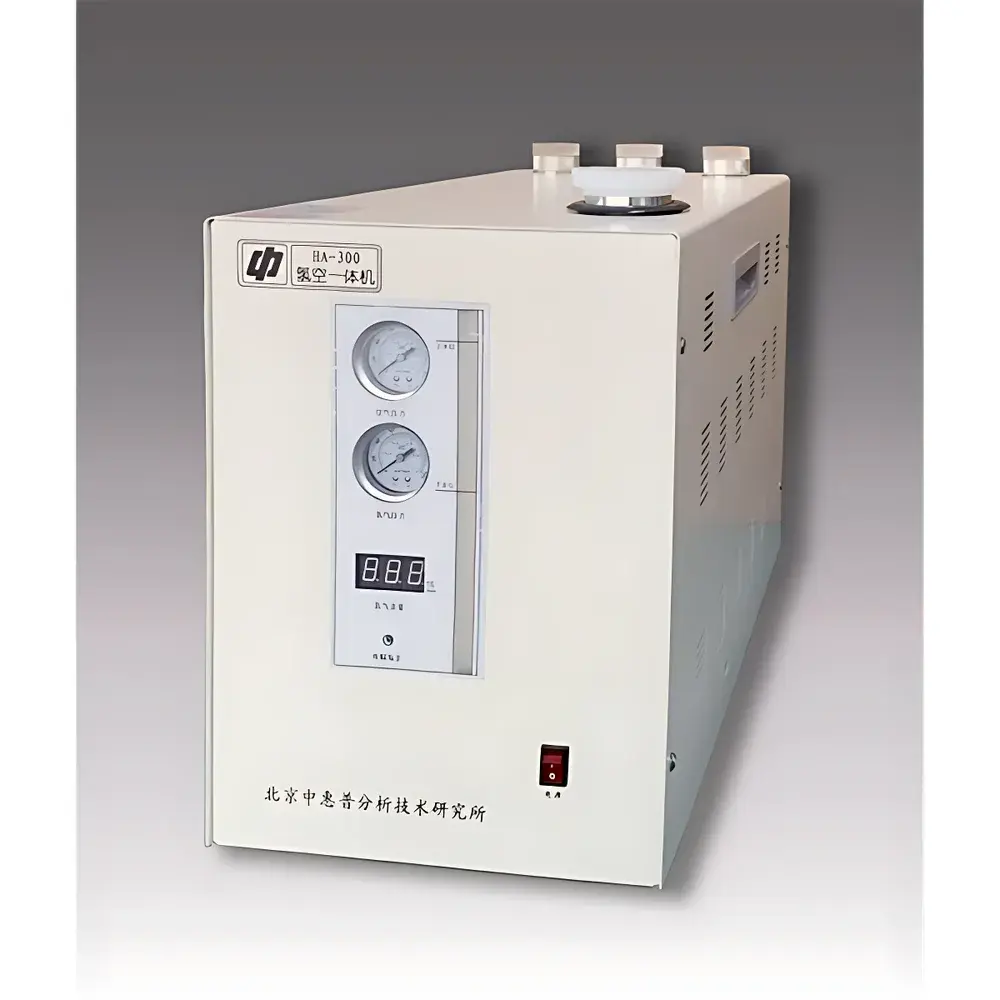
Zhonghuipu HA-300 / HA-500 Hydrogen-Air Integrated Gas Generator
| Brand | Zhonghuipu |
|---|---|
| Origin | Beijing, China |
| Manufacturer Type | Direct Manufacturer |
| Model | HA-300 / HA-500 |
| H₂ Purity | 99.999% |
| H₂ Flow Range | 0–300 mL/min (HA-300) / 0–500 mL/min (HA-500) |
| H₂ Output Pressure | 0.4 MPa |
| Air Flow Range | 0–2000 mL/min |
| Air Output Pressure | 0.4 MPa |
| Power Consumption | 300 W (HA-300) / 400 W (HA-500) |
| Dimensions (W×D×H) | 470 × 260 × 380 mm |
| Net Weight | ~28 kg |
Overview
The Zhonghuipu HA-300 and HA-500 Hydrogen-Air Integrated Gas Generators are engineered for continuous, on-demand supply of high-purity hydrogen and zero-air to gas chromatography (GC) systems. These dual-output generators eliminate reliance on high-pressure gas cylinders by producing hydrogen via PEM (Proton Exchange Membrane) electrolysis and compressed air through oil-free diaphragm compression and multi-stage purification. The integrated architecture ensures synchronized pressure regulation, flow stability, and fail-safe interlock between H₂ and air subsystems—critical for flame ionization detectors (FID), nitrogen-phosphorus detectors (NPD), and thermal conductivity detectors (TCD). Designed for unattended 24/7 operation in analytical laboratories, the system meets the stringent gas quality requirements defined in ASTM D4057, ISO 8573-1 Class 1 for particulates and oil aerosols, and USP for carrier and detector gases in regulated environments.
Key Features
- Integrated dual-gas architecture with independent control loops for hydrogen and air outputs, enabling simultaneous delivery at stable 0.4 MPa working pressure.
- Hydrogen generation via PEM electrolysis with automatic anti-alkaline backflow protection and real-time flow tracking—ensuring precise stoichiometric matching to GC detector demand.
- Air subsystem featuring oil-free diaphragm compressor, automatic condensate drainage, and precision pressure regulation (< ±0.01 MPa deviation).
- Three-stage stainless-steel filtration: particulate removal (0.01 µm), hydrocarbon adsorption (activated carbon), and trace oxygen scavenging (oxygen-depleting catalyst)—achieving ≤0.1 ppm O₂ and ≤0.1 ppm total hydrocarbons in final H₂ output.
- Low-sulfur silicone rubber sealing system compliant with ASTM D6299, eliminating sulfur contamination that compromises sulfur chemiluminescence detection (SCD) or pulsed flame photometric detection (PFPD).
- Compact footprint (470 × 260 × 380 mm) and robust stainless-steel gas storage reservoir—designed for benchtop deployment with minimal infrastructure requirements (single-phase 220 V AC input).
Sample Compatibility & Compliance
The HA-300/HA-500 is compatible with all major GC platforms—including Agilent, Thermo Fisher Scientific, Shimadzu, PerkinElmer, and Waters—regardless of detector configuration or column type. Its gas specifications conform to ICH Q5C recommendations for excipient-grade gases and satisfy the baseline stability requirements for GLP-compliant method validation per FDA 21 CFR Part 11. The generator’s internal audit trail logs operational parameters (flow, pressure, temperature, runtime) with timestamped records exportable in CSV format—supporting GMP traceability and laboratory accreditation under ISO/IEC 17025:2017.
Software & Data Management
While the HA-300/HA-500 operates as a standalone hardware unit without embedded touchscreen or network interface, it incorporates industrial-grade microcontroller firmware with configurable safety thresholds and self-diagnostics. All critical alarms—including low water level, overpressure, high temperature, filter saturation, and electrolyzer current anomaly—are relayed via dry-contact outputs and front-panel LED indicators. Optional RS-232 or analog 4–20 mA interfaces enable integration into centralized lab monitoring systems (e.g., LabVantage, STARLIMS) for remote status verification and predictive maintenance scheduling based on cumulative operating hours and filter service intervals.
Applications
- Routine QC analysis in pharmaceutical, environmental, and food testing labs requiring FID fuel gas with guaranteed purity and zero downtime.
- Method development workflows where variable H₂/air ratios must be reproducibly maintained across multiple instrument runs.
- Multi-instrument labs consolidating gas supply to reduce cylinder logistics, storage hazards, and certification overhead.
- Research settings employing hyphenated techniques (e.g., GC-MS with auxiliary H₂ make-up gas) demanding ultra-low oxygen and moisture content.
- Regulated environments requiring documented gas source qualification per USP , EP 2.5.27, or JP 17 General Chapter “Gases for Chromatography”.
FAQ
What is the expected service life of the PEM electrolyzer stack?
Under standard operating conditions (≤8 h/day, ambient temperature 15–30 °C), the electrolyzer is rated for ≥15,000 hours of operation with periodic deionized water replenishment and annual filter replacement.
Can the HA-500 supply hydrogen to two GCs simultaneously?
Yes—provided total combined H₂ demand remains within 500 mL/min and downstream pressure drop across distribution tubing and regulators does not exceed 0.05 MPa.
Is external drying required for the air output?
No—the integrated air subsystem includes refrigerated and desiccant coalescing stages, delivering dew point ≤−40 °C at 0.4 MPa, meeting ISO 8573-1:2010 Class 2.2.1 requirements.
How often must the oxygen scavenger cartridge be replaced?
Replacement interval is determined by total hydrogen throughput; typical service life is 6–12 months at 200 mL/min average flow, with end-of-life signaled by gradual O₂ rise above 0.5 ppm (verified via optional inline O₂ analyzer).
Does the generator support remote shutdown via building management system (BMS)?
Yes—via configurable dry-contact input (normally open, 24 V DC), enabling integration with fire alarm panels or emergency power-off circuits per NFPA 55 and local laboratory safety protocols.



