
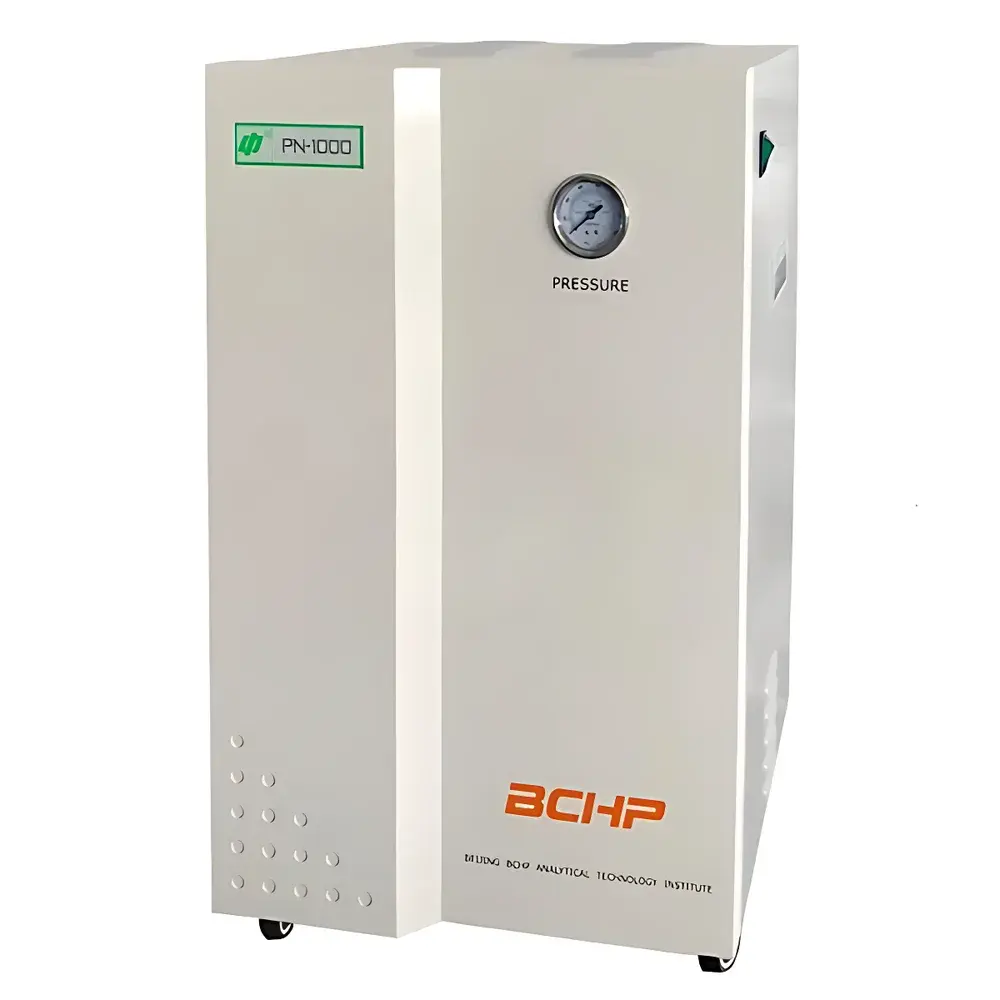
Zhonghuipu PN-1000 PSA Nitrogen Generator
| Brand | Zhonghuipu |
|---|---|
| Origin | Beijing, China |
| Manufacturer Type | Direct Manufacturer |
| Instrument Type | Nitrogen Generator |
| Nitrogen Generation Principle | Pressure Swing Adsorption (PSA) |
| Output Flow Rate | 0–1000 mL/min |
| Output Pressure | 0–0.4 MPa |
| Nitrogen Purity | 99.5%–99.999% |
| Particulate Filtration | <0.01 µm |
| Power Consumption | 650 W |
| Dimensions (W×D×H) | 400 × 425 × 700 mm |
| Net Weight | ~45 kg |
Overview
The Zhonghuipu PN-1000 PSA Nitrogen Generator is an integrated, on-demand nitrogen supply system engineered for precision laboratory and analytical instrumentation applications. It employs pressure swing adsorption (PSA) technology—a proven, dry, and chemically inert gas separation method—to continuously extract high-purity nitrogen from ambient compressed air. Unlike membrane-based or cryogenic alternatives, PSA delivers superior purity stability across variable flow demands and maintains consistent performance without consumable liquid nitrogen or high-pressure cylinder dependency. The system is purpose-built for integration with LC-MS, GC, FTIR, ICP-MS, and other nitrogen-dependent analytical platforms requiring stable, oil-free, particle-free feed gas under regulated pressure and flow conditions.
Key Features
- Industrial-grade dual-tower PSA architecture with optimized cycle timing and regeneration logic—ensures uninterrupted nitrogen delivery with minimal downtime between adsorption/desorption phases.
- High-efficiency nitrogen-selective molecular sieve imported from Japan—engineered for large dynamic adsorption capacity, mechanical robustness under repeated pressure cycling, and extended service life (>20,000 hours typical).
- Integrated oil-free scroll compressor (THOMAS brand, USA)—eliminates hydrocarbon contamination risk and removes dependency on external compressed air sources; supports continuous 7×24 operation.
- Final-stage particulate filtration to <0.01 µm (SMC brand, Japan) combined with coalescing and desiccant stages—delivers dew point ≤ −40 °C and meets ISO 8573-1 Class 2:2:2 air quality requirements for critical instrumentation.
- All-wetted gas path components fabricated from electropolished 304 stainless steel—resistant to corrosion, low outgassing, and compliant with cleanroom-compatible material specifications.
- Microprocessor-based control system with real-time monitoring of pressure, flow, purity estimation (via thermal conductivity sensor), temperature, and system fault diagnostics—supports configurable setpoints and alarm thresholds.
Sample Compatibility & Compliance
The PN-1000 is compatible with all standard laboratory gas inlets rated for ≤0.4 MPa operating pressure and ≤1000 mL/min volumetric flow. Its output meets the gas quality requirements for ASTM D6349 (for GC carrier gas), USP (for pharmaceutical analytical instruments), and ISO/IEC 17025-accredited laboratories performing trace-level analysis. The unit conforms to IEC 61000-6-3 (EMC emission standards) and IEC 61000-6-2 (immunity), and its electrical design complies with GB 4793.1 (equivalent to IEC 61010-1) for safety in laboratory environments. Optional data logging modules support audit-ready records aligned with GLP/GMP documentation practices.
Software & Data Management
The embedded controller provides local LED interface for status visualization and manual parameter adjustment. For advanced integration, optional RS-485 Modbus RTU or Ethernet TCP/IP communication enables remote monitoring via LabView, SCADA, or LIMS platforms. Event logs—including start/stop timestamps, pressure deviations, filter saturation warnings, and compressor runtime—are timestamped and exportable as CSV. When paired with validated software packages, the system supports electronic signatures, user access levels, and 21 CFR Part 11-compliant audit trails for regulated environments.
Applications
- Carrier and purge gas for gas chromatography (GC) and GC-MS systems
- Collision/reaction gas for inductively coupled plasma mass spectrometry (ICP-MS)
- Drying and blanketing gas in gloveboxes and inert-atmosphere synthesis workstations
- Atomization and nebulization support in ICP-OES and laser ablation systems
- Blank runs and system conditioning in FTIR and Raman spectroscopy
- Mobile or field-deployable labs where cylinder logistics are impractical
FAQ
What is the expected lifetime of the molecular sieve under normal lab usage?
With proper inlet air filtration and adherence to ambient temperature/humidity limits (15–30 °C, RH <60%), the sieve typically operates effectively for ≥5 years before requiring replacement.
Does the unit require periodic calibration?
No routine calibration is required; however, annual verification of outlet purity using a trace oxygen analyzer (e.g., electrochemical or zirconia sensor) is recommended per ISO 8573-6 and internal QA protocols.
Can the PN-1000 be connected to multiple instruments simultaneously?
Yes—provided total demand remains within 1000 mL/min and downstream pressure drop is minimized via appropriately sized distribution manifolds and tubing (recommended ID ≥3 mm for runs >2 m).
Is the nitrogen output suitable for LC-MS applications?
Yes—the combination of <0.01 µm filtration, hydrocarbon-free compression, and moisture removal ensures compatibility with electrospray ionization (ESI) and atmospheric pressure chemical ionization (APCI) sources when operated within specified flow and pressure ranges.
What maintenance intervals are recommended?
Pre-filters every 3 months, coalescing filter every 6 months, desiccant cartridge annually, and full system inspection including compressor oil-free integrity check every 2 years.



