
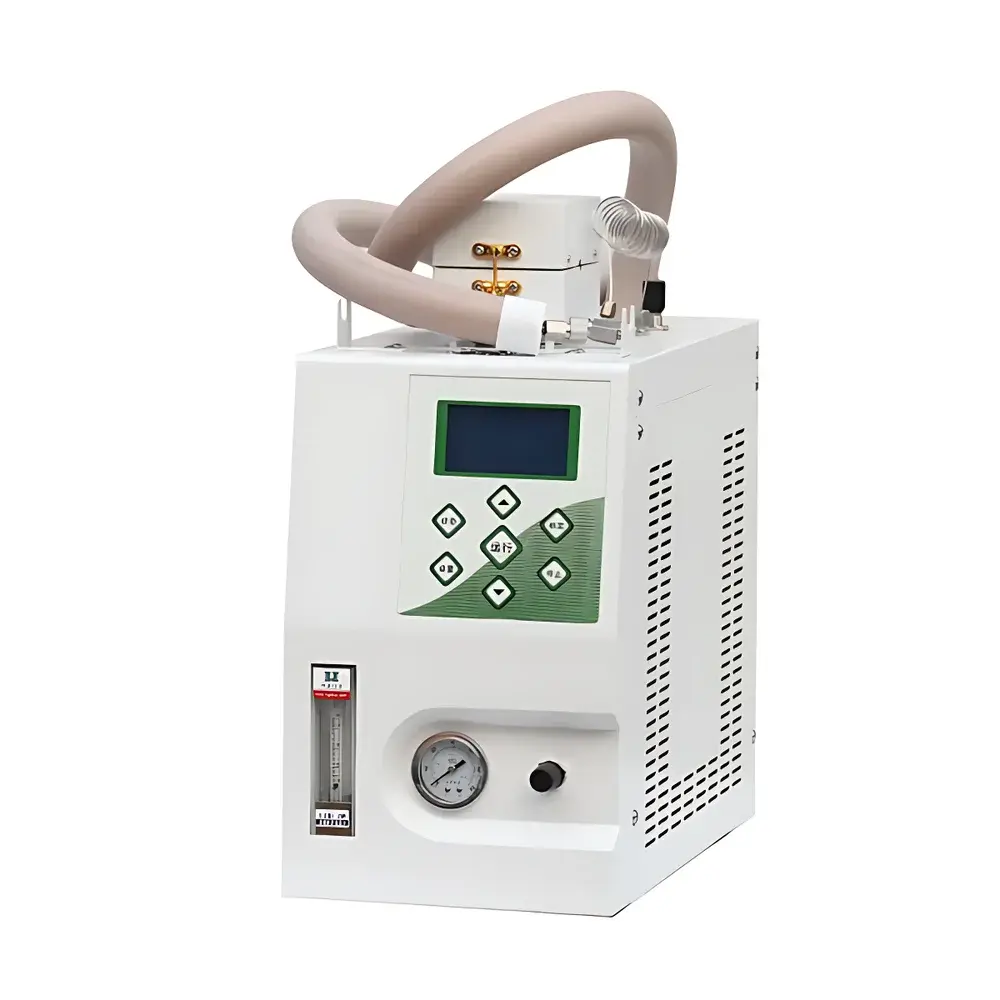
Zhonghuipu JX-3 Single-Stage Thermal Desorber
| Brand | Zhonghuipu |
|---|---|
| Origin | Beijing, China |
| Manufacturer Type | Manufacturer |
| Product Category | Domestic |
| Model | JX-3 |
| Instrument Type | Single-Stage Thermal Desorber |
| Automation Level | Semi-Automatic |
| Desorption Temperature Range | Ambient to 400 °C, Control Accuracy: ±1 °C |
| Valve Oven Temperature Range | Ambient to 240 °C, Control Accuracy: ±1 °C |
| Transfer Line Temperature Range | Ambient to 240 °C, Control Accuracy: ±1 °C |
| Sample Position Count | 1 |
| Calibration Simulation Time | 0–60 min |
| Desorption Duration | 0–60 min |
| Injection Time | 0–10 min |
| Trap Dimensions | Ø6 mm, Length >120 mm |
| Peak Power Consumption | 300 W |
Overview
The Zhonghuipu JX-3 Single-Stage Thermal Desorber is a compact, semi-automated thermal desorption system engineered for precise, reproducible release of volatile and semi-volatile organic compounds (VOCs and SVOCs) from sorbent tubes prior to gas chromatographic analysis. It operates on the principle of controlled resistive heating of thermally stable sorbent traps—typically packed with multi-bed materials such as Tenax TA, Carbopack B, or Carboxen—followed by direct transfer of desorbed analytes into the inlet of a coupled gas chromatograph (GC) via a heated, inert transfer line and high-temperature six-port valve. Unlike cryofocused or cold-trap-based systems, the JX-3 implements a single-stage desorption process optimized for routine compliance-driven applications in occupational hygiene and ambient/environmental air monitoring, where regulatory methods specify direct thermal desorption without cryogenic refocusing.
Key Features
- Three independently controlled temperature zones—desorption furnace, valve oven, and transfer line—each maintained within ±1 °C across their full operating ranges (ambient–400 °C for the furnace; ambient–240 °C for both valve and line), eliminating cold spots and ensuring quantitative analyte transfer.
- Integrated sample simulation capability enables accurate calibration using standard gaseous or permeation-based reference materials, supporting method validation per ISO 16000-6 and ASTM D6196 protocols.
- PTFE-sealed, de-activated 316 stainless steel fluidic pathways—including the six-port valve manifold and all heated tubing—minimize surface adsorption, carryover, and background contamination, even at elevated temperatures.
- Motor-driven, high-temperature six-port valve (rated to 240 °C) eliminates reliance on external pneumatic actuation, reducing system complexity and improving long-term operational stability.
- Optimized trap-to-line interface geometry—using calculated tapered fittings—reduces dead volume at critical junctions, enhancing peak shape fidelity and recovery efficiency for early-eluting compounds such as benzene and formaldehyde.
- Microcontroller-based embedded system supports fully programmable method sequences: tube conditioning (bake-out), calibration simulation, thermal desorption, and GC injection—all initiated via single-button operation.
Sample Compatibility & Compliance
The JX-3 accommodates standard 6 mm OD stainless steel or glass sorbent tubes (≥120 mm length), compatible with widely adopted trapping media used in EPA TO-17, HJ 583–2010, GB 11737–1989, and GB 50325–2020 methodologies. Its thermal performance and inert flow path meet the hardware requirements for compliant execution of benzene, toluene, ethylbenzene, xylenes (BTEX), and total volatile organic compound (TVOC) analyses in indoor air, workplace breathing zone, and ambient air sampling programs. While not inherently 21 CFR Part 11 compliant due to its embedded control architecture, audit-ready operation is supported through manual logbook documentation and external data capture from the connected GC’s acquisition software.
Software & Data Management
The JX-3 operates without proprietary PC software; all parameters—including desorption time (0–60 min), valve switching timing, simulation duration (0–60 min), and injection hold time (0–10 min)—are configured locally via membrane keypad and LCD interface. Method files are stored in non-volatile memory with timestamped execution logs. For laboratories requiring electronic records, integration is achieved via TTL-level trigger signals synchronized with GC start commands, enabling traceable correlation between desorption events and chromatographic runs. This design aligns with GLP-aligned workflows where instrument control remains decentralized and data integrity is anchored at the GC data system level.
Applications
- Routine quantification of BTEX and C2–C12 aliphatic/aromatic hydrocarbons in indoor air per GB 50325–2020 Annex E and F.
- Workplace exposure assessment under Chinese occupational health standards (e.g., GBZ/T 160 series) using charcoal or silica gel-backed sorbent tubes.
- Environmental monitoring of ambient VOCs in urban and industrial zones following HJ 583–2010 protocols.
- Method development and validation for thermal desorption-GC/MS applications targeting polar and thermally labile analytes, leveraging precise temperature ramping and zero-dead-volume interfaces.
- Sorbent tube reconditioning (bake-out) at up to 400 °C to restore trapping efficiency and minimize breakthrough artifacts in sequential sampling campaigns.
FAQ
Is the JX-3 compatible with Agilent, Thermo Fisher, and Shimadzu GC systems?
Yes—the JX-3 delivers a standard GC-compatible injection pulse via its heated valve interface and requires no hardware modification to the GC inlet. It has been validated with split/splitless injectors operating in purge-and-trap or direct injection mode.
Does the system support multi-tube batch processing?
No—the JX-3 is a single-position unit designed for sequential analysis. For high-throughput labs, parallel operation of multiple JX-3 units or migration to a fully automated multi-tube platform is recommended.
Can the desorption temperature exceed 400 °C?
No—the maximum furnace setpoint is 400 °C, consistent with thermal stability limits of common sorbents and regulatory method constraints. Exceeding this may degrade trap integrity and introduce carbonaceous artifacts.
What maintenance is required for long-term reliability?
Routine inspection of PTFE seals, periodic replacement of valve rotor seal (every 10,000 cycles), and annual verification of temperature uniformity across all three zones using NIST-traceable probes are recommended.
Is remote monitoring or Ethernet connectivity available?
No—remote access is not supported. All operation and diagnostics are performed locally via front-panel interface. Integration with LIMS or SCADA systems requires external signal logging via dry-contact I/O or analog voltage outputs (optional accessory).





