
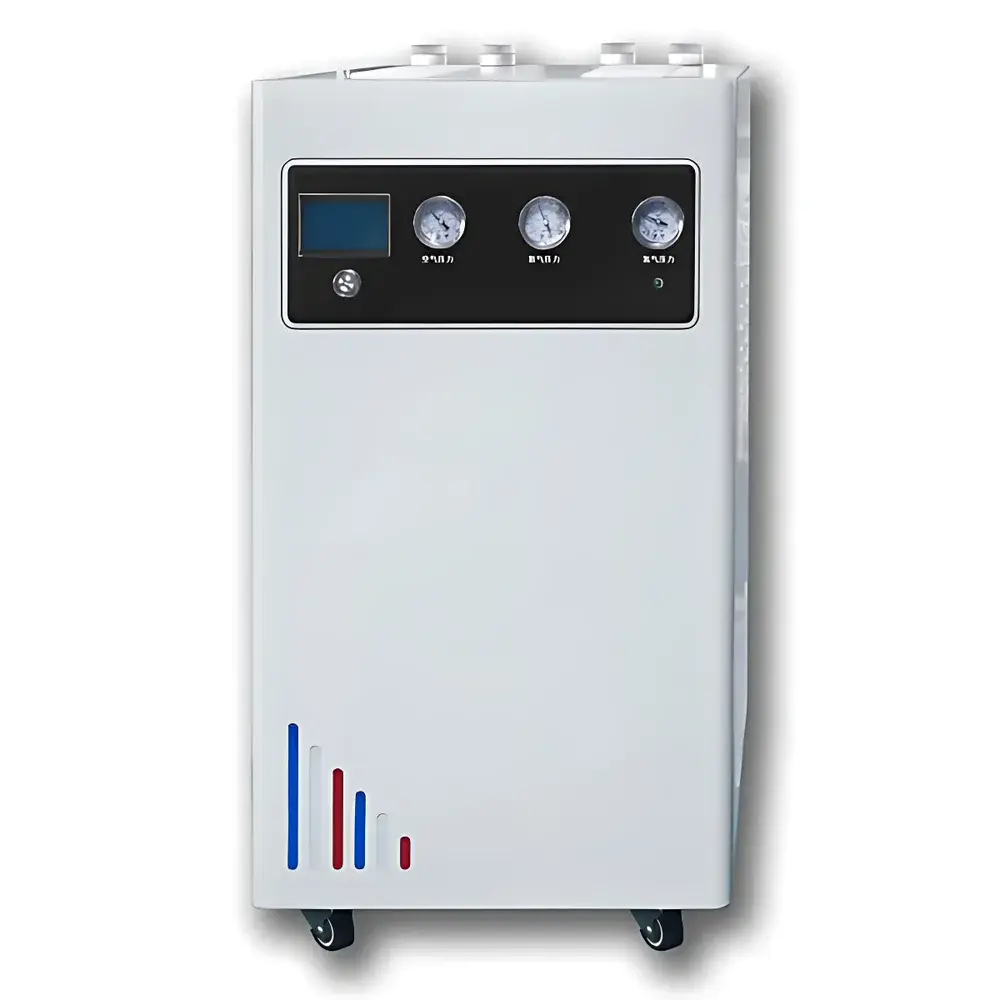
Zhonghuipu NHA-2300 Integrated Nitrogen-Hydrogen-Zero Air Generator
| Brand | Zhonghuipu |
|---|---|
| Origin | Beijing, China |
| Manufacturer Type | Direct Manufacturer |
| Model | NHA-2300 |
| Nitrogen Purity | 99.9995% |
| Nitrogen Flow Rate | 0–150 mL/min |
| Nitrogen Pressure | 0–0.4 MPa |
| Hydrogen Purity | 99.999% |
| Hydrogen Flow Rate | 0–300 mL/min |
| Hydrogen Pressure | 0–0.4 MPa |
| Zero Air Flow Rate | 0–1 L/min |
| Zero Air Pressure | 0–0.4 MPa |
| Hydrocarbon Content in Zero Air | <20 ppb |
| Power Supply | 220 V ±10%, 50 Hz |
| Peak Power Consumption | 1250 W |
| Operating Temperature | 5–35 °C |
| Relative Humidity | <85% RH |
| Dimensions (W×D×H, excluding casters) | 430 × 580 × 725 mm |
| Net Weight | ~55 kg |
Overview
The Zhonghuipu NHA-2300 Integrated Nitrogen-Hydrogen-Zero Air Generator is an engineered solution for laboratories requiring reliable, on-demand supply of three critical carrier and support gases for gas chromatography (GC) systems. Designed to replace high-pressure cylinders, this single-unit generator delivers purified nitrogen (for carrier and purge gas), hydrogen (for fuel in FID and as carrier in some GC applications), and zero-grade air (for detector makeup or FID oxidant) — all simultaneously and independently regulated. Its core architecture integrates pressure-swing adsorption (PSA) for nitrogen generation, PEM-free alkaline electrolysis for hydrogen production, and membrane-based dehydration coupled with catalytic hydrocarbon removal for zero air. The system operates continuously under unattended 7×24 conditions, meeting the stability and purity demands of modern GC configurations including ECD, FID, TCD, and capillary column setups.
Key Features
- Triple-gas output from one compact unit: nitrogen, hydrogen, and zero air — eliminating cylinder logistics, storage hazards, and cross-contamination risks.
- High-efficiency dual-tower PSA nitrogen generation using imported Japanese molecular sieves with enhanced adsorption capacity and mechanical durability; integrated SMC 0.01 µm particulate filtration and high-temperature precious-metal hydrocarbon catalyst ensures compliance with ECD and polar column specifications.
- Hydrogen generation via transition-metal-catalyzed alkaline electrolysis; liquid electrolyte design tolerates standard deionized water quality, reducing operational dependency on ultrapure water systems.
- Automated water replenishment controlled by microprocessor — detects electrolyte level depletion and triggers refill from optional 15 L external reservoir, supporting up to one month of continuous operation for single-detector GC systems.
- Integrated Thomas-brand oil-free scroll compressor for zero air generation; paired with SMC hollow-fiber membrane dryers and post-catalytic purification to achieve hydrocarbon content <20 ppb and consistent dew point performance without routine desiccant replacement.
- Comprehensive safety architecture: hydrogen leak detection with automatic shutdown, over-pressure and over-temperature cutouts, compressor duty-cycle monitoring with fatigue-based auto-shutdown, and dry-run protection for the electrolytic cell.
- Stainless-steel gas pathways and ASME-compliant aluminum adsorption towers with sandblasted anodized finish ensure long-term chemical inertness and minimal outgassing — critical for trace-level analysis.
Sample Compatibility & Compliance
The NHA-2300 is validated for use with all major GC platforms requiring certified-grade gases, including Agilent, Thermo Fisher, Shimadzu, and PerkinElmer instruments. Nitrogen output meets ASTM D6866 and ISO 8573-1 Class 1.2.1 requirements for particle and hydrocarbon content. Hydrogen purity aligns with ISO 8573-1 Class 1.1.1 and USP for instrumental gas purity. Zero air complies with EPA Method TO-14/TO-15 specifications for ambient air monitoring and VOC analysis. All internal firmware logs operational parameters (pressure, flow, temperature, alarm events) with timestamped records suitable for GLP/GMP audit trails. While not pre-certified to FDA 21 CFR Part 11, the system supports electronic record retention compatible with laboratory information management systems (LIMS) implementing Part 11-compliant validation protocols.
Software & Data Management
The NHA-2300 employs a dedicated embedded microcontroller platform with real-time monitoring of all subsystems — nitrogen tower cycling status, hydrogen cell voltage/current, zero air compressor runtime, and filter saturation indicators. Front-panel LED displays show individual gas pressures, flow rates, and active fault codes. Optional RS-232 or analog 4–20 mA outputs enable integration into centralized facility monitoring systems. Logged data (stored internally for ≥30 days) includes cumulative operating hours per module, number of safety interventions, and calibration event timestamps — exportable via USB for QA documentation. No cloud connectivity or proprietary software installation is required; configuration remains accessible via physical keypad navigation only, minimizing cybersecurity exposure in regulated environments.
Applications
- Carrier gas supply for capillary GC and GC-MS systems requiring ultra-high-purity nitrogen (≤0.5 ppm O₂, ≤0.1 ppm H₂O, ≤0.05 ppm hydrocarbons).
- Fuel gas source for flame ionization detectors (FID) and thermal conductivity detectors (TCD), where stable hydrogen flow and purity directly impact baseline noise and sensitivity.
- Zero air for FID makeup gas, electron capture detector (ECD) make-up, or dilution standards preparation in environmental testing labs (e.g., EPA SW-846, ASTM D5504).
- Support gas for headspace samplers, purge-and-trap concentrators, and automated GC sample introduction modules.
- Research laboratories performing method development under ICH Q2(R2) guidelines where gas source consistency impacts method robustness and intermediate precision.
FAQ
What maintenance intervals are recommended for the NHA-2300?
The nitrogen molecular sieve requires replacement every 20,000 operating hours; hydrogen electrolyte should be refreshed annually or after 12,000 hours; zero air membrane filters are lifetime components under normal humidity conditions but require inspection every 18 months.
Can the NHA-2300 be installed in a fume hood or enclosed cabinet?
No — adequate ventilation is mandatory due to heat dissipation (1250 W peak) and potential hydrogen accumulation risk; minimum 50 cm clearance on all sides and ceiling is required per IEC 61000-3-12.
Is remote monitoring supported via Ethernet or Wi-Fi?
No — the system provides only local display and analog/serial interfaces to maintain electromagnetic compatibility and regulatory simplicity in analytical lab environments.
Does the generator meet UL or CE safety certification requirements?
It conforms to GB 4793.1–2019 (China’s equivalent to IEC 61010-1) and carries CCC certification; CE marking is not applied as it is not intended for direct EU market distribution without additional Notified Body assessment.
How does the system handle power interruptions?
Upon power loss, all gas outputs shut down immediately; restart requires manual confirmation after stabilization — no automatic repressurization to prevent uncontrolled gas release during recovery.



