
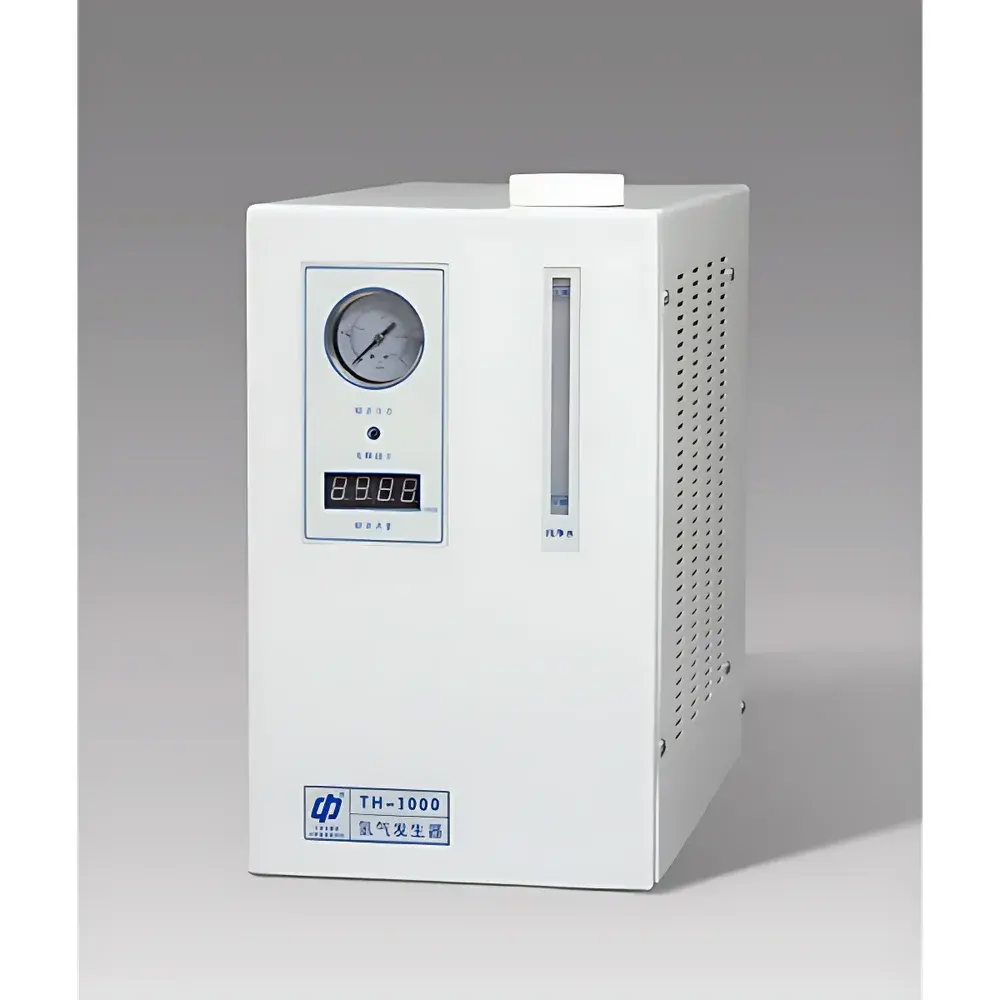
Zhonghuipu TH-1000 High-Purity Hydrogen Generator
| Brand | Zhonghuipu |
|---|---|
| Origin | Beijing, China |
| Manufacturer Type | Direct Manufacturer |
| Model | TH-1000 |
| Hydrogen Generation Principle | Pure Water Electrolysis |
| Output Flow Rate | 0–1000 mL/min |
| Output Pressure | 0–0.4 MPa |
| Hydrogen Purity | 99.999% |
| Power Consumption | 400 W |
| Dimensions (W×D×H) | 480 × 360 × 220 mm |
| Net Weight | 18 kg |
| Pressure Stability | < 0.001 MPa |
| Input Power | 220 V ±10%, 50 Hz |
| Certification | CE |
Overview
The Zhonghuipu TH-1000 High-Purity Hydrogen Generator is an on-demand, membrane-based electrolytic gas generator engineered for continuous, reliable hydrogen supply in analytical laboratories—particularly for gas chromatography (GC) and other precision instrumentation requiring ultra-high-purity carrier or fuel gas. It operates via proton exchange membrane (PEM) electrolysis of deionized water, eliminating the need for caustic potassium hydroxide (KOH) solutions and thereby reducing maintenance burden, corrosion risk, and potential contamination of sensitive detectors such as nitrogen-phosphorus (NPD) and flame photometric (FPD) detectors. The system delivers hydrogen at a maximum flow rate of 1000 mL/min and pressure up to 0.4 MPa, with pressure stability maintained within ±0.001 MPa under dynamic load conditions. Its compact footprint (480 × 360 × 220 mm) and integrated safety architecture—including automatic water-level monitoring, over-pressure cutoff, and thermal shutdown—make it suitable for benchtop deployment in regulated environments compliant with ISO/IEC 17025, GLP, and GMP workflows.
Key Features
- Solid Polymer Electrolyte (SPE) technology using imported perfluorosulfonic acid (PFSA) ion-exchange membranes for high proton conductivity and long-term electrochemical stability
- Zero-KOH operation: pure water feedstock only—no alkaline electrolytes, no neutralization waste, no risk of column contamination or detector poisoning
- Low-sulfur silicone elastomer seals throughout gas path to minimize sulfur-based interference, ensuring stable baselines for sulfur- and phosphorus-selective detectors
- Fully integrated pressure and flow control via closed-loop PID regulation; real-time adjustment without manual regulators or external back-pressure valves
- Intelligent water management system with capacitive level sensing and automatic shutdown upon low-water condition to protect the electrolytic cell from dry-run damage
- CE-certified electrical design meeting EN 61010-1 safety requirements for laboratory equipment; EMI/EMC compliance per EN 61326-1
Sample Compatibility & Compliance
The TH-1000 is compatible with all major GC platforms—including Agilent, Thermo Fisher Scientific, Shimadzu, PerkinElmer, and Waters—regardless of detector type (FID, TCD, NPD, FPD, ECD) or inlet configuration (split/splitless, PTV, on-column). Its 99.999% hydrogen purity meets ASTM D7520 (Standard Test Method for Determination of Hydrogen Purity in Gas Chromatography Carrier Gases) and aligns with USP and EP 2.5.27 specifications for high-purity gases used in pharmaceutical analysis. The generator supports method transfer across instruments without revalidation of gas quality, and its digital control interface enables audit-ready event logging for FDA 21 CFR Part 11–compliant environments when paired with validated LIMS or chromatography data systems (CDS).
Software & Data Management
The TH-1000 features a microprocessor-controlled front panel with LED status indicators for power, water level, pressure, and fault conditions. While it does not include embedded PC software or remote connectivity, its analog output signals (0–5 V DC for pressure and flow) and digital relay outputs (dry contact) allow seamless integration into centralized lab monitoring systems or PLC-based facility management infrastructure. All operational parameters—including cumulative runtime, total H₂ volume generated, and number of auto-shutdown events—are stored in non-volatile memory for periodic review during preventive maintenance. Calibration records and service logs may be maintained externally in accordance with ISO/IEC 17025 clause 7.7 (Equipment Records) and GLP Principle 5.2.3 (Instrument History Files).
Applications
- Carrier gas for capillary GC and GC-MS systems requiring consistent, low-part-per-trillion oxygen and moisture content
- Fuel gas for flame ionization detectors (FID), where stoichiometric H₂/air ratios demand precise, pulse-free flow delivery
- Hydrogenation support in preparative GC or hyphenated techniques such as GC-FTIR
- Lab-scale hydrogen supply for electrochemical cell testing, catalyst evaluation, or materials science research under inert atmosphere
- Replacement for high-pressure hydrogen cylinders in multi-instrument labs seeking improved safety, space efficiency, and operational continuity
FAQ
What type of water is required for optimal operation?
Deionized water with resistivity ≥ 15 MΩ·cm and total organic carbon (TOC) < 50 ppb is recommended. Use of lower-grade water may accelerate membrane fouling and reduce electrolyzer lifetime.
Does the TH-1000 require periodic electrolyte replacement or conditioning?
No. As a zero-KOH, SPE-based system, it uses only purified water—no liquid electrolyte replenishment, no pH balancing, and no membrane reconditioning procedures are necessary.
Can the TH-1000 be operated continuously for 24/7 applications?
Yes. Designed for unattended operation, it includes thermal protection, pressure relief, and fail-safe water monitoring to support extended duty cycles typical in core analytical facilities.
Is the hydrogen output traceable to national standards?
While the TH-1000 itself is not a certified reference standard, its performance specifications (e.g., 99.999% purity) are verified per ISO 8573-1:2010 Class 1 for gaseous contaminants and can be confirmed using calibrated gas analyzers traceable to NIST SRMs.
How often should preventive maintenance be performed?
Annual inspection of seals, water reservoir integrity, and pressure sensor calibration is recommended; membrane replacement is typically required every 3–5 years depending on usage intensity and water quality.



