
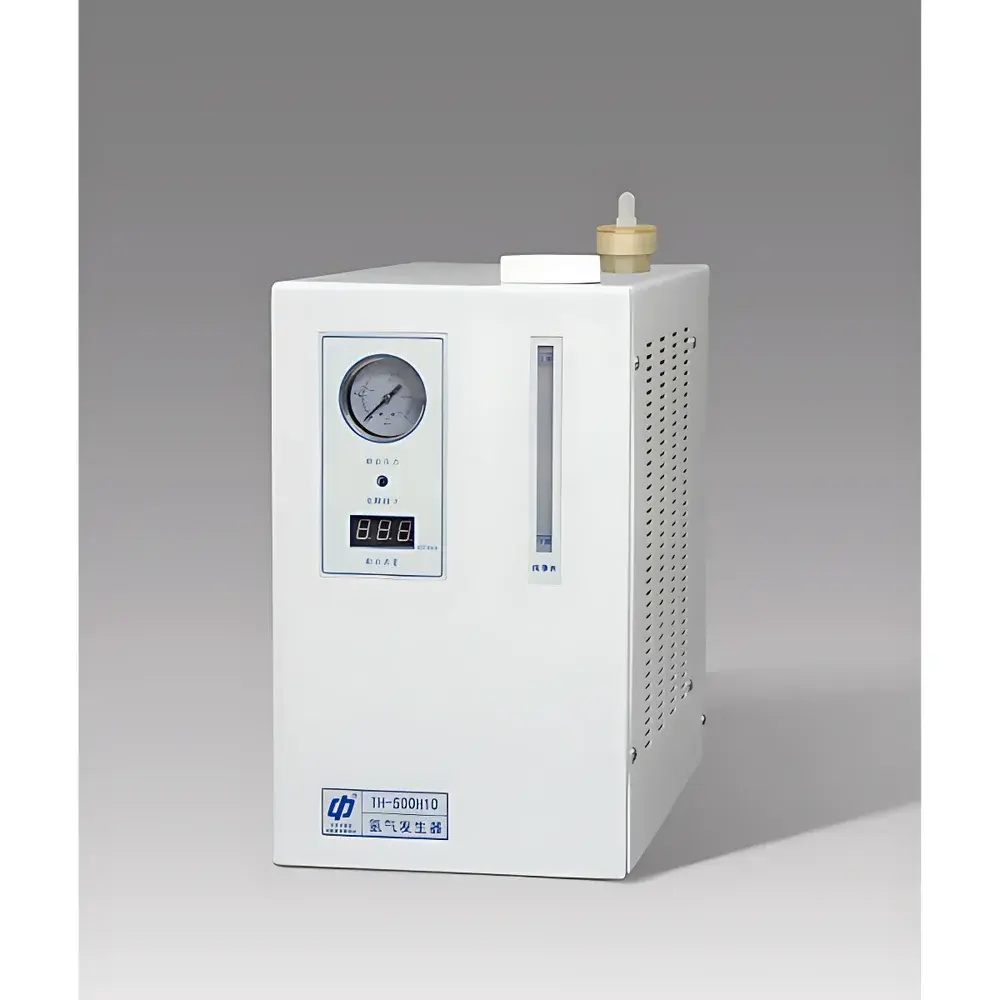
Zhonghuipu TH-500H10 High-Pressure Hydrogen Generator
| Brand | Zhonghuipu |
|---|---|
| Origin | Beijing, China |
| Manufacturer Type | Direct Manufacturer |
| Model | TH-500H10 |
| Hydrogen Generation Principle | Pure Water Electrolysis via SPE Membrane |
| Output Flow Rate | 0–500 mL/min |
| Output Pressure | 0–10 MPa (100 kg/cm²) |
| Hydrogen Purity | 99.999% |
| Power Consumption | 250 W |
| Dimensions (W×D×H) | 400 × 360 × 220 mm |
| Net Weight | 26 kg |
| Pressure Stability | < 0.01 MPa |
| Input Power | 220 V ±10%, 50 Hz |
| Certifications | CE |
Overview
The Zhonghuipu TH-500H10 High-Pressure Hydrogen Generator is an engineered solution for laboratories requiring ultra-pure, high-pressure hydrogen gas on-demand. It employs solid polymer electrolyte (SPE) membrane-based water electrolysis—a zero-chemical, closed-loop process that splits deionized water into high-purity H₂ and O₂ without alkaline electrolytes or consumable reagents. Unlike traditional KOH-based systems, the TH-500H10 eliminates caustic handling risks, reduces maintenance frequency, and ensures consistent gas quality under variable load conditions. Designed for integration into catalytic hydrogenation reactors, high-pressure GC carrier gas supply, fuel cell testing rigs, and hydride generation atomic absorption spectrometry (HG-AAS), this generator delivers stable output at pressures up to 10 MPa—enabling direct use as a reaction gas in sealed autoclaves or flow-through reactor systems.
Key Features
- SPE proton exchange membrane technology with imported perfluorosulfonic acid (PFSA) ionomer—ensuring high proton conductivity, low gas crossover, and long-term operational stability.
- Electrolyte-free operation: uses only ultrapure water (≥15 MΩ·cm resistivity) as feedstock; no KOH, NaOH, or other corrosive electrolytes required.
- Integrated pressure and flow control architecture: digital PID regulation maintains setpoint accuracy within ±0.5% of full scale across the entire 0–500 mL/min range.
- High-integrity gas path: all wetted components—including gas–liquid separator, particulate filter, and pressure regulators—are constructed from electropolished 316L stainless steel; low-sulfur silicone O-rings minimize trace sulfur contamination.
- Intelligent water management system: capacitive level sensing triggers automatic shutdown when reservoir volume falls below safe operating threshold, preventing dry-electrolysis damage to the membrane electrode assembly (MEA).
- Robust mechanical design: compact footprint (400 × 360 × 220 mm), vibration-damped chassis, and IP20-rated enclosure suitable for standard laboratory environments.
Sample Compatibility & Compliance
The TH-500H10 is compatible with any application requiring continuous, high-purity hydrogen at elevated pressures—particularly where regulatory traceability and material compatibility are critical. Its gas output meets ISO 8573-1:2010 Class 1 (oil-free) and Class 2 (particulate ≤ 0.1 µm) specifications for compressed gases. The system complies with CE marking requirements under the EU Machinery Directive 2006/42/EC and Low Voltage Directive 2014/35/EU. While not inherently 21 CFR Part 11 compliant, its analog control interface supports external data logging systems validated for GLP/GMP environments. All pressure vessels conform to PED 2014/68/EU Category II design standards, with ASME Section VIII Div. 1 equivalency verified through third-party hydrostatic testing at 1.5× maximum allowable working pressure (MAWP).
Software & Data Management
The TH-500H10 operates via a front-panel LCD interface with real-time display of pressure, flow rate, water level, and operating temperature. Optional RS-485 Modbus RTU or analog 4–20 mA outputs enable integration with centralized lab monitoring platforms (e.g., LabVantage, DeltaV, or custom SCADA). No proprietary software is bundled; however, the device supports standard industrial protocols for remote parameter adjustment, alarm logging, and runtime diagnostics. Audit trails—including start/stop timestamps, pressure excursions, and maintenance alerts—can be captured externally using compliant data acquisition hardware meeting FDA 21 CFR Part 11 requirements when paired with appropriate electronic signature and access control layers.
Applications
- Catalytic hydrogenation in high-pressure batch and continuous-flow reactors (e.g., Parr reactors, H-Cube Pro interfaces).
- Carrier and fuel gas supply for high-resolution gas chromatography (GC), especially in capillary column analysis requiring inert, moisture-free H₂.
- Hydrogen sulfide (H₂S) and hydride generation for atomic absorption spectroscopy (AAS) and ICP-MS sample introduction.
- Fuel cell performance evaluation under realistic operating pressures (up to 10 MPa anode feed).
- Isotope labeling studies requiring chemically pure, low-carbon-background hydrogen.
- Calibration gas generation for hydrogen sensors and leak detection systems.
FAQ
What type of water is required for optimal operation?
Deionized water with resistivity ≥15 MΩ·cm and total organic carbon (TOC) < 50 ppb is mandatory. Tap water, distilled water, or reverse-osmosis-only water will cause rapid membrane fouling and irreversible performance loss.
Can the TH-500H10 be used with existing hydrogen piping infrastructure?
Yes—provided the downstream system is rated for 10 MPa service pressure and certified for hydrogen service (per ISO 15848-1 for fugitive emissions and ASTM G136 for embrittlement resistance). Stainless steel 316 or higher-grade tubing with metal-seal fittings is required.
How often does the SPE membrane require replacement?
Under normal operation with compliant feed water, the membrane has a typical service life of 8,000–10,000 hours. Replacement intervals are tracked via cumulative runtime logging and confirmed by declining efficiency (2.2 V at 500 mL/min).
Is oxygen venting safe in an enclosed lab space?
Oxygen is produced stoichiometrically (1:2 H₂:O₂ ratio) and must be vented to ambient air via dedicated exhaust ducting. Local ventilation codes (e.g., ANSI Z9.5) require dilution airflow ≥6 air changes per hour in rooms housing electrolytic gas generators.
Does the unit include automatic safety shutoffs?
Yes—integrated safeguards include overpressure relief (set at 10.5 MPa), thermal cutoff at 85°C, low-water interlock, and hydrogen sensor-triggered emergency purge (optional add-on module).



