
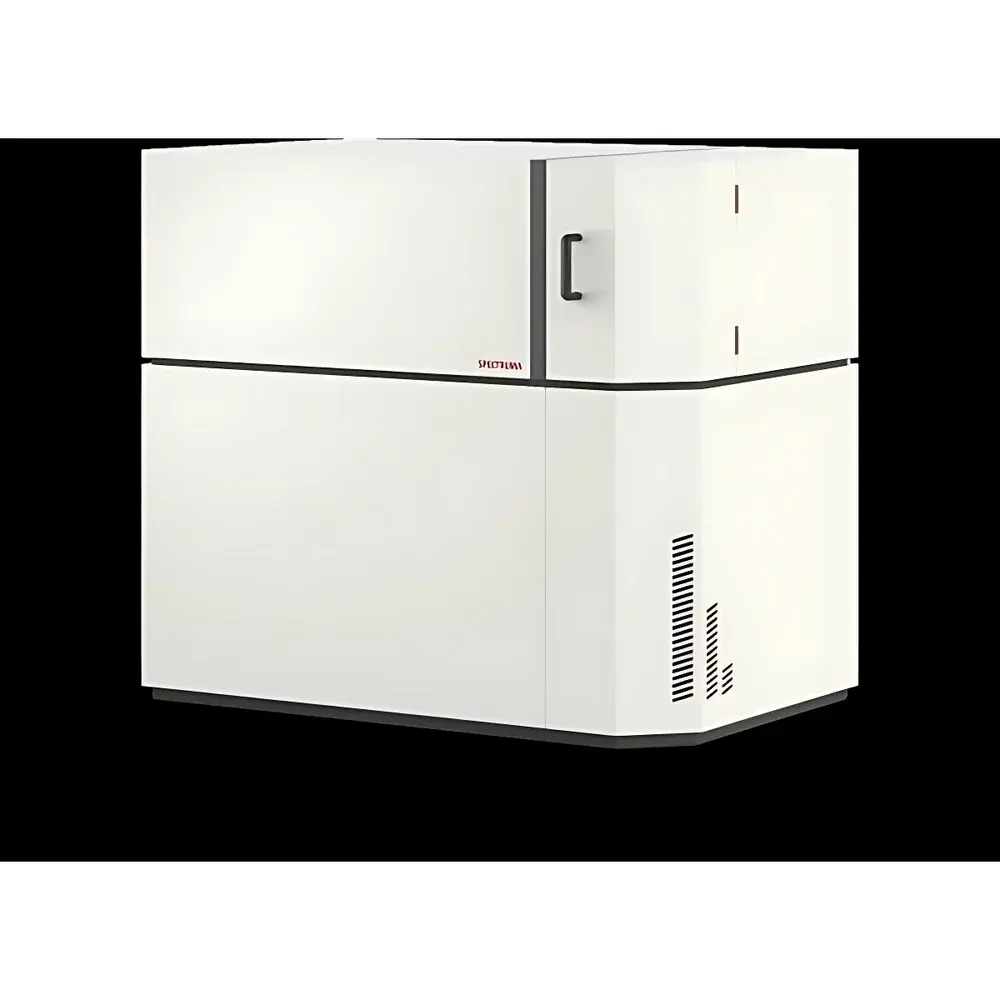
SPECTRUMA GDA 750 HR Glow Discharge Optical Emission Spectrometer
| Brand | SPECTRUMA |
|---|---|
| Origin | Germany |
| Model | GDA 750 HR |
| Detection Range | H–U (76 elements) |
| Detection Limit | sub-ppm level |
| Depth Resolution | nanometer-scale to several hundred micrometers |
| Quantitative Precision | RSD < 2% (content), RSD < 5% (depth) |
| Sample Types | conductive & non-conductive solids (flat, curved, thin-film, air-sensitive layers) |
| Compliance | ISO/IEC 17025-ready architecture, GLP-compatible data handling |
Overview
The SPECTRUMA GDA 750 HR Glow Discharge Optical Emission Spectrometer (GDOES) is a high-resolution, direct solid analysis instrument engineered for quantitative depth profiling of layered materials. Operating on the principle of radiofrequency (RF) or pulsed DC glow discharge plasma sputtering coupled with high-resolution optical emission spectroscopy, the GDA 750 HR enables rapid, matrix-independent elemental quantification from surface (sub-nanometer) to depths exceeding 300 µm. Unlike destructive micro-analytical techniques such as SIMS or SNMS—requiring ultra-high vacuum, complex sample preparation, and limited lateral homogeneity—the GDA 750 HR delivers macroscopic compositional mapping with minimal sample intervention. Its RF source design allows stable, reproducible sputtering of both electrically conductive (e.g., metals, alloys) and insulating substrates (e.g., glass, ceramics, DLC, polymer-coated wafers), eliminating the need for conductive coating or embedding. This makes it uniquely suited for industrial quality control, R&D validation, and process optimization across multi-layered functional coatings.
Key Features
- High-resolution monochromator with optimized grating and photomultiplier tube (PMT) detection for simultaneous multi-element monitoring
- RF-powered glow discharge source enabling robust analysis of non-conductors without auxiliary electrodes or metallization
- Programmable sputtering parameters (power, pressure, gas flow) for controlled erosion rates and depth resolution down to ~1 nm per data point
- Integrated sample chamber with inert gas purge capability for air-sensitive thin films (e.g., Li-ion battery cathodes, perovskite layers)
- Modular detector configuration supporting extended UV–VIS spectral range (110–800 nm), covering H, O, N, C, F, Cl, and all metallic elements up to U
- Robust mechanical architecture compliant with ISO 14644-1 Class 8 cleanroom integration requirements
Sample Compatibility & Compliance
The GDA 750 HR accepts solid samples up to Ø50 mm × 25 mm in thickness, including planar, cylindrical, and low-curvature geometries. It routinely analyzes PVD/CVD-deposited stacks (TiN/TiAlN, Al₂O₃/ZrO₂), electroplated multilayers (Zn/Ni/Cr, Sn-Cu), conversion coatings (phosphate, chromate), thermally diffused zones (carburized/ nitrided steel), and emerging energy materials (CIGS photovoltaic absorbers, NMC cathodes, amorphous Si:H). Non-conductive substrates—including fused silica, alumina ceramics, PET-based flexible electronics, and biomedical hydroxyapatite coatings—are analyzed without preprocessing. All analytical workflows align with ISO 14707 (metallic coatings – depth profiling by GD-OES), ASTM E3061 (standard guide for glow discharge optical emission spectrometry), and support audit-ready documentation per FDA 21 CFR Part 11 when paired with validated WinGDOES software configurations.
Software & Data Management
WinGDOES v4.x provides full instrument control, real-time sputter rate calibration, matrix-matched standardization, and certified quantification protocols. The software supports automated sequence execution, multi-sample batch processing, and export of traceable ASCII/CSV datasets compliant with LIMS integration. Built-in uncertainty propagation models calculate combined standard uncertainty (k=2) for each depth-resolved concentration value. Audit trails record all parameter changes, user logins, calibration events, and report generations—enabling full GLP/GMP compliance. Optional modules include layer-thickness calculation (based on stoichiometric sputter yields), interface diffusion modeling, and comparative overlay analysis for cross-lot validation.
Applications
- Automotive: Zn–Ni alloy plating adhesion verification, brake rotor DLC coating uniformity, catalytic converter washcoat depth distribution
- Aerospace: Ti–6Al–4V anodized layer integrity, thermal barrier coating (YSZ) interdiffusion with bond coat
- Semiconductor & PV: Cu–Ta–SiN stack composition in BEOL interconnects; CdTe/CdS heterojunction grading profiles
- Medical Devices: Hydroxyapatite coating thickness and Ca/P ratio on titanium implants; drug-eluting polymer film degradation kinetics
- Energy Storage: Solid-electrolyte interphase (SEI) evolution on graphite anodes; Ni-rich NMC cathode surface reconstruction after cycling
- Research Institutions: Validation of ALD cycle repeatability; interfacial reaction kinetics in Mg–Al diffusion couples
FAQ
Can the GDA 750 HR analyze hydrogen and light elements reliably?
Yes. Equipped with vacuum UV optics and MgF₂ windows, it detects H, He, Li, Be, B, C, N, O, and F with sub-ppm detection limits under optimized RF plasma conditions.
Is sample polishing required prior to analysis?
No. Flatness within ±5 µm over the analysis area is sufficient. Rough surfaces may require minor leveling, but no metallographic grinding or etching is needed.
How is depth scale calibrated?
Using certified reference materials (CRMs) with known layer thicknesses (e.g., NIST SRM 2136, BAM 1090), or via profilometry of sputter craters post-analysis.
Does the system support regulatory compliance for pharmaceutical manufacturing?
When deployed with 21 CFR Part 11-compliant WinGDOES configuration and qualified IQ/OQ/PQ protocols, it meets analytical instrument qualification requirements for coated medical device substrates.
What maintenance intervals are recommended?
Vacuum pump oil change every 6 months; anode/cathode cleaning every 200 hours of operation; annual PM including optical alignment verification and gas flow calibration.






