
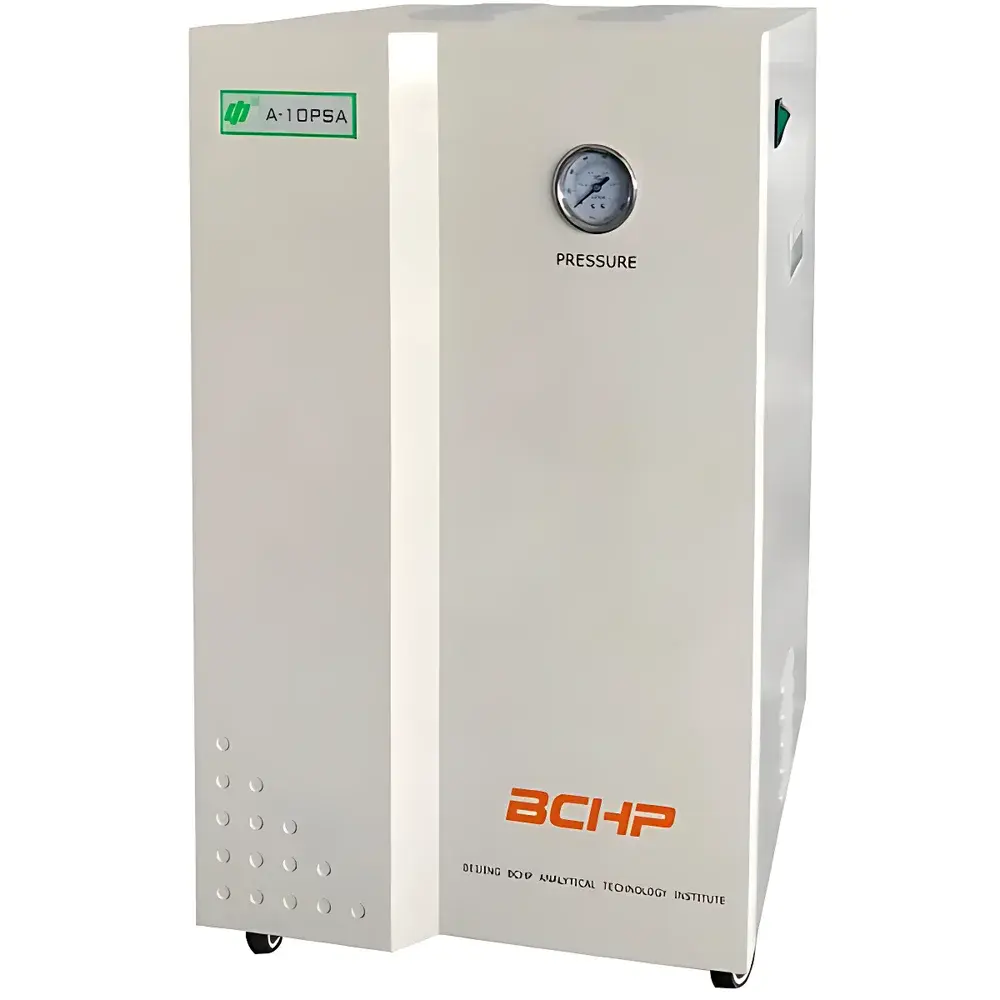
Zhonghuipu A-10PSA Pure Oil-Free Automatic Air Generator
| Brand | Zhonghuipu |
|---|---|
| Origin | Beijing, China |
| Manufacturer Type | Direct Manufacturer |
| Model | A-10PSA |
| Output Flow | 0–10 L/min at 0.4 MPa |
| Output Pressure | 0–0.4 MPa |
| Dew Point | < −10 °C |
| Pressure Stability | < ±0.003 MPa |
| Power Consumption | 550 W |
| Input Voltage | 220 V ±10% |
| Dimensions (L×W×H) | 400 × 425 × 650 mm |
| Net Weight | ~45 kg |
| Operating Environment | 5–40 °C, RH ≤85% |
| Filtration | Dual-stage particulate + PSA desiccant drying |
| Compressor | Thomas (USA) oil-free rocking piston type |
| Pneumatic Components | SMC (Japan), Airtac (Taiwan) |
| Tank & Filter Housing | 304 stainless steel & aluminum alloy |
Overview
The Zhonghuipu A-10PSA Pure Oil-Free Automatic Air Generator is an engineered solution for laboratories requiring continuous, contamination-free compressed air for analytical instrumentation—including gas chromatography (GC), GC-MS, nitrogen generators, FTIR, and pneumatic sample handling systems. Unlike conventional oil-lubricated air sources, the A-10PSA employs a certified oil-free rocking piston compressor (Thomas, USA) coupled with pressure swing adsorption (PSA) drying technology to deliver dry, particle-free air without risk of hydrocarbon carryover or lubricant degradation. The system operates on a closed-loop, demand-driven architecture: air is drawn from ambient, compressed, cooled, filtered through dual-stage particulate traps (SMC, Japan), dried via zeolite-based PSA beds, and stabilized by dual-stage pressure regulation. This architecture ensures consistent dew point performance (< −10 °C) and pressure stability (< ±0.003 MPa) over extended operation—critical for maintaining baseline integrity in sensitive detection systems.
Key Features
- Oil-free compression core: Thomas (USA) rocking piston compressor eliminates hydrocarbon vapor, particulates, and oil aerosols—ensuring compliance with ISO 8573-1 Class 1:4:1 (solid particles, water, oil) for instrument-grade air.
- PSA desiccant drying: Integrated twin-tower PSA system with automatic cycling maintains stable dew point below −10 °C; desiccant life exceeds 12 months under typical lab usage (7×24 h), minimizing maintenance intervals.
- Dual-stage pressure regulation: Precision regulators (Airtac, Taiwan) and stainless-steel buffer tank ensure minimal pressure fluctuation (< ±0.003 MPa), supporting stable carrier gas flow in GC applications.
- Robust mechanical design: 304 stainless steel air reservoir and aluminum-alloy filter housings resist corrosion; vibration-dampened compressor enclosure reduces operational noise to ≤52 dB(A) at 1 m distance.
- Intelligent safety architecture: Microcontroller-based control logic monitors flow rate, temperature, and pressure in real time; triggers automatic shutdown during over-pressure, over-temperature, or leak conditions; includes redundant mechanical safety valve (set at 0.45 MPa).
- Lab-integrated footprint: Floor-standing configuration with casters enables flexible placement; compact dimensions (400 × 425 × 650 mm) conserve bench space while accommodating internal cooling and airflow management.
Sample Compatibility & Compliance
The A-10PSA is validated for use with GC, GC-MS, headspace samplers, and other air-dependent analytical platforms where trace hydrocarbons or moisture compromise detector response or column longevity. Its output meets the air purity requirements specified in ASTM D6299 (for GC carrier gas support), ISO 8573-1:2010 Class 1:4:1, and USP for instrumental air used in pharmaceutical QC labs. The unit’s electrical design conforms to IEC 61010-1 for laboratory equipment safety; all pneumatic components comply with FDA-relevant material certifications (e.g., USP Class VI elastomers in seals). Full audit trail capability—including runtime logging, fault event timestamps, and pressure/flow history—is available via optional RS-232 or USB interface for GLP/GMP environments requiring 21 CFR Part 11-compliant data integrity.
Software & Data Management
While the base A-10PSA operates via embedded microcontroller without external software dependency, optional digital interfaces enable integration into centralized lab monitoring systems. The RS-232 port supports ASCII command protocols for remote status interrogation (e.g., “GET_PRESSURE”, “GET_DEWPOINT”) and alarm acknowledgment. When paired with Zhonghuipu’s LabAir Manager™ software (v2.1+), users gain access to historical trend plots, predictive maintenance alerts (based on cumulative runtime and pressure deviation thresholds), and exportable CSV logs compliant with ALCOA+ principles. All firmware updates are delivered via signed binary packages to prevent unauthorized modification—supporting IT security policies in regulated facilities.
Applications
- Carrier and make-up gas supply for flame ionization (FID), thermal conductivity (TCD), and electron capture (ECD) detectors in GC systems
- Air source for nitrogen generator feed gas (membrane or PSA-based N₂ systems)
- Pneumatic actuation in automated liquid handlers, autosamplers, and valve sequencing modules
- Zero-air generation for environmental air quality calibrators (when combined with catalytic scrubbers)
- Instrument purge gas for FTIR spectrometers and laser-based analyzers requiring low-humidity, particle-free airflow
- QC/QA labs operating under ISO/IEC 17025 or FDA 21 CFR Part 11 frameworks requiring documented air quality assurance
FAQ
Is the A-10PSA suitable for GC-MS systems requiring ultra-low hydrocarbon air?
Yes—its Thomas oil-free compressor and dual-stage filtration eliminate measurable hydrocarbon contaminants (detection limit < 0.01 ppm C₁–C₄), meeting GC-MS manufacturer specifications for auxiliary air.
How often must the PSA desiccant be replaced?
Under standard lab conditions (10 L/min average flow, 25 °C ambient), the zeolite beds maintain < −10 °C dew point for ≥12 months; replacement is indicated only when dew point rises above −5 °C during routine verification.
Can the unit be integrated into a building-wide compressed air monitoring network?
Yes—via optional Modbus RTU (RS-485) or Ethernet/IP module, enabling real-time pressure, flow, and fault status reporting to BMS or SCADA platforms.
Does the A-10PSA meet regulatory requirements for pharmaceutical QC labs?
It complies with USP , ISO 8573-1 Class 1:4:1, and supports 21 CFR Part 11 audit trails when configured with LabAir Manager™ and electronic signature modules.
What is the expected service interval for preventive maintenance?
Annual inspection is recommended: visual check of filters, validation of dew point and pressure stability, and verification of safety valve function per ISO 8573-9.



