
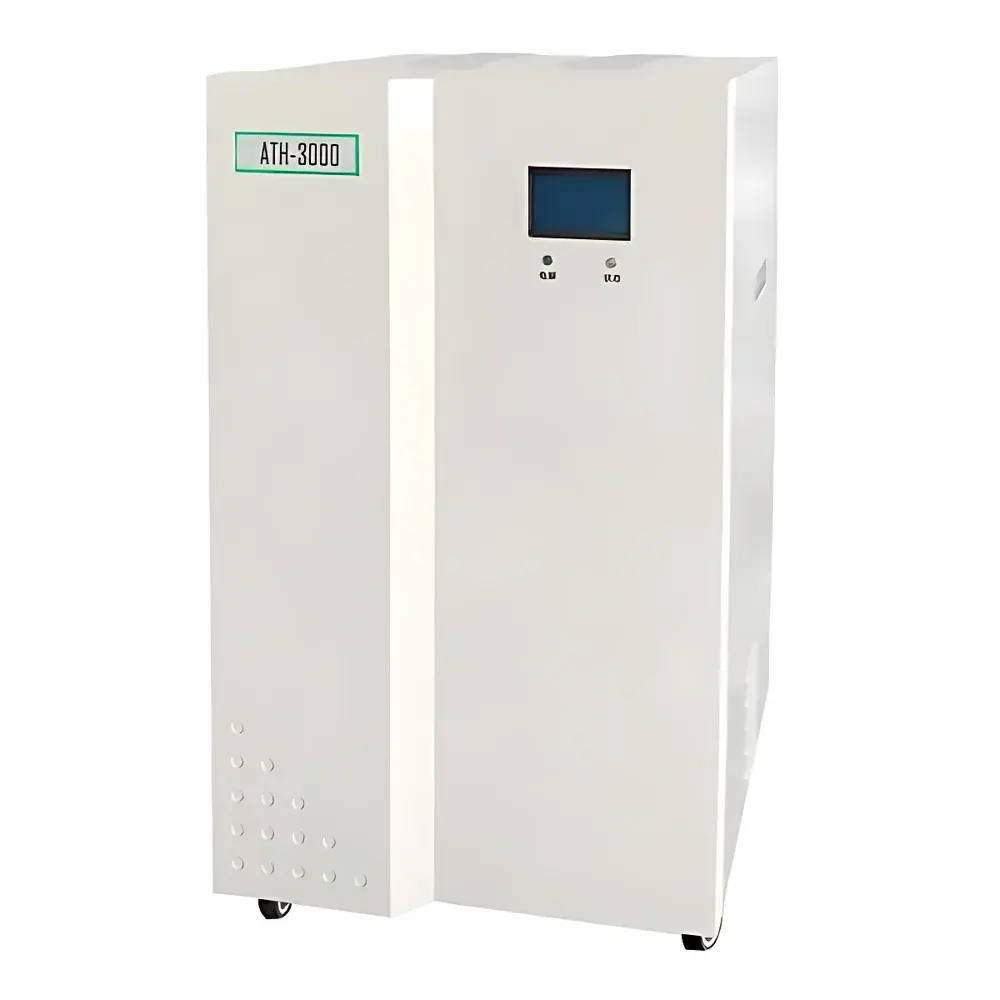
Zhonghuipu ATH-3000 Hydrogen Generator
| Brand | Zhonghuipu |
|---|---|
| Origin | Beijing, China |
| Manufacturer Type | OEM Manufacturer |
| Country of Origin | China |
| Model | ATH-3000 |
| Pricing | Upon Request |
| Hydrogen Generation Principle | Pure Water Electrolysis |
| Output Flow Rate | 0–3000 mL/min |
| Output Pressure | 0–0.7 MPa |
| Hydrogen Purity | 99.999% |
| Power Consumption | 1500 W |
| Oxygen Content in H₂ Output | ≤3 ppm |
| Dew Point of H₂ Output | ≤−55 °C |
| Input Power Supply | 220 V ±10%, 50 Hz |
| Operating Ambient Temperature | 1–40 °C |
| Relative Humidity | <85% RH |
| Dimensions (W×D×H) | 400 × 600 × 600 mm |
| Net Weight | ~50 kg |
Overview
The Zhonghuipu ATH-3000 Hydrogen Generator is a high-purity, on-demand hydrogen source engineered for continuous, safe, and maintenance-optimized operation in analytical laboratories. It employs zero-gap solid polymer electrolyte (SPE) membrane technology—eliminating the need for liquid KOH or NaOH electrolytes—and generates ultra-high-purity hydrogen (≥99.999%) directly from deionized water via proton exchange membrane (PEM) electrolysis. This principle ensures stable output pressure (0–0.7 MPa) and flow (0–3000 mL/min), with real-time regulation to match dynamic demand from gas chromatography (GC) systems, including flame ionization (FID), nitrogen-phosphorus (NPD), and flame photometric (FPD) detectors. The generator operates without hazardous alkaline solutions, corrosion risks, or routine chemical replenishment—making it compliant with modern lab safety protocols and green chemistry guidelines.
Key Features
- Solid Polymer Electrolyte (SPE) Architecture: Integrates a Nafion™-based PEM stack with integrated oxygen scavenging media, achieving ≤3 ppm residual O₂ and dew point ≤−55 °C without external purifiers or activated catalysts.
- Intelligent Microcontroller Control: Equipped with an embedded single-board controller featuring real-time monitoring of electrolyte level, system pressure, flow rate, and thermal load; supports automatic refill from external DI water reservoirs via optical liquid-level sensors.
- Self-Regulating Gas Delivery: Maintains constant pressure or constant flow mode with closed-loop feedback; dynamically adjusts electrolysis current to match downstream consumption—ensuring stable supply during GC oven ramping or multi-instrument distribution.
- Integrated Desiccation System: Utilizes pressure-swing adsorption (PSA) with low-sulfur, sulfur-resistant desiccant media; designed for ≥12 months of uninterrupted service under typical lab conditions without filter replacement.
- Comprehensive Safety Architecture: Includes over-pressure shutoff, flow-limit alarm, dry-cell protection (auto-shutdown upon low water detection), and redundant thermal fusing—fully aligned with IEC 61010-1 requirements for laboratory electrical equipment.
Sample Compatibility & Compliance
The ATH-3000 delivers hydrogen suitable for all major GC detector types requiring carrier or fuel gas, including FID, NPD, FPD, and TCD. Its low-sulfur internal wetted materials (fluorosilicone seals, PTFE-lined tubing, and sulfur-free elastomers) prevent detector contamination and baseline drift—critical for trace-level pesticide or sulfur compound analysis per EPA Method 8081/8082. The unit meets CE marking requirements (EMC Directive 2014/30/EU and Low Voltage Directive 2014/35/EU), conforms to ISO 8573-1:2010 Class 1 compressed air purity equivalency for gaseous outputs, and supports audit-ready documentation for GLP and GMP environments. While not certified to FDA 21 CFR Part 11 out-of-the-box, its firmware supports timestamped event logging and user-accessible error history—enabling integration into validated chromatography data systems (CDS) with appropriate configuration.
Software & Data Management
The ATH-3000 features a built-in monochrome LCD interface with Chinese-language menu navigation (English firmware optional upon request). All operational parameters—including real-time flow, pressure, temperature, cumulative runtime, and fault codes—are displayed and stored locally for up to 30 days. Event logs record startup/shutdown cycles, alarm triggers (e.g., “Low Water”, “Over-Pressure”), and manual mode changes. For centralized lab management, analog 0–10 V or 4–20 mA output signals (configurable) enable integration with building management systems (BMS) or SCADA platforms. Remote status monitoring is achievable via optional RS-485 Modbus RTU interface, supporting programmable logic controller (PLC) synchronization in multi-generator installations.
Applications
- Carrier gas supply for capillary GC and GC-MS systems requiring ultra-high-purity H₂ (e.g., method development per ASTM D6299 or ISO 10302)
- Fuel gas generation for FID, NPD, and FPD detectors in environmental, petrochemical, and pharmaceutical QC labs
- On-site hydrogen sourcing for portable GC units and field-deployable analytical kits
- Centralized gas supply for multi-station GC laboratories—replacing high-pressure cylinder banks and associated manifold infrastructure
- Research applications requiring stable, low-oxygen hydrogen for catalytic studies or hydride generation atomic absorption (HG-AAS)
FAQ
What type of water is required for optimal operation?
Deionized water with resistivity ≥1 MΩ·cm (ASTM Type II or better) is mandatory. Tap water, distilled water, or reverse-osmosis-only water will cause rapid membrane fouling and void warranty coverage.
Can the ATH-3000 be integrated into an existing GC network with multiple instruments?
Yes—the unit supports daisy-chained distribution via stainless steel 1/8″ tubing and precision needle valves; recommended maximum line length is 30 meters with ≤2 bar total pressure drop across the network.
Is routine maintenance required beyond water refills?
No scheduled consumable replacements are needed within the first 12 months under normal operating conditions; only periodic visual inspection of tubing integrity and external filter housing is advised.
Does the generator produce hydrogen continuously when powered on?
No—it operates on demand: electrolysis initiates only when downstream pressure drops below setpoint, minimizing energy use and extending PEM stack lifetime.
What certifications does the ATH-3000 hold for international shipment?
It carries CE marking (LVD + EMC), RoHS 2011/65/EU compliance, and UN3480 Class 9 hazard classification exemption documentation for air freight transport.



