
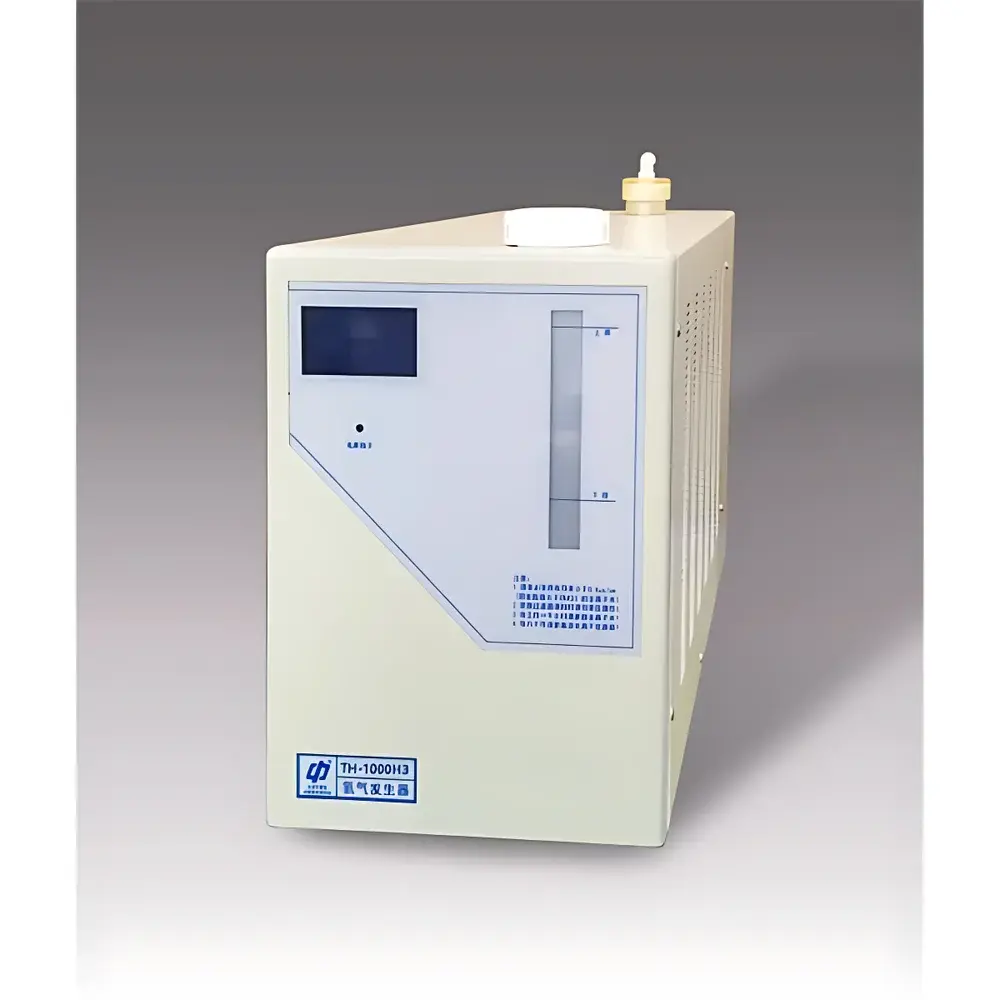
Zhonghuipu TH-1000H3 High-Pressure Hydrogen Generator
| Brand | Zhonghuipu |
|---|---|
| Origin | Beijing, China |
| Manufacturer Type | Direct Manufacturer |
| Model | TH-1000H3 |
| Hydrogen Generation Principle | Pure Water Electrolysis via SPE Membrane |
| Output Flow Rate | 0–1000 mL/min |
| Output Pressure | 0–3 MPa (30 kg/cm²) |
| Hydrogen Purity | 99.999% |
| Power Consumption | 450 W |
| Dimensions (L×W×H) | 550 × 245 × 400 mm |
| Net Weight | 24 kg |
| Pressure Stability | < 0.001 MPa |
| Input Power | 220 V ±10%, 50 Hz |
| Certification | CE |
Overview
The Zhonghuipu TH-1000H3 High-Pressure Hydrogen Generator is an engineered solution for laboratories requiring continuous, on-demand hydrogen gas at elevated pressures—up to 3 MPa (30 bar)—with ultra-high purity and operational reliability. It employs solid polymer electrolyte (SPE) membrane technology to perform pure water electrolysis, eliminating the need for caustic potassium hydroxide (KOH) or sodium hydroxide (NaOH) solutions commonly associated with traditional alkaline electrolyzers. This design ensures inherently safer operation, reduced maintenance, and minimized risk of electrolyte carryover into the gas stream. The system integrates a precision pressure-regulated flow control architecture, enabling stable delivery across the full 0–1000 mL/min range while maintaining pressure stability within ±0.001 MPa—critical for applications such as high-pressure catalytic hydrogenation, gas chromatography carrier gas supply, and in-situ reactor feed systems.
Key Features
- SPE-based proton exchange membrane electrolysis using deionized water only—no liquid electrolytes, no neutralization waste, no corrosion hazards
- Imported perfluorosulfonic acid (PFSA) ion-exchange membrane ensuring long-term ionic conductivity and mechanical integrity under sustained pressure
- Full stainless-steel construction for gas path components—including gas–liquid separator, particulate filter, and pressure-rated manifolds—to withstand repeated cycling up to 3 MPa
- Low-sulfur silicone O-rings and fluoropolymer-sealed valves to prevent sulfur contamination, preserving catalyst integrity in sensitive hydrogenation workflows
- Integrated dual-loop control: real-time feedback regulation of both output pressure and mass flow rate via proportional solenoid valves and digital PID algorithms
- Intelligent water-level monitoring with automatic shutdown upon low-water detection, protecting the electrolytic cell from dry-run damage and extending service life beyond 8,000 operating hours
- CE-certified electrical architecture compliant with EN 61000-6-3 (EMC emission) and EN 61000-6-2 (immunity), suitable for integration into ISO 17025-accredited laboratory environments
Sample Compatibility & Compliance
The TH-1000H3 delivers hydrogen meeting ISO 8573-1:2010 Class 1 (solid particles), Class 2 (water), and Class 1 (oil) specifications when operated with ≥18.2 MΩ·cm ultrapure water. Its 99.999% purity (5N) supports analytical-grade applications including GC-FID/TCD carrier gas, FTIR purge gas, and blank-sensitive electrochemical cells. The generator conforms to ASTM D6866–22 requirements for trace carbon monoxide and moisture content (<0.1 ppm CO; dew point ≤ –70 °C). As a CE-marked device, it satisfies essential health and safety requirements under the EU Machinery Directive 2006/42/EC and Low Voltage Directive 2014/35/EU. No additional external purification modules are required for standard laboratory use, though optional palladium-diffusion purifiers can be integrated for ultra-trace metal analysis applications demanding 6N+ purity.
Software & Data Management
The TH-1000H3 operates via embedded firmware with local LED interface for manual setpoint adjustment (pressure, flow limit, standby mode). While not equipped with onboard data logging, its analog 0–10 V and 4–20 mA outputs enable seamless integration into centralized LabVantage, DeltaV, or Siemens Desigo SCADA systems. Digital RS-485 Modbus RTU communication (optional upgrade) supports remote parameter readout—including real-time pressure, flow, cell temperature, and cumulative runtime—for audit-ready GLP/GMP documentation. All operational events (startup, shutdown, fault codes, water refill alerts) are timestamped and stored in non-volatile memory for traceability during regulatory inspections aligned with FDA 21 CFR Part 11 requirements.
Applications
- High-pressure heterogeneous catalysis studies requiring stoichiometric H₂ delivery at 1–3 MPa in fixed-bed or autoclave reactors
- Carrier and fuel gas supply for GC systems—particularly those configured with thermal conductivity detectors (TCD) or pulsed discharge helium ionization detectors (PDHID)
- Inert atmosphere generation for glovebox purging and metal-organic framework (MOF) synthesis where residual oxygen and moisture must remain below 1 ppm
- Hydrogen sensor calibration standards in metrology labs accredited to ISO/IEC 17025
- On-site refueling of portable hydrogen-powered analytical tools, including handheld Raman spectrometers and field-deployable fuel cell test rigs
FAQ
What type of water is required for optimal operation?
Deionized water with resistivity ≥18.2 MΩ·cm and total organic carbon (TOC) < 5 ppb is mandatory. Tap water, distilled water, or reverse-osmosis-only water will cause rapid membrane fouling and irreversible performance loss.
Can the TH-1000H3 be used in explosion-hazardous areas (ATEX Zone 1)?
No. The unit is not ATEX-certified or intrinsically safe. It must be installed in ventilated, non-classified laboratory spaces with hydrogen leak detection and forced-air exhaust per NFPA 55 guidelines.
How often does the SPE membrane require replacement?
Under continuous operation with compliant water quality and routine preventive maintenance, the membrane service life exceeds 5 years or 15,000 operating hours—verified by periodic purity verification using online gas chromatography.
Is external cooling required?
No. The system incorporates passive heat dissipation via aluminum finned heat sinks and thermally optimized electrolyzer stack geometry. Ambient operating temperature range is 10–35 °C.
Does the generator support unattended overnight operation?
Yes—provided the water reservoir is filled to capacity and connected to a stable 220 V AC supply with surge protection. Automatic shutdown on low water prevents unsafe conditions during extended runs.



