
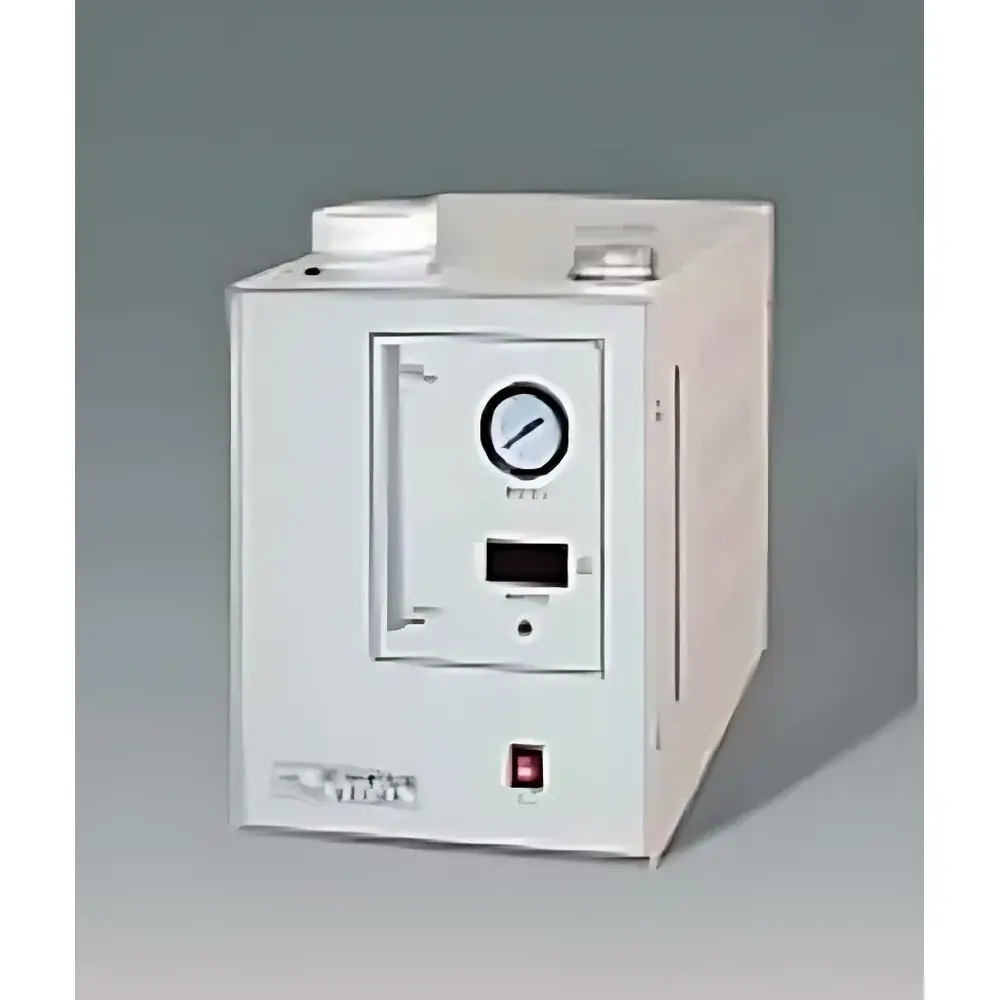
Zhonghuipu SPN-300A/500A Membrane-Based Nitrogen Generator
| Brand | Zhonghuipu |
|---|---|
| Origin | Beijing, China |
| Manufacturer Type | Direct Manufacturer |
| Model | SPN-300A / SPN-500A |
| Output Flow Rate | 0–300 mL/min (SPN-300A) / 0–500 mL/min (SPN-500A) |
| Output Pressure | 0–0.4 MPa (air-source dependent) |
| Nitrogen Purity | <3 ppm O₂, dew point ≤ –56 °C |
| Pressure Stability | <0.003 MPa (subject to inlet air stability) |
| Power Supply | 220 V ±10%, 50 Hz |
| Power Consumption | 60 W (SPN-300A) / 100 W (SPN-500A) |
| Operating Environment | 1–40 °C, RH <85% |
| Dimensions (W×D×H) | 360 × 200 × 260 mm |
| Net Weight | ~9 kg |
Overview
The Zhonghuipu SPN-300A and SPN-500A are compact, membrane-based nitrogen generators engineered for continuous, on-demand supply of high-purity nitrogen gas in analytical laboratory environments. These units utilize hollow-fiber membrane separation technology to extract nitrogen from compressed ambient air—removing oxygen, water vapor, carbon dioxide, and trace hydrocarbons through selective permeation. The process delivers nitrogen with residual oxygen content below 3 ppm and a moisture dew point of ≤ –56 °C, meeting stringent requirements for gas chromatography (GC), liquid chromatography–mass spectrometry (LC-MS) nitrogen curtain gas, FTIR purge applications, and inert atmosphere sample preparation. Unlike pressure swing adsorption (PSA) systems, membrane generators offer inherently stable output without cycling valves or desiccant beds, minimizing maintenance intervals and ensuring consistent flow-pressure profiles critical for baseline-sensitive detection systems.
Key Features
- Auto-regulated constant-pressure and constant-flow operation: Integrated electronic pressure control and mass flow sensing enable real-time adjustment of nitrogen delivery to match instrument demand—eliminating manual throttling and reducing gas waste.
- Stainless-steel particulate and coalescing filtration upstream of the membrane module ensures removal of oil aerosols, rust, and dust from the feed air stream; extends membrane service life and maintains long-term purity stability.
- Low-sulfur silicone O-rings and fluoropolymer-sealed internal pathways prevent sulfur contamination—a known cause of GC detector poisoning and column degradation—supporting robust baseline integrity across extended run times.
- Dual-stage safety architecture: Includes automatic alkaline-backflow prevention (critical when interfaced with GC nitrogen-driven pneumatic controls) and overpressure relief calibrated to 0.45 MPa, compliant with IEC 61000-6-2 electromagnetic compatibility and mechanical safety guidelines.
- Intuitive front-panel digital display showing real-time output pressure (MPa) and volumetric flow rate (mL/min); supports quick verification during method setup or troubleshooting without external meters.
Sample Compatibility & Compliance
The SPN series is designed for integration into regulated analytical workflows where gas quality directly impacts data validity. Its certified nitrogen specifications align with ASTM D6866-22 (for isotopic analysis support), ISO 8573-1 Class 1.2.1 (compressed air purity for instrumentation), and USP requirements for carrier and purge gases in pharmaceutical QC labs. While not intrinsically rated for hazardous locations, the unit meets CE marking directives (2014/30/EU EMC, 2014/35/EU LVD) and operates within GLP-compliant infrastructure when paired with documented air source validation (e.g., oil-free scroll compressor + refrigerated dryer). No consumables—such as carbon molecular sieves or catalyst cartridges—are required, simplifying audit trails and reducing lifecycle cost of ownership.
Software & Data Management
The SPN-300A/500A operates as a standalone hardware platform with no embedded firmware or network interface. However, its analog 0–5 V DC output signals for pressure and flow are compatible with third-party lab data acquisition systems (e.g., LabVIEW, DeltaV, or Chromatography Data Systems) via optional signal conditioning modules. For GxP environments, users may configure external logging of operational parameters using validated USB data loggers—enabling full traceability of gas supply conditions during analytical runs. Audit trail requirements under FDA 21 CFR Part 11 can be satisfied by integrating the generator’s status outputs into an existing ELN or LIMS via programmable logic controllers (PLCs) or OPC UA gateways.
Applications
- Carrier gas for capillary GC and GC-MS systems requiring ultra-dry, low-oxygen nitrogen with minimal baseline drift.
- Curtain gas and nebulizer gas in electrospray ionization (ESI) and atmospheric pressure chemical ionization (APCI) sources.
- Purge gas for FTIR spectrometers, TGA-DSC instruments, and glovebox inerting in material science labs.
- Blanketing gas during solvent evaporation, lyophilization, and standard solution preparation to prevent oxidation.
- Support gas for nitrogen-powered autosamplers, valve actuators, and pneumatic chromatographic oven doors.
FAQ
What feed air quality is required for optimal performance?
Compressed air must be oil-free, with particulate filtration ≤ 0.01 µm and dew point ≤ –20 °C prior to entering the generator. Use of a refrigerated dryer and coalescing filter is strongly recommended.
Can the SPN series replace liquid nitrogen dewars in LC-MS applications?
Yes—for curtain gas and auxiliary functions—but not for cryogenic cooling. Verify compatibility with your instrument manufacturer’s specified inlet pressure and flow tolerance before installation.
Is routine maintenance required beyond filter replacement?
Yes: inlet coalescing filters should be replaced every 6–12 months depending on air quality; membrane modules typically last ≥3 years under continuous operation with validated feed air.
Does the unit support 24/7 unattended operation?
Yes—the design includes thermal overload protection, auto-shutdown on pressure loss, and passive cooling; suitable for integration into automated lab environments with scheduled uptime protocols.
How is nitrogen purity verified post-installation?
Users should perform initial validation using a calibrated electrochemical oxygen analyzer (±0.1 ppm resolution) and chilled-mirror hygrometer (±0.5 °C dew point accuracy), per ISO 8573-3 Annex B procedures.



