
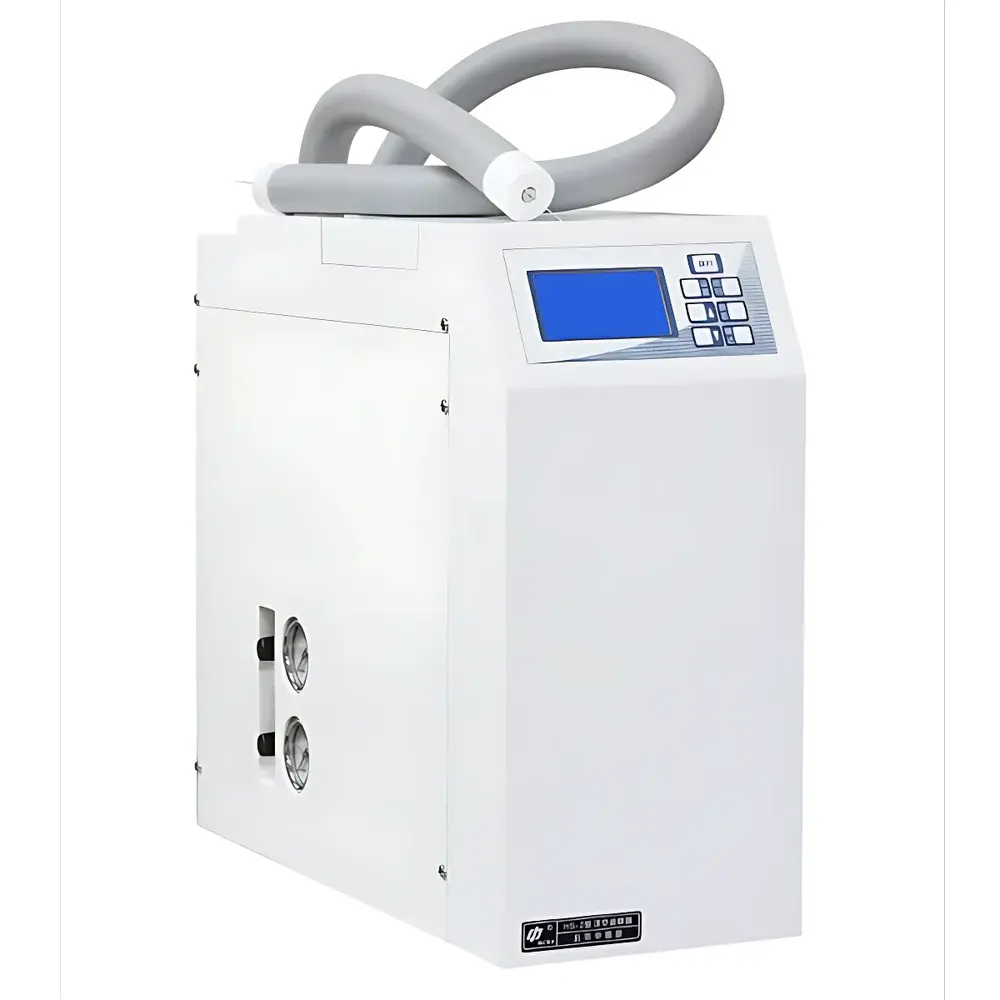
ZhonghuiPu HS-2 Static Headspace Sampler
| Brand | ZhonghuiPu |
|---|---|
| Origin | Beijing, China |
| Manufacturer Type | Direct Manufacturer |
| Instrument Type | Static Headspace Sampler |
| Automation Level | Semi-Automatic |
| Sample Vial Heating Range | 40–200 °C (customizable up to 330 °C) |
| Valve Heating Range | 40–200 °C (customizable up to 330 °C) |
| Transfer Line Heating Range | 40–200 °C (customizable up to 330 °C) |
| Pressurization Time | 0–10 min |
| Sampling Time | 0–10 min |
| Injection Time | 0–10 min |
| Loop Volume | 1 mL (customizable up to 3 mL) |
| Temperature Control Accuracy | ±1 °C |
| Vial Capacity | 10 positions (customizable to 12) |
| Vial Sizes | 10 mL and 20 mL |
| RSD | ≤1.5% (for 100 ppm ethanol in water) |
| Power Consumption | Peak 350 W, Average 100 W |
| Dimensions (L×W×H) | 500×180×400 mm |
| Net Weight | ~18 kg |
Overview
The ZhonghuiPu HS-2 Static Headspace Sampler is an engineered solution for reproducible, thermally stable headspace analysis in gas chromatography (GC) workflows. It operates on the principle of static headspace sampling—equilibrating volatile analytes between a solid or liquid sample phase and its overlying vapor phase within a sealed vial, followed by precise pressurized transfer of the equilibrated headspace gas into a GC inlet via a heated six-port valve and quantitative loop. Designed for laboratories requiring robust, routine analysis of residual solvents, environmental volatiles, flavor compounds, or forensic volatiles, the HS-2 delivers high thermal integrity across all critical zones—including sample vial oven, valve manifold, and transfer lines—to prevent condensation, adsorption, or degradation of thermally labile species.
Key Features
- Uniform matrix-heated sample chamber with optimized thermal distribution across all vial positions, minimizing inter-vial temperature gradients and ensuring consistent equilibration kinetics.
- Full-zone active heating: independently controlled and insulated heating for vial oven (40–200 °C), six-port valve (40–200 °C), and transfer line (40–200 °C), all extendable to 330 °C upon customization for high-boiling-point analytes.
- High-inertness fluidic path: all internal tubing, valve surfaces, and the quantitative loop are fabricated from de-activated fused silica or silonized stainless steel, eliminating carryover and cross-contamination—validated by <1.5% RSD in replicate analysis of 100 ppm aqueous ethanol.
- Zero-dead-volume valve-loop interface: the six-port valve is mechanically actuated (no external carrier gas required) and mounted inside the heated oven, eliminating cold spots and preserving analyte integrity during transfer.
- Positive-pressure sampling architecture: enables reliable quantitation of both liquid and solid matrices without vacuum-induced baseline drift; compatible with standard split/splitless GC inlets.
- Integrated microprocessor control with backlit LCD interface; supports parameter programming (equilibration time, pressurization duration, sampling time, injection time) and real-time status monitoring.
- Standard RS-232 serial interface for bidirectional communication with GC data systems; includes trigger output to auto-start GC acquisition and optional synchronization with chromatography data systems (CDS) for audit-ready method execution.
Sample Compatibility & Compliance
The HS-2 accommodates standard 10 mL and 20 mL crimp-top or screw-cap headspace vials, supporting a wide range of sample types—including pharmaceutical tablets, polymer pellets, soil slurries, beverages, and biological fluids. Its semi-automatic operation allows manual vial loading while maintaining full thermal and timing control, making it suitable for method development, QC release testing, and GLP-compliant environments. Though not certified to ISO/IEC 17025 out-of-box, the instrument’s deterministic timing, traceable temperature calibration points, and electronic parameter logging support validation per USP Chapter <467> (Residual Solvents), ASTM D3699 (gasoline volatility), and EPA Method 502.2 (volatile halocarbons). Full 21 CFR Part 11 compliance is achievable when paired with validated CDS software featuring electronic signatures and audit trail functionality.
Software & Data Management
The HS-2 operates as a standalone peripheral but integrates seamlessly with major GC data systems via RS-232. Users can configure all operational parameters—including vial temperature, valve temperature, transfer line temperature, equilibration delay, pressurization time, loop fill time, and injection time—directly from the host workstation. The instrument logs timestamps, setpoints, and actual measured temperatures for each run, enabling retrospective verification of thermal history. When deployed in regulated environments, these logs—combined with GC raw data and sequence tables—form a complete analytical record compliant with ALCOA+ principles (Attributable, Legible, Contemporaneous, Original, Accurate, Complete, Consistent, Enduring, Available).
Applications
- Pharmaceutical quality control: residual solvent analysis in APIs and finished dosage forms per ICH Q3C guidelines.
- Environmental testing: determination of volatile organic compounds (VOCs) in water, soil, and waste extracts.
- Food and beverage safety: quantification of ethanol, acetaldehyde, or off-flavor volatiles in wines, spirits, dairy, and packaged foods.
- Polymer and packaging analysis: migration testing of monomers, plasticizers, or adhesives from films and containers.
- Forensic toxicology: headspace detection of ethanol, acetone, or volatile drugs in blood and urine specimens.
FAQ
What sample formats does the HS-2 support?
The HS-2 accepts standard 10 mL and 20 mL headspace vials with crimp seals or screw caps. Solid, semi-solid, and liquid samples are all compatible when properly sealed and equilibrated.
Is the HS-2 compatible with all gas chromatographs?
Yes—it interfaces with any GC equipped with a standard split/splitless inlet and accepts 1–3 mL headspace injections. A universal trigger cable and RS-232 protocol ensure broad vendor compatibility (Agilent, Thermo Fisher, Shimadzu, PerkinElmer).
Can temperature zones be calibrated independently?
Each heated zone (vial oven, valve, transfer line) features independent PT100 sensor feedback and digital PID control. NIST-traceable calibration certificates are available upon request for IQ/OQ validation.
Does the HS-2 meet regulatory requirements for GMP laboratories?
While the hardware itself is not pre-certified, its design—repeatable timing, thermal stability, electronic parameter logging, and RS-232 audit trail capability—supports qualification under FDA 21 CFR Part 11 and EU Annex 11 when integrated into a validated system architecture.
What maintenance is required for long-term reliability?
Routine maintenance includes periodic inspection of septa, cleaning of the valve rotor seal surface with solvent, and verification of loop volume accuracy using certified gas standards. No consumable parts require scheduled replacement under normal operating conditions.





