
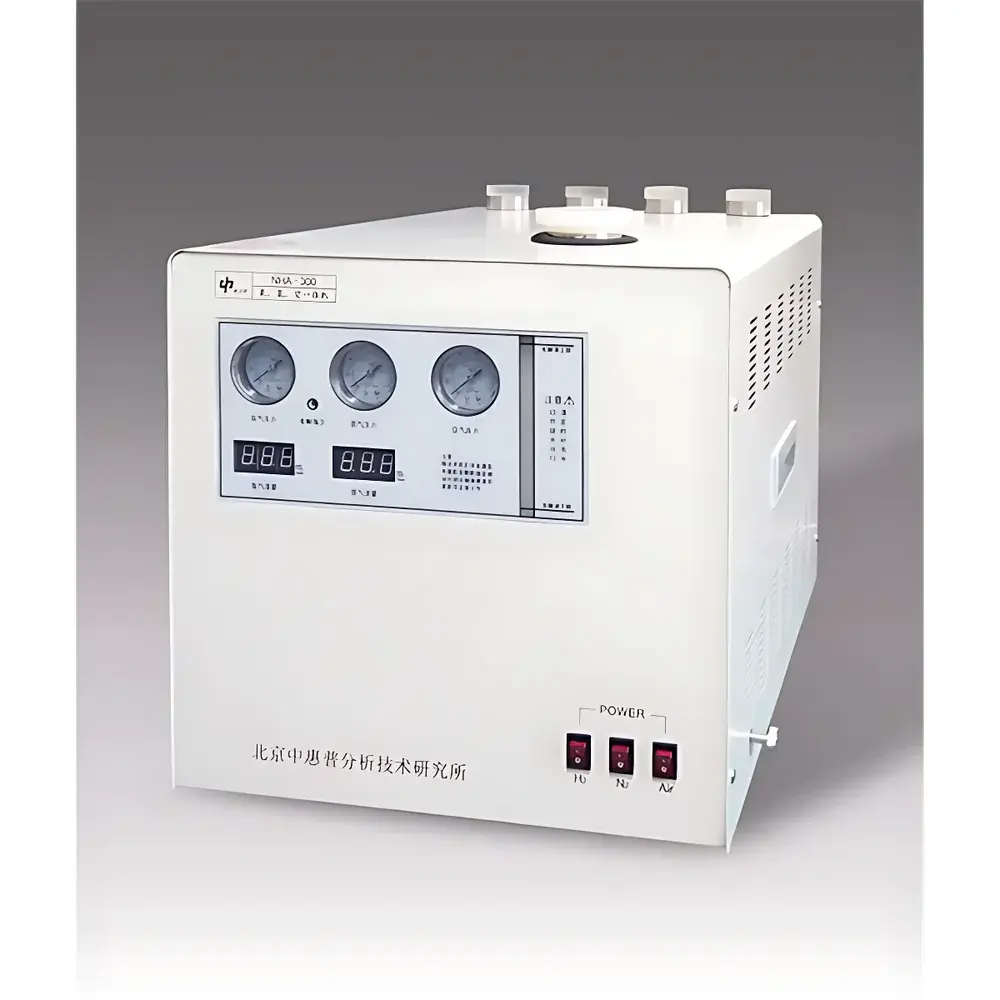
Zhonghuipu NHA-300/NHA-500 Integrated Nitrogen-Hydrogen-Air Gas Generator
| Brand | Zhonghuipu |
|---|---|
| Origin | Beijing, China |
| Manufacturer Type | Direct Manufacturer |
| Model | NHA-300 / NHA-500 |
| Nitrogen Purity | <3 ppm O₂, Dew Point −56 °C |
| Nitrogen Flow Rate | 0–300 mL/min (NHA-300) / 0–500 mL/min (NHA-500) |
| Nitrogen Pressure | 0.4 MPa |
| Hydrogen Purity | 99.999% |
| Hydrogen Flow Rate | 0–300 mL/min (NHA-300) / 0–500 mL/min (NHA-500) |
| Hydrogen Pressure | 0.4 MPa |
| Air Flow Rate | 0–2000 mL/min |
| Air Pressure | 0.4 MPa |
| Power Consumption | 360 W (NHA-300) / 500 W (NHA-500) |
| Dimensions (W×D×H) | 350 × 350 × 500 mm |
| Net Weight | ~33 kg |
Overview
The Zhonghuipu NHA-300 and NHA-500 are integrated laboratory-grade gas generators engineered to supply high-purity nitrogen, hydrogen, and zero-air simultaneously for gas chromatography (GC) and related analytical applications. Unlike conventional cylinder-based gas delivery systems, these units employ membrane separation for nitrogen generation, PEM (proton exchange membrane) electrolysis for hydrogen production, and catalytic purification combined with desiccant drying for zero-air synthesis. All three gases meet stringent purity requirements for sensitive GC detectors—including FID, TCD, ECD, and FPD—where trace oxygen, moisture, or hydrocarbon contamination can compromise baseline stability, detector response, and column lifetime. The system operates continuously under ambient conditions, eliminating the logistical burden and safety risks associated with high-pressure gas cylinders.
Key Features
- Triple-gas output in a single compact footprint: independently regulated nitrogen, hydrogen, and zero-air streams, each with dedicated pressure stabilization and real-time flow monitoring.
- Stainless-steel internal storage tanks and four-stage stainless-steel filtration—comprising particulate, coalescing, activated carbon, and ultra-low-oxygen scavenging stages—to ensure consistent gas purity and extended consumable life.
- Low-sulfur silicone rubber sealing components, rigorously selected to prevent sulfur leaching that could poison sulfur-sensitive detectors (e.g., PFPD, SCD) or degrade GC stationary phases.
- Automatic alkali-backflow prevention on both nitrogen and hydrogen modules, eliminating risk of electrolyte migration into gas lines—a critical safeguard for long-term instrument reliability and operator safety.
- Intelligent flow-tracking control: nitrogen and hydrogen output dynamically match downstream demand without manual adjustment, maintaining stable pressure and minimizing gas waste.
- Zero-air subsystem includes precision pressure regulation, automated condensate drainage, and redundant thermal protection to prevent overheating during extended operation.
- Robust architecture with front-panel digital interface, LED status indicators for each gas stream, and audible/visual alarms for low water level, filter saturation, or pressure deviation.
Sample Compatibility & Compliance
The NHA-300/NHA-500 is universally compatible with all major GC platforms—including Agilent, Thermo Fisher, Shimadzu, PerkinElmer, and Waters—regardless of detector configuration or inlet type (split/splitless, PTV, or cold-on-column). Its nitrogen output (<3 ppm O₂, dew point −56 °C) satisfies ASTM D6304 and ISO 8573-1 Class 2 specifications for instrumental gas quality. Hydrogen at 99.999% purity complies with USP requirements for carrier gas in pharmaceutical residual solvent analysis. Zero-air meets EPA Method TO-15 and ASTM D5502 criteria for hydrocarbon-free oxidant supply in FID operation. The unit’s electrical design conforms to IEC 61010-1 for laboratory equipment safety; CE marking is applicable per EU Directive 2014/30/EU (EMC) and 2014/35/EU (LVD).
Software & Data Management
While the NHA series operates as a standalone hardware platform without embedded PC software, it supports full integration into GLP/GMP-compliant laboratory environments through analog 0–10 VDC or 4–20 mA output signals for remote pressure and flow telemetry. Optional RS-232 or RS-485 interfaces enable connection to building management systems (BMS) or centralized lab monitoring platforms for audit-ready operational logs. All alarm events—including filter replacement alerts, low-water warnings, and pressure excursions—are timestamped and stored in non-volatile memory for up to 30 days, satisfying FDA 21 CFR Part 11 requirements when paired with validated third-party data acquisition software. Firmware updates are performed via secure USB interface with cryptographic signature verification.
Applications
- Routine and method-developed GC-FID analysis of volatile organic compounds (VOCs), environmental pollutants (e.g., BTEX, PAHs), and fuel hydrocarbons.
- GC-TCD applications requiring ultra-dry, oxygen-free carrier gas for high-resolution analysis of permanent gases (H₂, O₂, N₂, CO, CH₄).
- Residual solvent testing in pharmaceutical manufacturing per ICH Q2(R2) and USP , where hydrogen purity and nitrogen inertness directly impact quantitation accuracy.
- GC-MS carrier gas supply in labs seeking to reduce helium dependency while maintaining retention time reproducibility and spectral integrity.
- Quality control laboratories performing ASTM D3606 (benzene in gasoline) or EPA 8260D, where consistent zero-air performance is essential for FID calibration stability.
FAQ
Can the NHA-300/NHA-500 replace helium as a carrier gas in GC?
No—it generates nitrogen and hydrogen only; helium is not produced. However, nitrogen and hydrogen serve as validated alternatives for many GC methods, particularly with modern narrow-bore columns and optimized temperature programs.
What maintenance intervals are recommended for filters and electrolyte?
Stainless-steel particulate and coalescing filters require replacement every 12 months under continuous use; oxygen-scavenging cartridges every 18–24 months. PEM electrolyte does not require replenishment; the stack is designed for >15,000 hours of operation.
Is external cooling required for sustained operation?
No—integrated thermal management and forced-air convection ensure stable performance at ambient temperatures up to 35 °C and relative humidity ≤80% non-condensing.
Does the unit support 24/7 unattended operation?
Yes—designed for continuous duty with automatic shutdown on water depletion, overpressure, or thermal fault, and restart capability upon condition recovery.
How is gas purity verified during qualification?
Users may perform periodic verification using calibrated trace oxygen analyzers (e.g., electrochemical or zirconia-based) and dew point meters; Zhonghuipu provides IQ/OQ documentation templates aligned with ISO/IEC 17025 and GAMP 5 guidelines.



