
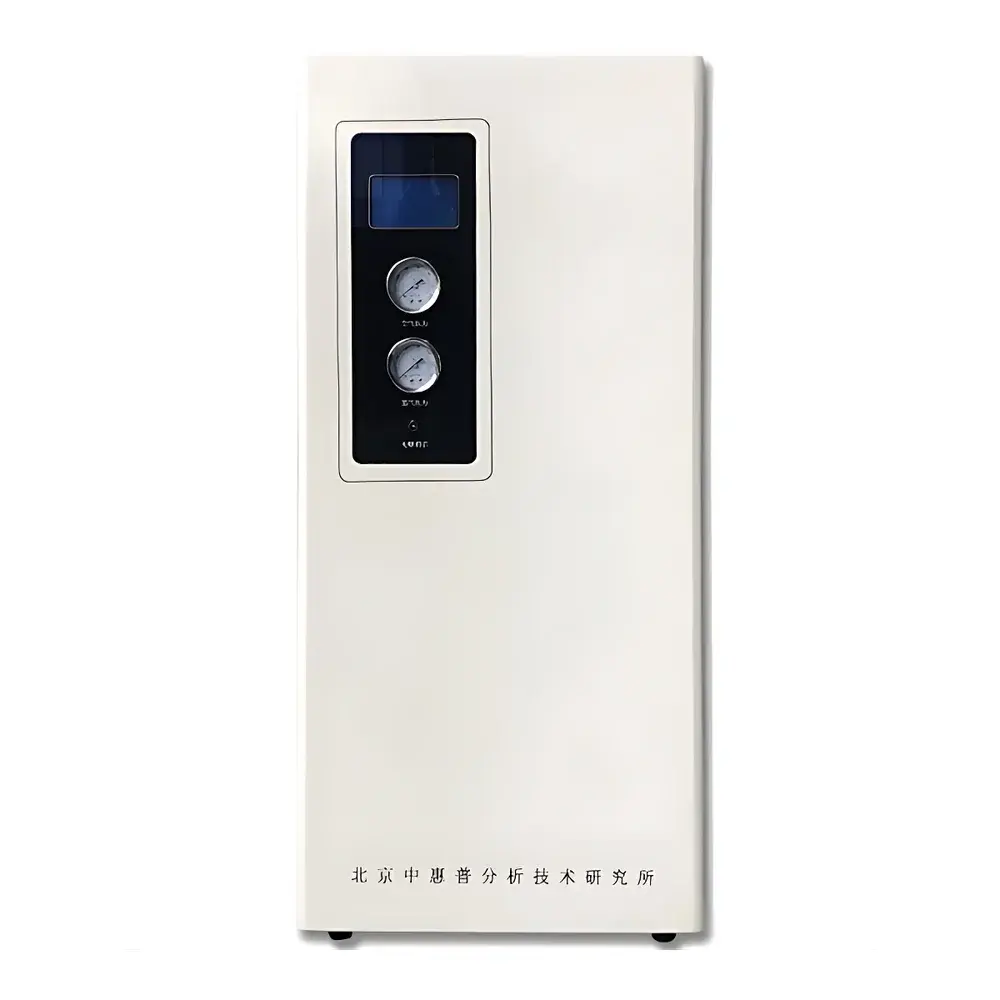
Zhonghuipu HA-3680 Hydrogen-Air Integrated Gas Generator
| Brand | Zhonghuipu |
|---|---|
| Origin | Beijing, China |
| Manufacturer Type | Direct Manufacturer |
| Model | HA-3680 |
| H₂ Flow Rate | 0–300 mL/min |
| H₂ Purity | 99.999% |
| H₂ Output Pressure | 0.4 MPa (4 kgf/cm²) |
| H₂ Pressure Stability | < 0.001 MPa |
| Zero Air Flow Rate | 0–1.5 L/min |
| Zero Air Pressure | 0–0.4 MPa |
| Hydrocarbon Content in Zero Air | < 20 ppb |
| Particulate Size in Zero Air | < 0.01 µm |
| Operating Ambient | 1–35 °C, RH ≤ 85% |
| Max Power Consumption | 680 W |
| Input Voltage | 220 V ± 10% |
| Dimensions (L×W×H) | 350 × 400 × 730 mm |
| Net Weight | ~43 kg |
Overview
The Zhonghuipu HA-3680 Hydrogen-Air Integrated Gas Generator is an engineered solution for laboratories requiring continuous, on-demand supply of high-purity hydrogen and ultra-low-hydrocarbon zero air—both critical for gas chromatography (GC), GC–MS, flame ionization detection (FID), and other analytical instrumentation. Unlike conventional cylinder-based systems, the HA-3680 eliminates logistical constraints, safety hazards, and purity inconsistencies by generating gases *in situ* via electrochemical and catalytic purification pathways. Hydrogen is produced through alkaline water electrolysis using a transition-metal-catalyzed cell, followed by multi-stage purification including palladium diffusion and pressure-swing adsorption. Zero air is generated from ambient intake via a maintenance-free, oil-free Thomas compressor, integrated desiccant drying (PSA-based), high-efficiency particulate filtration (SMC 0.01 µm), and high-temperature precious-metal-catalyzed hydrocarbon oxidation. The system operates as a single integrated unit with shared control architecture, ensuring synchronized pressure regulation, real-time status monitoring, and fail-safe interlocks.
Key Features
- Integrated dual-output architecture delivering both hydrogen (0–300 mL/min) and zero air (0–1.5 L/min) from one compact chassis (350 × 400 × 730 mm).
- H₂ purity of ≥99.999% (5.0 grade), verified per ISO 8573-1:2010 Class 1 for particles and Class 2 for moisture and oil content.
- Zero air compliant with ASTM D6216-22 specifications for hydrocarbon content (<20 ppb C₁–C₄), with particulate filtration to <0.01 µm per ISO 12103-1 A4 test dust standard.
- Electrolyte-level sensing and auto-refill function prevents dry-electrolysis; optional 15 L external reservoir supports >60 days of unattended operation.
- H₂ leak detection with immediate shutoff and audible/visual alarm—fully compliant with IEC 61000-6-2 EMC immunity and UL 61010-1 functional safety requirements.
- All wetted parts—including electrolyzer housing, storage buffer, and gas lines—constructed from ASTM A240 304 stainless steel for corrosion resistance and long-term gas integrity.
- Embedded microcontroller with LCD interface enables local parameter configuration, runtime logging, and fault diagnostics; RS-232/RS-485 optional for SCADA integration and remote supervision.
Sample Compatibility & Compliance
The HA-3680 is validated for use with all major GC and detector platforms requiring carrier or fuel gas, including Agilent, Thermo Fisher, Shimadzu, and PerkinElmer systems. It meets essential regulatory expectations for laboratory gas supply under GLP and GMP environments: pressure stability (<0.001 MPa fluctuation) ensures retention time reproducibility in chromatographic methods; hydrocarbon-free zero air satisfies USP , EP 2.2.46, and FDA 21 CFR Part 11 data integrity prerequisites when paired with compliant software. The unit carries CE marking per Machinery Directive 2006/42/EC and Electromagnetic Compatibility Directive 2014/30/EU. No external cooling or ventilation ducting is required—ambient heat dissipation is managed within the 680 W thermal envelope.
Software & Data Management
While the HA-3680 operates autonomously via its onboard controller, optional serial communication enables bidirectional data exchange with laboratory information management systems (LIMS) or centralized monitoring dashboards. Logged parameters include cumulative operating hours, H₂/air flow setpoints vs. actuals, pressure deviations, electrolyte level trends, and alarm event timestamps—all timestamped with millisecond resolution. Audit trails support 21 CFR Part 11 compliance when deployed with validated third-party software that enforces electronic signatures, role-based access control, and immutable record archiving. Firmware updates are performed via secure UART protocol with checksum verification to prevent unauthorized modification.
Applications
- Fuel gas source for FID, NPD, and PID detectors in environmental, petrochemical, and pharmaceutical QC labs.
- Carrier gas for capillary GC columns where helium scarcity or cost drives substitution with hydrogen—enabling faster analysis and improved resolution without compromising method validation.
- Zero air supply for calibration gas generators, ozone analyzers, and chemiluminescence NOₓ monitors requiring baseline-free oxidant streams.
- Support gas for FTIR gas cells and laser-based trace gas analyzers demanding sub-ppb hydrocarbon background.
- On-site gas provisioning for mobile labs, field-deployable GC units, and ISO/IEC 17025-accredited testing facilities seeking reduced cylinder dependency and enhanced traceability.
FAQ
What safety certifications does the HA-3680 hold?
The unit complies with CE marking requirements under the EU Machinery and EMC Directives, and conforms to IEC 61000-6-2 for industrial immunity. Internal H₂ leak detection, overpressure relief, and dry-run prevention satisfy fundamental risk mitigation per ISO 5171:2016 for electrolytic gas generators.
Can the HA-3680 replace both hydrogen and zero air cylinders simultaneously?
Yes—its dual-output design eliminates the need for separate H₂ and zero air cylinders, reducing footprint, handling risk, and recurring certification costs associated with compressed gas logistics.
Is routine maintenance required for the zero air module?
No scheduled filter or desiccant replacement is needed for ≥12 months under typical lab conditions (25 °C, 50% RH); the catalytic hydrocarbon oxidizer has a rated service life of >10,000 hours at full load.
Does the generator support integration with LabView or custom Python scripts?
Yes—ASCII-based command protocols over RS-232/RS-485 allow direct scripting for automated startup, flow ramping, and status polling; documentation includes register maps and response syntax.
What is the expected service life of the electrolyzer stack?
Rated for >15,000 operating hours with proper water quality (conductivity <5 µS/cm) and ambient temperature control; performance degradation is linear and monitored via voltage drift trending in the diagnostic log.



