
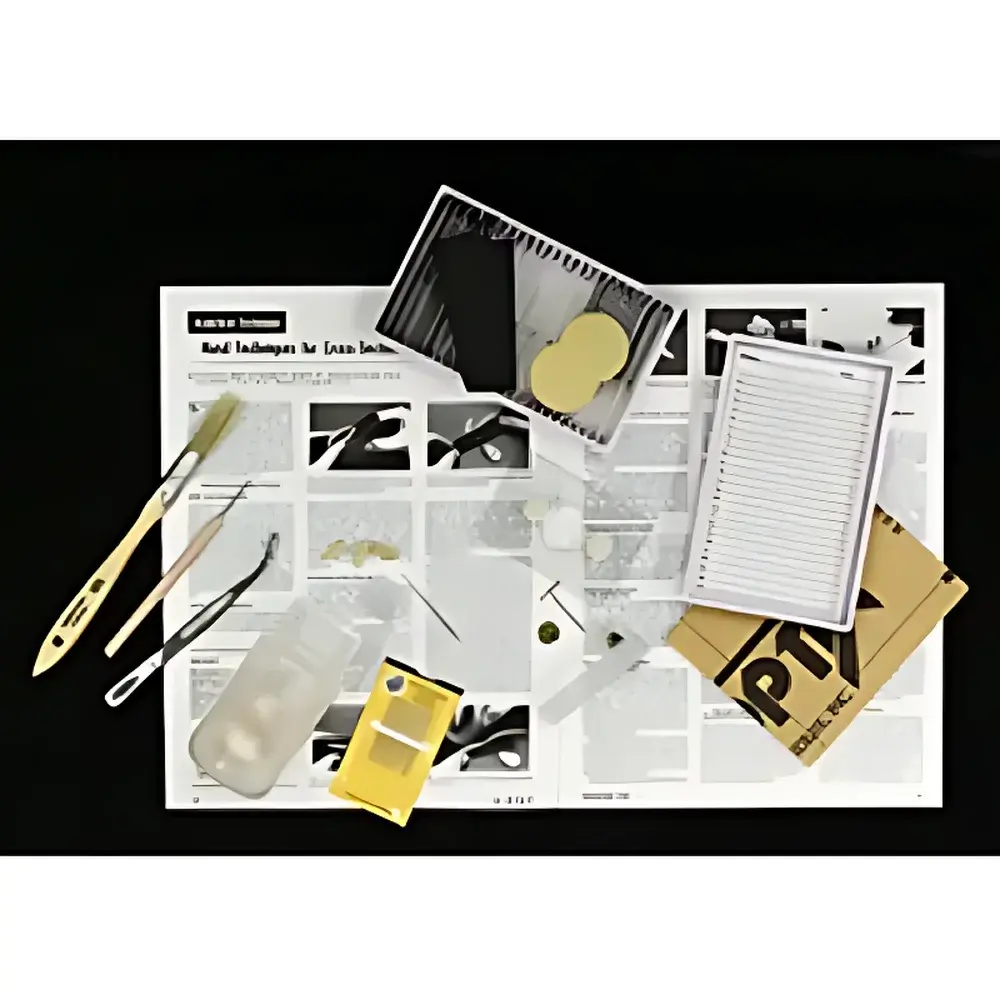
Fiber Cross-Sectional Microtome Kit F025A by SDL Atlas
| Brand | SDL Atlas |
|---|---|
| Origin | USA |
| Manufacturer Type | Direct Manufacturer |
| Origin Category | Imported |
| Model | F025A |
| Price Range | USD 4,200 – 7,000 |
Overview
The Fiber Cross-Sectional Microtome Kit F025A is a precision-engineered toolset designed specifically for the preparation of high-fidelity transverse sections of individual fibers and yarns in textile laboratories. Developed by SDL Atlas—a globally recognized leader in textile testing instrumentation—the kit implements a standardized adaptation of the AATCC Test Method 20A (Fiber Analysis: Microscopy) and aligns with the principles of ASTM D276–22 (Standard Test Methods for Identification of Fibers in Textiles). It enables reproducible, artifact-minimized cross-sectional slicing through controlled manual microtomy, leveraging optimized geometry, calibrated blade angles, and material-specific embedding protocols. Unlike automated cryo-microtomes or ultramicrotomes used in biomedical contexts, the F025A is purpose-built for thermally stable natural and synthetic fibers—including cotton, wool, polyester, nylon, aramid, and blended filaments—without requiring cryogenic handling or resin polymerization steps.
Key Features
- Complete turnkey solution: Includes all essential components—precision microtome base, adjustable specimen holder, hardened stainless-steel cutting blades (reusable and replaceable), fiber embedding molds (paraffin-compatible), mounting tweezers, micro-spatulas, and calibration reference slides.
- AATCC-validated workflow integration: Implements the modified cork-sectioning technique per AATCC TM20A Annex B, ensuring compatibility with routine fiber identification and morphology assessment protocols across accredited textile QA/QC labs.
- Ergonomic, benchtop design: Compact footprint (210 × 140 × 95 mm) with non-slip rubber feet and tactile blade-height adjustment dial for consistent section thickness control (typical range: 8–25 µm).
- Material-optimized consumables: Pre-calibrated paraffin wax formulations and low-viscosity embedding media included to minimize fiber distortion during infiltration and solidification—critical for preserving lumen structure in cellulose-based fibers and surface topology in melt-spun synthetics.
- Traceable metrology: Each kit ships with NIST-traceable dimensional verification slide and blade alignment gauge, supporting ISO/IEC 17025-compliant instrument verification procedures.
Sample Compatibility & Compliance
The F025A accommodates single fibers (diameter range: 10–50 µm), staple bundles (up to 5 mm width), and multifilament yarns (up to 300 dtex). Samples must be pre-conditioned per ISO 139 (standard atmosphere: 20 °C ± 2 °C, 65 % RH ± 4 %) prior to embedding. The system complies with AATCC TM20A, ASTM D276–22, and GB/T 2910 (Chinese national standard for quantitative fiber analysis). All components meet RoHS Directive 2011/65/EU for hazardous substance restrictions. Documentation includes full Declaration of Conformity (DoC) and technical file summary for GLP audit readiness.
Software & Data Management
As a manual mechanical preparation system, the F025A does not incorporate embedded electronics or proprietary software. However, it is fully interoperable with industry-standard digital microscopy platforms (e.g., Olympus Stream, Zeiss ZEN, or open-source Fiji/ImageJ) for subsequent image acquisition, measurement, and morphometric analysis. Digital records generated from sections prepared using this kit satisfy FDA 21 CFR Part 11 requirements when captured via validated microscope systems with electronic signature and audit trail functionality. SDL Atlas provides optional SOP templates aligned with ISO 17025 clause 7.2.2 (method validation) and internal lab documentation standards.
Applications
- Identification and quantification of fiber blends in forensic textile analysis and customs verification.
- Morphological evaluation of regenerated cellulose fibers (e.g., lyocell, modal) for lumen integrity and wall thickness uniformity.
- Assessment of thermal damage in flame-retardant treated fabrics via cross-sectional char layer profiling.
- Quality control of bicomponent fibers (e.g., PE/PET sheath-core) to verify concentricity and interface continuity.
- Academic research on fiber development stages (e.g., cotton maturity index estimation via lumen-to-wall ratio).
FAQ
Is the F025A compatible with epoxy resin embedding?
Yes—though paraffin is recommended for routine use, the specimen holder accepts standard 10 mm diameter resin capsules; users must adjust polymerization time and temperature per resin manufacturer specifications.
Can I prepare sections from carbon or glass fibers?
Carbon fibers (≤10 µm) and E-glass filaments (10–24 µm) are compatible; however, diamond-coated blades (sold separately) are advised to extend edge life and reduce micro-fracturing.
Does SDL Atlas offer training or method validation support?
Yes—comprehensive on-site or virtual technician training is available upon request, including AATCC TM20A hands-on workshops and ISO/IEC 17025 method validation consulting packages.
What is the expected service life of the included blades?
Under typical lab usage (≤50 sections/day), stainless-steel blades maintain acceptable sharpness for 3–5 weeks; replacement blades (F025A-BL) are supplied in sterile foil packs of 10 units.
Is CE marking applicable to this kit?
The F025A is classified as a laboratory tool under EU Machinery Directive 2006/42/EC and carries CE marking; full technical documentation is provided in English and German upon order confirmation.
Related Products






