
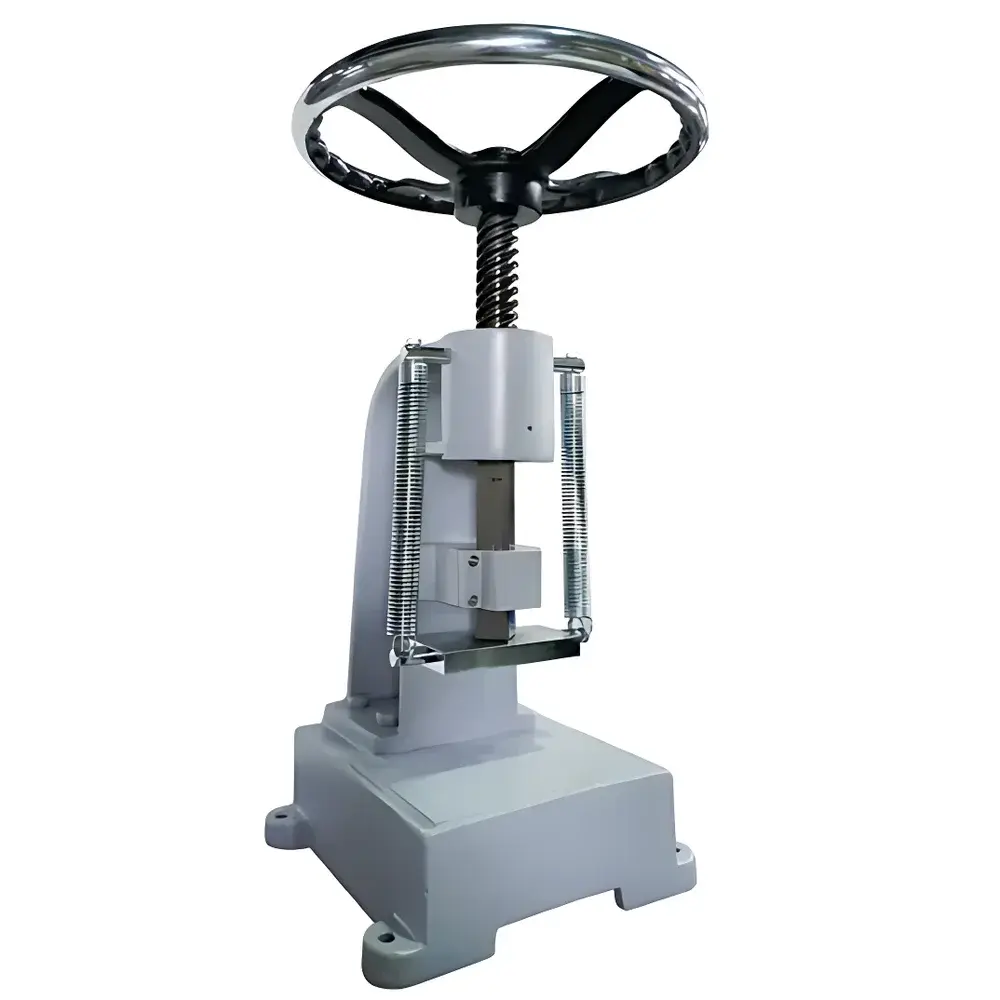
Cometech QC-603 Manual Specimen Cutter
| Brand | Cometech |
|---|---|
| Origin | Taiwan |
| Model | QC-603 |
| Cutting Plate Area | 70 × 150 mm |
| Dimensions (W×D×H) | 42 × 42 × 75 cm |
| Weight | 65 kg |
| Compatible Materials | Rubber, Soft Plastics, Leather, Foam, Paper |
| Accessories | One Base Pad |
| Optional | Custom-Dimension Cutting Dies |
| Application | Preparation of Standard Test Specimens for Tensile, Tear, Elongation, and Aging Tests |
Overview
The Cometech QC-603 Manual Specimen Cutter is a precision-engineered laboratory tool designed specifically for the reproducible preparation of standardized test specimens from soft, flexible polymeric and elastomeric materials. It operates on a mechanical lever-and-gear transmission principle, where rotational force applied to the handwheel is translated into controlled, uniform vertical pressure via a robust toggle mechanism. This ensures consistent cutting force distribution across the entire 70 × 150 mm platen area—critical for minimizing specimen edge deformation and maintaining dimensional fidelity required by international testing standards. Unlike motorized or hydraulic cutters, the QC-603 eliminates variability introduced by inconsistent actuation speed or pressure ramping, making it particularly suitable for quality control labs operating under GLP-compliant workflows where operator-controlled repeatability is essential.
Key Features
- Manually operated gear-driven system with ergonomic handwheel for precise, stepwise force application—enabling tactile feedback and full operator control over cutting initiation and termination.
- Sturdy cast-iron frame and hardened steel platens engineered for long-term dimensional stability and resistance to lateral deflection during high-load cutting cycles.
- Standard 70 × 150 mm cutting area accommodates common ASTM D412, ISO 37, and GB/T 528 dumbbell and strip die configurations; compatible with interchangeable custom dies (e.g., Type I, Type II, crescent, trouser tear).
- Included aluminum base pad provides uniform support and prevents substrate compression or curling during cutting—especially critical for low-modulus foams and thin elastomer sheets.
- Compact footprint (42 × 42 × 75 cm) and 65 kg mass ensure stable placement on standard lab benches without anchoring, while facilitating relocation between QC and R&D workstations.
Sample Compatibility & Compliance
The QC-603 is validated for use with non-reinforced, low-to-medium hardness elastomers (Shore A 30–90), thermoplastic elastomers (TPEs), soft PVC, polyurethane foam (density ≥15 kg/m³), natural and synthetic leather, and cellulose-based papers. It is not intended for reinforced composites, fiber-filled compounds, or rigid thermoplastics (e.g., ABS, PC, PP above 120 °C HDT). Specimen preparation using this cutter supports compliance with ASTM D412 (tensile properties), ASTM D624 (tear resistance), ISO 37 (vulcanized rubber), ISO 1798 (flexible cellular materials), and GB/T 528–2009. When used in conjunction with certified cutting dies and documented SOPs, the QC-603 contributes to audit-ready specimen traceability under ISO/IEC 17025 and FDA 21 CFR Part 11–aligned data management protocols.
Software & Data Management
As a fully manual, non-electronic instrument, the QC-603 does not incorporate embedded firmware, sensors, or digital interfaces. Its operation requires no software installation, driver configuration, or network connectivity—reducing validation burden in regulated environments. All usage records (e.g., operator ID, material batch, die type, date/time, specimen count) are maintained externally via paper-based logbooks or LIMS-integrated electronic worksheets. This analog architecture inherently satisfies requirements for deterministic mechanical action and eliminates risks associated with firmware updates, cybersecurity vulnerabilities, or timestamp drift—key considerations in GMP-aligned rubber compounding and polymer formulation labs.
Applications
- Preparation of dumbbell-shaped tensile specimens from vulcanized rubber compounds prior to ASTM D412 testing.
- Cutting standardized strip specimens for tear strength evaluation per ASTM D624 or ISO 34-1.
- Generating uniform thickness samples for accelerated aging studies (ASTM D573, ISO 188) and compression set analysis (ASTM D395).
- Producing defined geometry samples for hardness correlation studies (e.g., Shore A vs. modulus mapping).
- Routine QC sampling in extrusion lines producing rubber profiles, seals, gaskets, and medical tubing—where rapid, offline specimen generation supports real-time process feedback loops.
FAQ
Can the QC-603 cut reinforced rubber compounds containing fabric or metal cord?
No. The cutter is rated exclusively for unreinforced elastomers and soft thermoplastics. Reinforced materials risk premature die edge chipping and inconsistent cut profiles due to heterogeneous modulus distribution.
Is calibration required before use?
No formal calibration is specified, but daily verification of platen parallelism and die sharpness is recommended per internal SOP. A feeler gauge check (≤0.02 mm gap across platen surface) ensures cutting consistency.
What maintenance intervals are advised?
Lubrication of gear train and pivot points every 200 operational cycles using ISO VG 68 mineral oil; visual inspection of die edges for nicks or burrs prior to each shift.
Are cutting dies supplied with NIST-traceable dimensional certification?
Standard dies are manufactured to ±0.05 mm tolerance per ISO 2768-mK; traceable certification is available as a value-added option upon request.
Does Cometech provide installation or operator training?
Yes—on-site or virtual training sessions covering safe operation, die selection logic, specimen handling best practices, and integration with ASTM/ISO test workflows are offered separately.





