
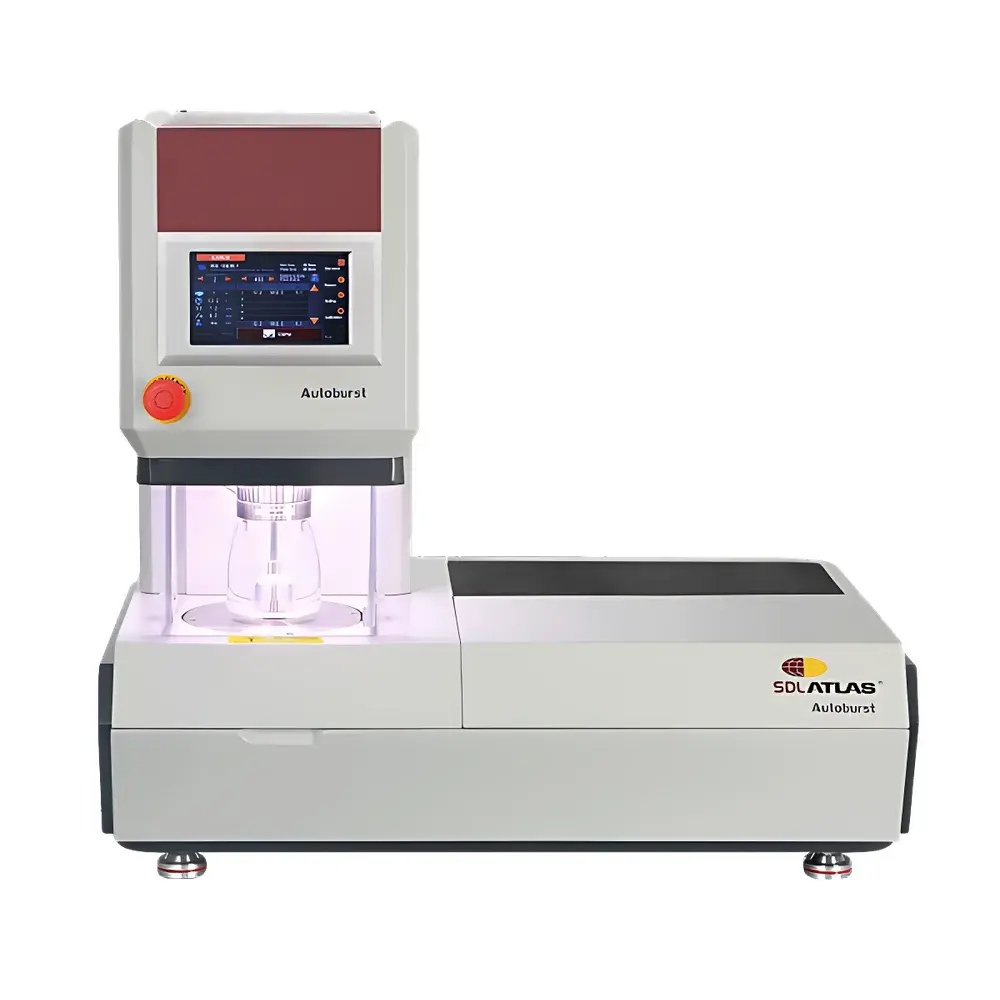
SDL Atlas M229 Digital Automatic Burst Strength Tester
| Brand | SDL Atlas |
|---|---|
| Origin | Shenzhen, China |
| Manufacturer Type | Manufacturer |
| Region of Origin | Domestic (China) |
| Model | M229 |
| Price Range | USD 14,000 – 43,000 |
| Maximum Burst Pressure | 6000 kPa (871 psi) |
| Maximum Diaphragm Expansion | 70 mm |
| Test Cup Sizes | Five standard sizes compliant with ISO 13938-1, ASTM D3786/D3787, BS EN ISO 13938, GB/T 7742 |
| Display | Full-color touchscreen controller with multilingual UI (English, Spanish, Chinese, Turkish) |
| Compliance Features | Automatic diaphragm correction, programmable ramp rate control, GLP-compliant audit trail (via PC software), integrated safety guard and emergency stop |
| Calibration Verification | Compatible with certified burst verification fabrics traceable to UKAS-accredited instruments |
Overview
The SDL Atlas M229 Digital Automatic Burst Strength Tester is a precision-engineered hydraulic bursting instrument designed for rigorous, standards-compliant evaluation of fabric and flexible sheet material resistance to multidirectional stress. Operating on the principle of controlled hydraulic pressure application against a clamped specimen, the M229 measures the maximum pressure (kPa or psi) required to rupture the sample under a defined diaphragm expansion rate—directly aligned with the fundamental mechanics described in ISO 13938-1 (hydraulic method) and ASTM D3786/D3787. Its 6000 kPa maximum pressure capacity enables reliable testing of high-performance technical textiles—including coated outdoor fabrics, geotextiles, industrial filter media, and reinforced polymer sheets—while maintaining sub-millimeter resolution in expansion measurement up to 70 mm. Unlike legacy analog systems, the M229 integrates closed-loop hydraulic flow regulation to ensure strict adherence to standardized pressurization profiles, eliminating operator-dependent variability and supporting repeatable, inter-laboratory comparable results.
Key Features
- Hydraulic burst testing platform compliant with ISO 13938-1, ASTM D3786/D3787, BS EN ISO 13938, and GB/T 7742
- Full-range pressure capability up to 6000 kPa (871 psi) with ±0.5% full-scale accuracy
- Programmable ramp rate control ensures precise pressure increase timing per test standard requirements
- Automatic diaphragm correction algorithm subtracts baseline diaphragm-only burst pressure from total measured pressure, yielding true material-specific burst strength
- Five interchangeable test cups (30 mm, 38 mm, 44.5 mm, 50 mm, and 70 mm diameters) cover all major international test configurations without tooling
- Integrated safety enclosure with interlocked guard and emergency stop button meeting IEC 61000-6-2/6-4 and ISO 13857 mechanical safety requirements
- Standalone operation via 7-inch full-color touchscreen controller with multilingual interface (English, Spanish, Chinese, Turkish)
- Optional PC connectivity via USB or Ethernet for advanced data logging, report generation, and 21 CFR Part 11–compliant audit trail functionality
Sample Compatibility & Compliance
The M229 accommodates a broad spectrum of planar materials: woven and knitted textiles (including laminated, coated, and stretch fabrics), nonwovens, leather substitutes, thin rubber sheets, and geosynthetic membranes. Its modular cup system supports both low-burst-strength lightweight fabrics (e.g., medical gowns, filtration media) and ultra-high-strength composites (e.g., ballistic nylon, PTFE-coated fiberglass). All test protocols are implemented in accordance with ISO/IEC 17025:2017 general requirements for competence of testing and calibration laboratories. The instrument supports traceable calibration using UKAS-certified burst verification fabrics—two reference materials with certified mean burst strengths established across multiple accredited hydraulic and pneumatic testers. This enables in-house performance verification between formal calibrations, satisfying internal quality assurance and external accreditation surveillance requirements.
Software & Data Management
When connected to a Windows-based host PC, the M229 operates with proprietary software that embeds preloaded test methods for ISO, ASTM, BS, and GB standards—including automatic selection of appropriate cup size, pressure ramp profile, and pass/fail criteria. The software generates PDF test reports with embedded metadata: operator ID, timestamp, environmental conditions (if linked to optional ambient sensor), raw pressure vs. expansion curves, burst peak values, and diaphragm correction offsets. Audit logs record all user actions—including method edits, calibration events, and result exports—with immutable timestamps. For regulated environments (e.g., textile QA labs serving medical device or automotive supply chains), the software optionally supports electronic signatures and 21 CFR Part 11 compliance through role-based access control and encrypted database storage.
Applications
- Quality control of technical outerwear and protective apparel (EN 343, ISO 20471)
- Performance validation of geotextiles for civil engineering applications (ISO 10319, ASTM D4595)
- R&D assessment of coated and laminated composites for aerospace and automotive interiors
- Regulatory submission testing for medical textile barriers (ASTM F1670/F1671)
- Supplier qualification and incoming inspection for high-tensile synthetic membranes
- In-process verification during coating or lamination manufacturing lines
FAQ
Does the M229 require annual third-party calibration?
Yes—per ISO/IEC 17025 and internal QA policies, annual traceable calibration by an accredited provider is recommended; however, daily verification using supplied UKAS-traceable burst validation fabrics satisfies interim performance checks.
Can the M229 test samples with irregular edges or coatings?
Yes—provided the specimen is securely clamped within the active test area and does not interfere with diaphragm sealing, coated, laminated, or thermally bonded fabrics may be tested without modification.
Is firmware update support available post-purchase?
Yes—SDL Atlas provides free firmware updates via secure download portal, including new standard implementations, bug fixes, and enhanced diagnostics.
What is the expected service life of the hydraulic diaphragm?
Under normal use (≤100 tests/week), the silicone diaphragm maintains metrological integrity for ≥12 months; replacement kits include calibration verification instructions and batch-specific correction coefficients.
How is data integrity ensured during power interruption?
The embedded controller features non-volatile memory that retains active test parameters and partial results; upon restart, the system resumes from last stable state without data loss.





