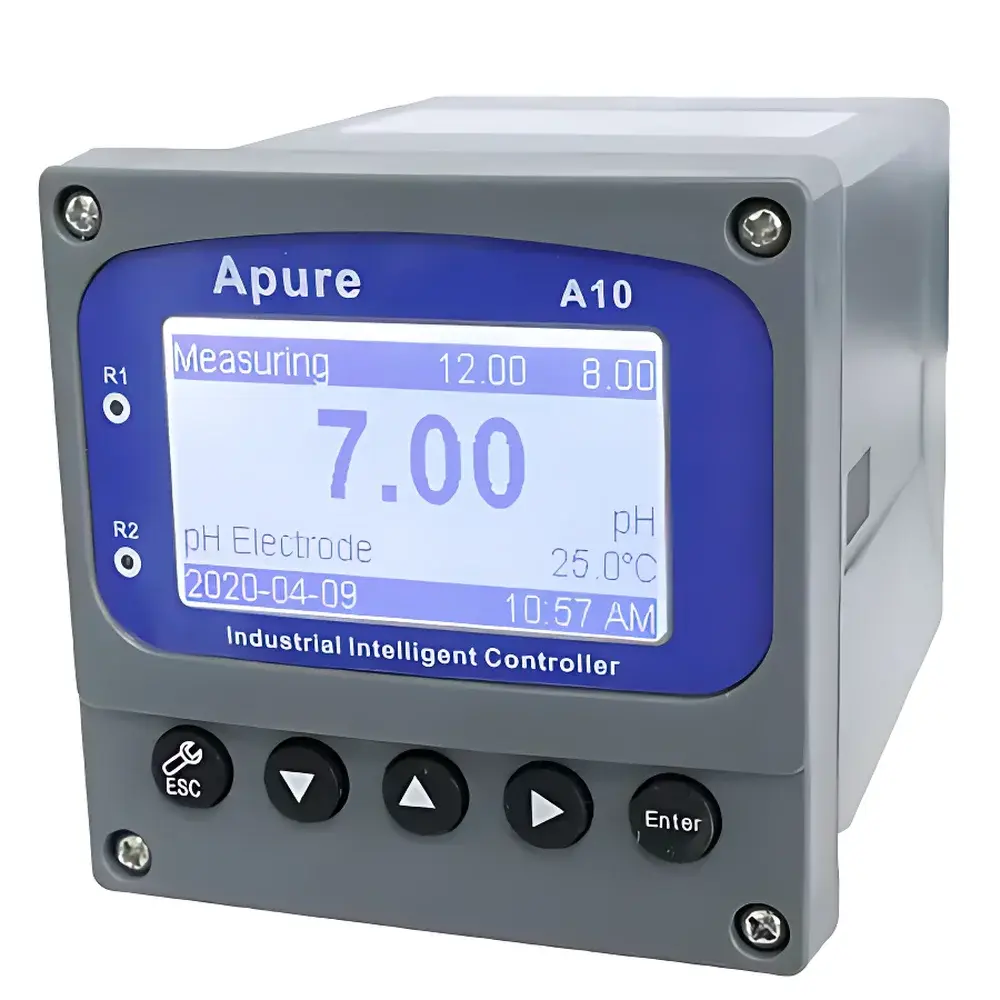
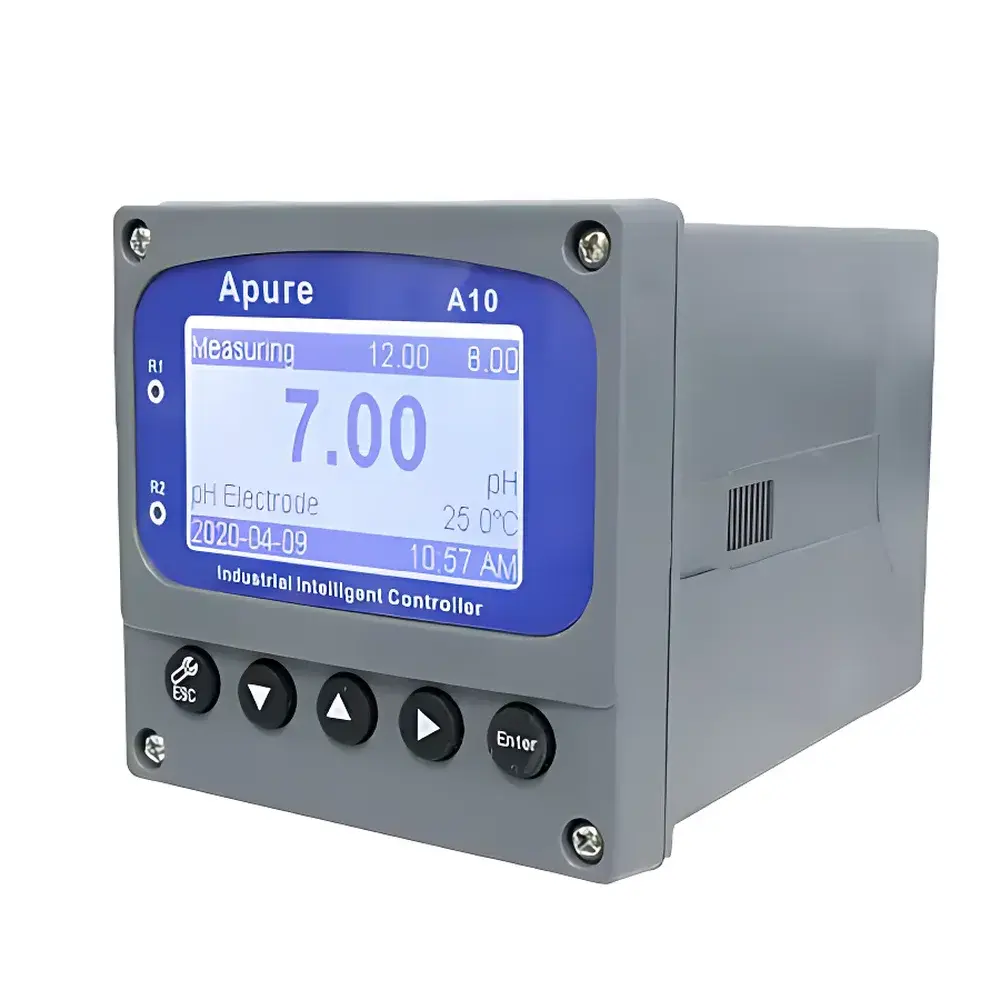
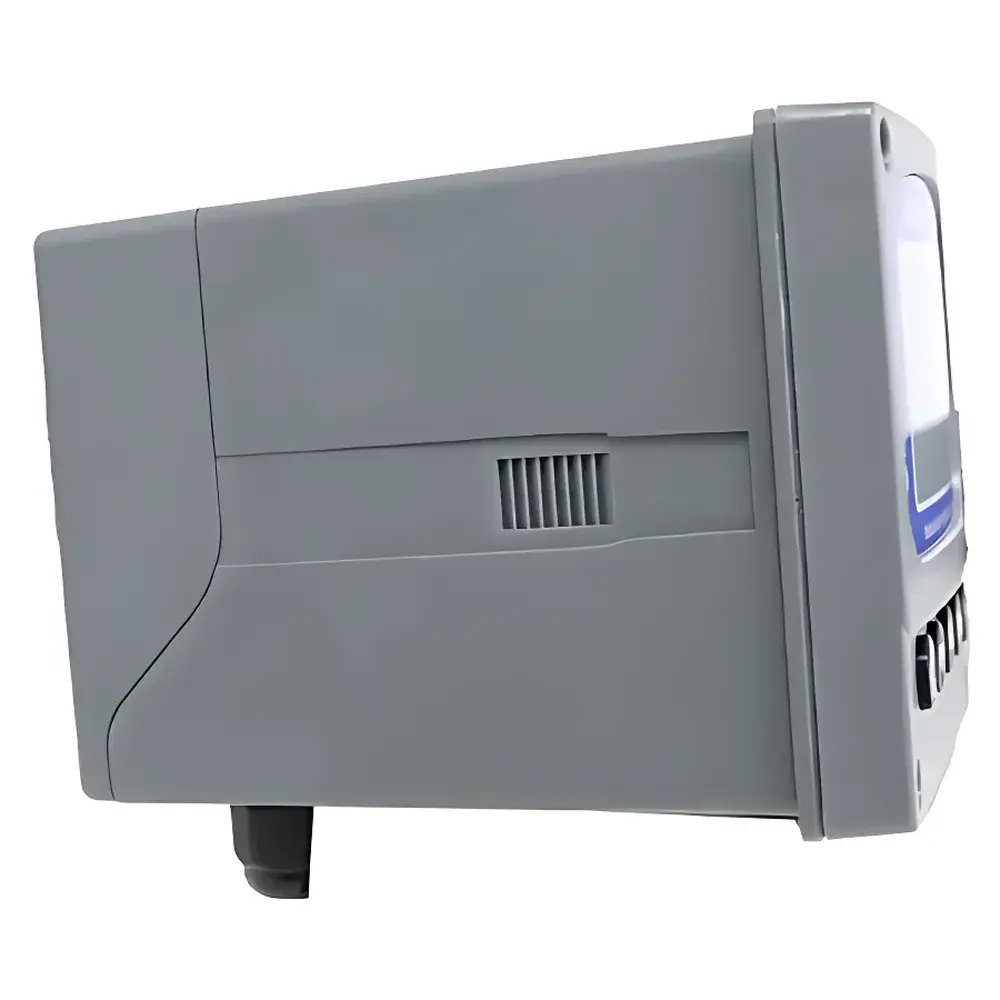
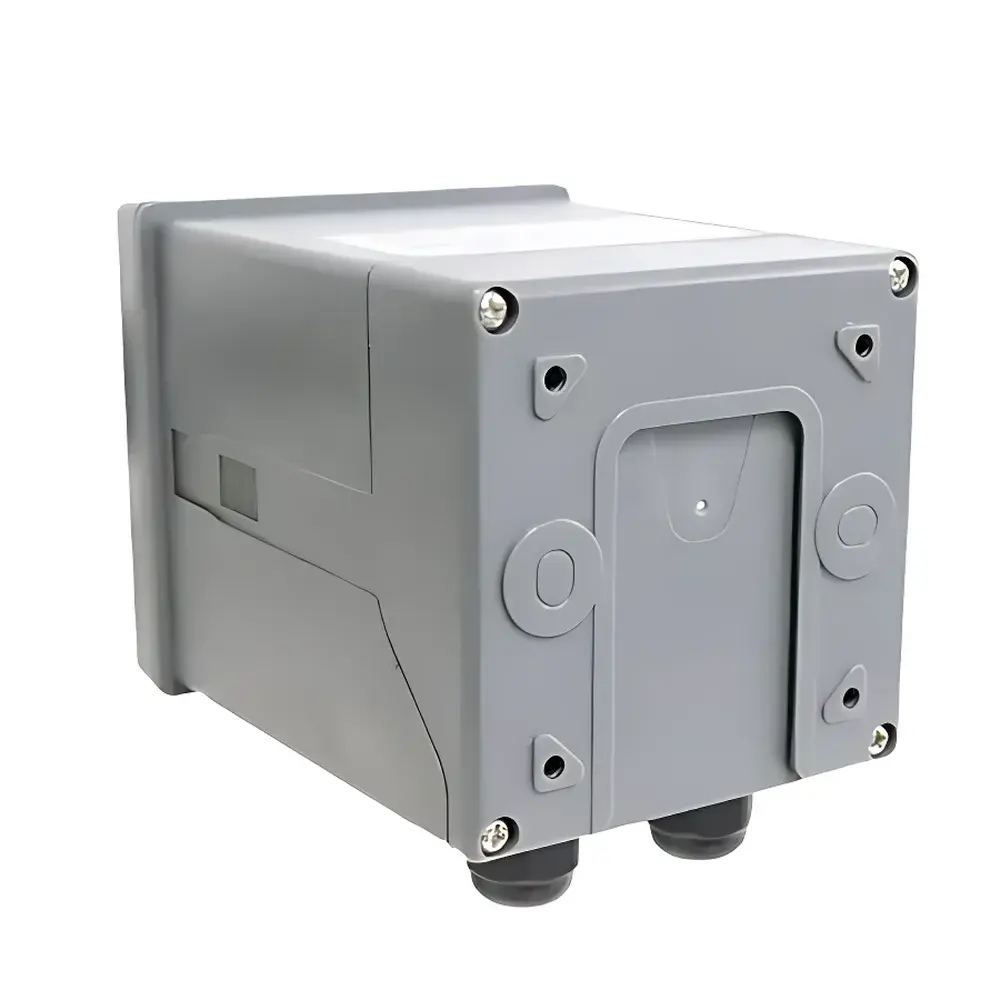
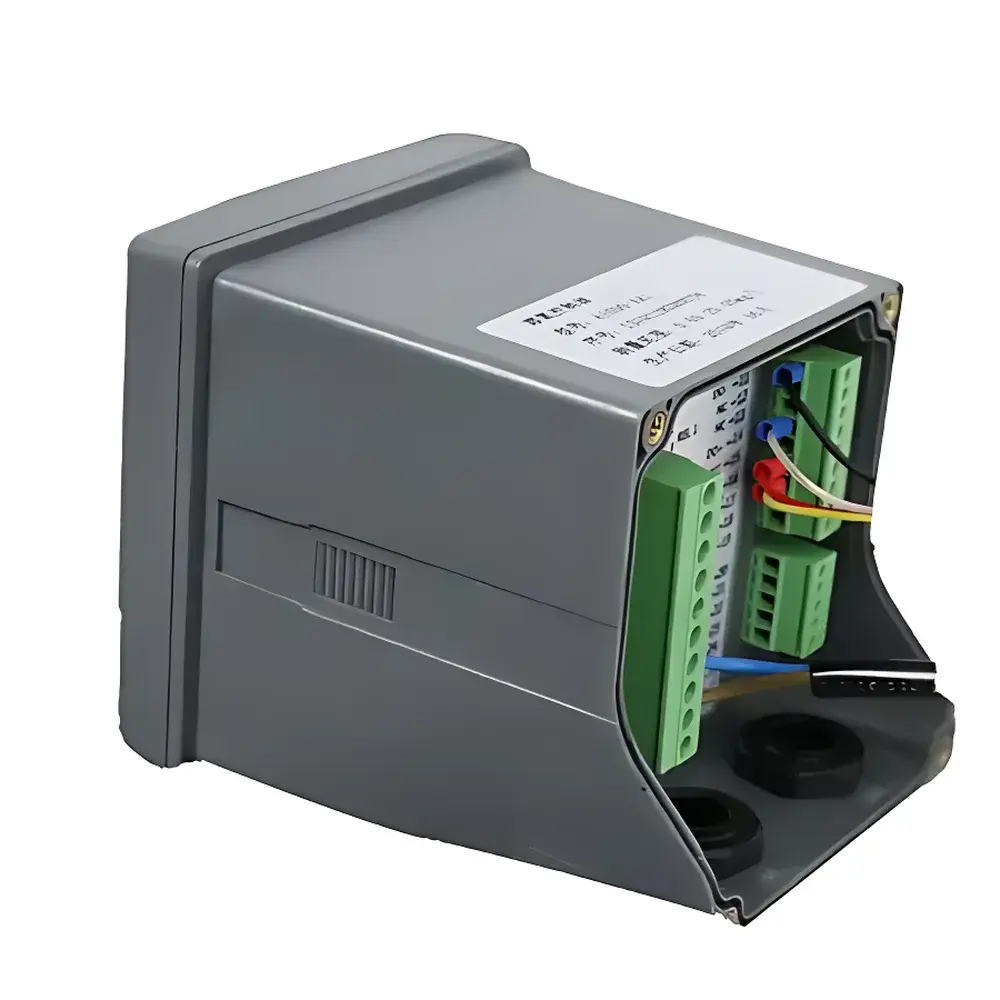
APURE A10PR-AA1 Industrial Online pH/ORP Transmitter
| Brand | APURE |
|---|---|
| Origin | Shanghai, China |
| Manufacturer Type | Direct Manufacturer |
| Model | A10PR-AA1 |
| Price | USD 70 (FOB) |
| pH Range | 0.00–14.00 pH |
| ORP Range | −2000 to +2000 mV |
| Resolution | 0.01 pH, 1 mV, 0.1 °C |
| Accuracy | ±0.01 pH, ±1 mV, ±0.2 °C |
| Dimensions | 96 × 96 × 132 mm (H × W × D) |
| Temperature Compensation | Automatic (PT1000/NTC10K) or Manual (0–100 °C) |
| Output | Dual isolated 4–20 mA outputs (configurable for pH/ORP and temperature, max load 500 Ω) |
| Relay Outputs | Two programmable SPDT relays (3 A / 250 V AC, NO contact), adjustable hysteresis |
| Power Supply | AC 220 V ±10% or DC 24 V ±10%, ≤5 W |
| Operating Environment | 0–60 °C, ≤85% RH (non-condensing) |
| Panel Cutout | 92.5 × 92.5 mm |
Overview
The APURE A10PR-AA1 Industrial Online pH/ORP Transmitter is a microprocessor-based, dual-parameter process analyzer engineered for continuous, high-stability monitoring of hydrogen ion activity (pH) and oxidation-reduction potential (ORP) in demanding industrial liquid streams. It operates on the principle of potentiometric measurement: pH is determined via the Nernst equation using a glass electrode and reference electrode pair, while ORP is measured as the open-circuit potential difference (in millivolts) between a noble metal sensing electrode (e.g., platinum or gold) and a stable reference electrode—typically Ag/AgCl—without current flow. Designed for wall- or panel-mount installation in fixed-process environments, the A10PR-AA1 delivers laboratory-grade metrological traceability under field conditions, supporting real-time control loop integration in water treatment, pharmaceutical manufacturing, chemical synthesis, food & beverage processing, and power plant cooling systems.
Key Features
- True dual-parameter capability: Simultaneous, independent measurement and display of pH (0.00–14.00), ORP (−2000 to +2000 mV), and temperature (0–100 °C) with auto-scaling digital readouts.
- Multi-mode temperature compensation: Supports PT1000 RTD, NTC10K thermistor, or manual input—enabling accurate pH correction per ISO 7027 and ASTM D1293 protocols across variable thermal profiles.
- Dual isolated 4–20 mA analog outputs: Electrically separated channels assignable to pH, ORP, or temperature; each compliant with IEC 61000-4 immunity standards (surge, EFT, radiated RF) for noise-immune signal transmission over extended cable runs.
- Two fully configurable relay outputs: SPDT contacts rated at 3 A / 250 V AC (NO), with user-defined setpoints, hysteresis adjustment (0.01–2.00 pH or 1–100 mV), and fail-safe logic for pump control, dosing activation, or alarm escalation.
- Secure operational interface: Password-protected configuration menu (four-level access), context-sensitive on-screen prompts, and bilingual firmware (English/Chinese) with seamless runtime switching—reducing operator training time and misconfiguration risk.
- Rugged industrial enclosure: IP65-rated front panel, flame-retardant ABS housing, and wide-input power architecture (AC 220 V or DC 24 V) ensure reliable operation in humid, electrically noisy, or chemically aggressive environments.
Sample Compatibility & Compliance
The A10PR-AA1 is compatible with standard industrial pH and ORP sensors featuring BNC, DIN, or T-type connectors—including gel-filled, refillable, and solid-state electrodes. It meets CE marking requirements under the EU Electromagnetic Compatibility Directive 2014/30/EU and Low Voltage Directive 2014/35/EU. Its measurement performance aligns with technical validation benchmarks defined in ISO 10523 (water quality — pH determination) and USP (pH measurement in pharmaceutical water systems). While not intrinsically safe, it supports connection to certified IS barriers for use in Zone 2 hazardous areas when paired with appropriate sensor assemblies.
Software & Data Management
No external PC software is required for basic operation; all calibration, output mapping, and alarm logic are configured locally via the integrated 4-button keypad and 128×64 dot-matrix LCD. However, the device supports optional Modbus RTU (RS-485) communication (add-on module) for integration into SCADA, DCS, or MES platforms—enabling remote parameter read/write, event logging, and audit trail capture per FDA 21 CFR Part 11 guidelines when deployed with validated system architecture. Calibration history (date, buffer values, slope, offset, electrode impedance) is retained in non-volatile memory for GLP/GMP traceability.
Applications
- Municipal and industrial wastewater treatment: Continuous pH monitoring pre- and post-neutralization, ORP feedback for chlorine or ozone dosing control, and bioreactor redox profiling.
- Power generation: Condensate polishing loop pH supervision, boiler feedwater alkalinity control, and corrosion mitigation via ORP trending.
- Pharmaceutical water systems: USP Purified Water and Water for Injection (WFI) pH verification per pharmacopoeial monographs; compliance-ready documentation support.
- Chemical process lines: Reaction endpoint detection in acid-base titrations, electroplating bath stability monitoring, and catalyst regeneration tracking via ORP drift analysis.
- Food & beverage production: CIP rinse water pH validation, fermentation broth redox state assessment, and cleaning-in-place (CIP) chemical concentration verification.
FAQ
What electrode types are compatible with the A10PR-AA1?
It accepts standard pH electrodes with BNC or DIN connectors and ORP electrodes with platinum or gold sensing elements and Ag/AgCl reference systems—provided they operate within the specified input impedance and mV range.
Does the transmitter support automatic calibration?
No—it requires manual two-point (pH 4.01/7.00 or 7.00/10.01) or single-point calibration using NIST-traceable buffers; auto-calibration is not implemented due to regulatory preference for operator-verified validation steps in GxP environments.
Can the 4–20 mA outputs be assigned to different parameters simultaneously?
Yes—Output 1 may be assigned to pH while Output 2 is assigned to temperature, or both may transmit ORP and pH concurrently, with independent zero/span scaling.
Is firmware upgrade possible in the field?
Firmware updates require APURE-certified service tools and are performed via RS-232 serial interface under controlled engineering supervision—not end-user accessible—to maintain measurement integrity and regulatory compliance.
What is the recommended maintenance interval for long-term accuracy?
Electrode inspection and recalibration are advised every 7–14 days in aggressive media (e.g., high TDS, sulfide-rich waste streams); in clean, low-conductivity applications (e.g., deionized water loops), intervals may extend to 30 days—always verified against primary reference standards.
Related Products