SDL Atlas F215 Pressley Fiber Bundle Strength Tester
| Brand | SDL Atlas |
|---|---|
| Origin | Guangdong, China |
| Manufacturer Type | Manufacturer |
| Country of Origin | China |
| Model | F215 |
| Price Range | USD 7,000 – 14,000 |
Overview
The SDL Atlas F215 Pressley Fiber Bundle Strength Tester is a dedicated mechanical tensile testing instrument engineered for the quantitative evaluation of breaking strength and elongation at break of staple fiber bundles—primarily cotton, wool, flax, and other natural or regenerated cellulosic fibers. Based on the classical Pressley test method (ASTM D1445 / ISO 2062), the instrument applies a controlled, uniaxial tensile load to a standardized bundle of parallelized fibers until rupture occurs. Force transmission is achieved via precision-machined clamping jaws actuated by a calibrated electromechanical drive system, with load measured using a high-stability load cell traceable to national standards. The device operates under constant-rate-of-extension (CRE) mode, ensuring compliance with textile standardization requirements for reproducible inter-laboratory comparisons.
Key Features
- Electromechanical CRE drive system with adjustable crosshead speed (range: 0.5–30 mm/min) to accommodate diverse fiber types and standard protocols.
- High-precision load cell (full-scale range: 0–500 N, resolution: 0.1 N) with factory calibration certificate and optional NIST-traceable recalibration support.
- Dual-clamp configuration with hardened steel gripping surfaces and adjustable pressure control to minimize slippage and fiber damage during testing.
- Integrated digital display showing real-time load (N), extension (mm), and calculated breaking strength (cN/tex) — no external software required for basic operation.
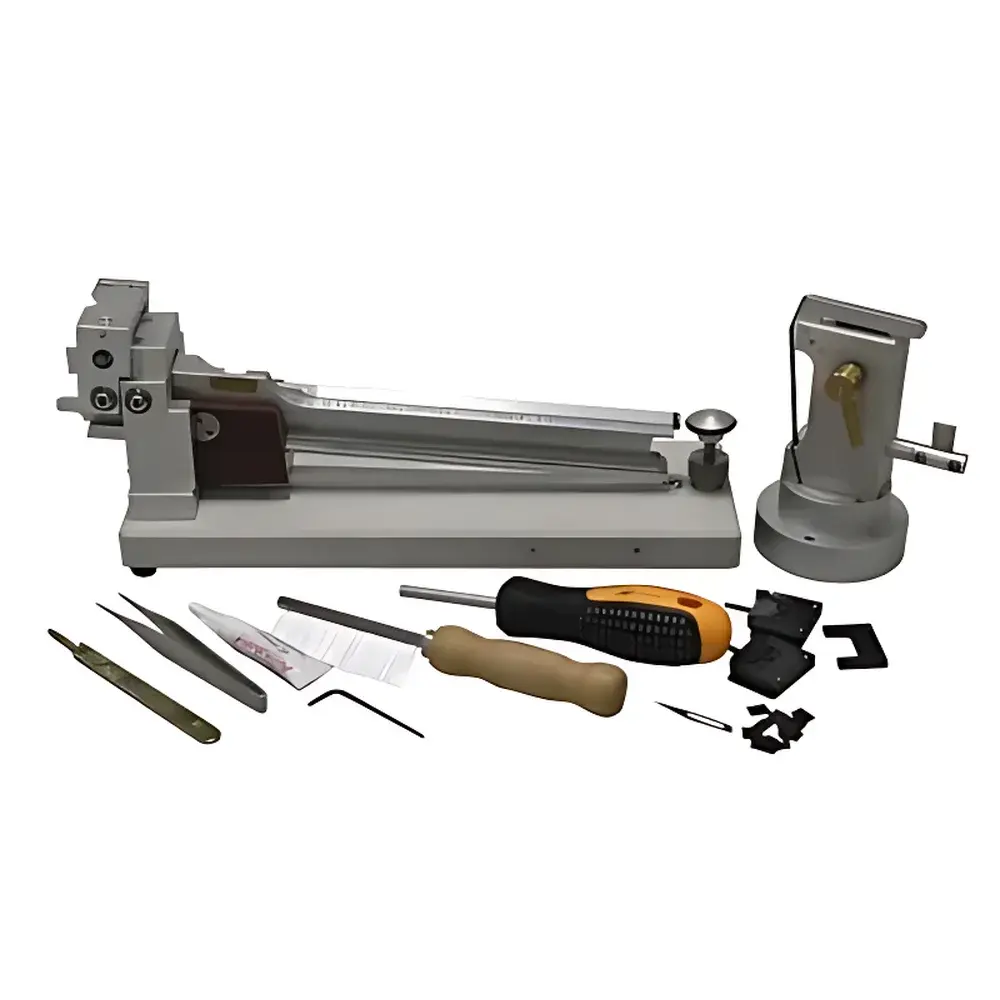
- Modular accessory set included: pair of specimen clamps, bench-mounted vise, hex wrench set, precision fiber cutting knife, fiber comb, and stainless-steel tweezers — all designed for repeatable sample preparation per ASTM D1445 Annex A.
- Robust cast-iron frame with vibration-dampening base, enabling stable measurements in shared laboratory environments without isolation tables.
Sample Compatibility & Compliance
The F215 is optimized for fiber bundles prepared according to standardized conditioning (ISO 139:2005, 65% RH / 20°C) and alignment procedures. It accepts bundles of 20–40 mg mass (typical cotton), with length fixed at 3.2 mm gauge length per Pressley protocol. While primarily intended for natural fibers, it supports testing of lyocell, modal, and mercerized cotton bundles when pre-conditioned and aligned per ISO 5079. The instrument meets mechanical design and performance criteria referenced in ASTM D1445–22 (Standard Test Method for Tensile Properties of Yarns by the Single-Strand Method), ISO 2062:2019 (Textiles — Yarns — Method for Determination of Tensile Properties), and GB/T 3916 (Chinese national standard equivalent). All mechanical components comply with CE machinery directive 2006/42/EC for safe operation in industrial and academic labs.
Software & Data Management
The F215 operates as a standalone unit but supports optional RS-232 or USB-to-serial interface for data export to external PCs. When used with SDL Atlas’ optional TextileTest Suite v3.2 software, users gain GLP-compliant functionality including user-level access control, electronic signatures, audit trail logging (per FDA 21 CFR Part 11 requirements), and automated report generation in PDF or CSV format. Software-calculated metrics include mean breaking strength (cN/tex), coefficient of variation (CV%), elongation at break (%), and work-to-break (mJ). Raw force-extension curves are stored with timestamp, operator ID, and environmental condition metadata (if connected to optional hygrothermograph).
Applications
- Quality assurance of raw cotton bales prior to ginning and spinning — correlating Pressley values with yarn tenacity and processing efficiency.
- Research into fiber modification effects (e.g., enzymatic treatment, plasma exposure, or alkali mercerization) on bundle cohesion and failure mechanics.
- Validation of fiber blending uniformity in carded or combed slivers through comparative bundle strength profiling.
- Teaching laboratories demonstrating fundamental structure–property relationships in natural polymers, including stress transfer mechanisms across interfibrillar junctions.
- Supporting ISO/IEC 17025-accredited textile testing labs requiring documented measurement uncertainty budgets for tensile strength reporting.
FAQ
Is a balance required for operation?
Yes — accurate bundle mass determination (±0.01 mg) is mandatory per ASTM D1445. A 5 mg capacity analytical balance with 0.01 mg readability is recommended but sold separately.
Can the F215 test synthetic fiber bundles?
It is not validated for high-tenacity synthetics (e.g., aramid or UHMWPE) due to excessive breaking loads exceeding the 500 N limit and potential jaw slippage; use only for natural and regenerated cellulose fibers within specified mass and length ranges.
Does the instrument support automatic sample feeding?
No — the F215 is manually loaded. Sample alignment, clamping, and positioning require operator intervention to ensure bundle parallelism and consistent grip depth, as defined in ISO 2062 Annex B.
What calibration documentation is provided?
Each unit ships with a factory calibration certificate covering load cell linearity, zero stability, and crosshead displacement accuracy, valid for 12 months under normal use conditions.
Is technical support available outside China?
Yes — SDL Atlas provides global service coverage through authorized distributors in North America, EU, Southeast Asia, and South America, including remote diagnostics, on-site maintenance, and certified operator training programs.