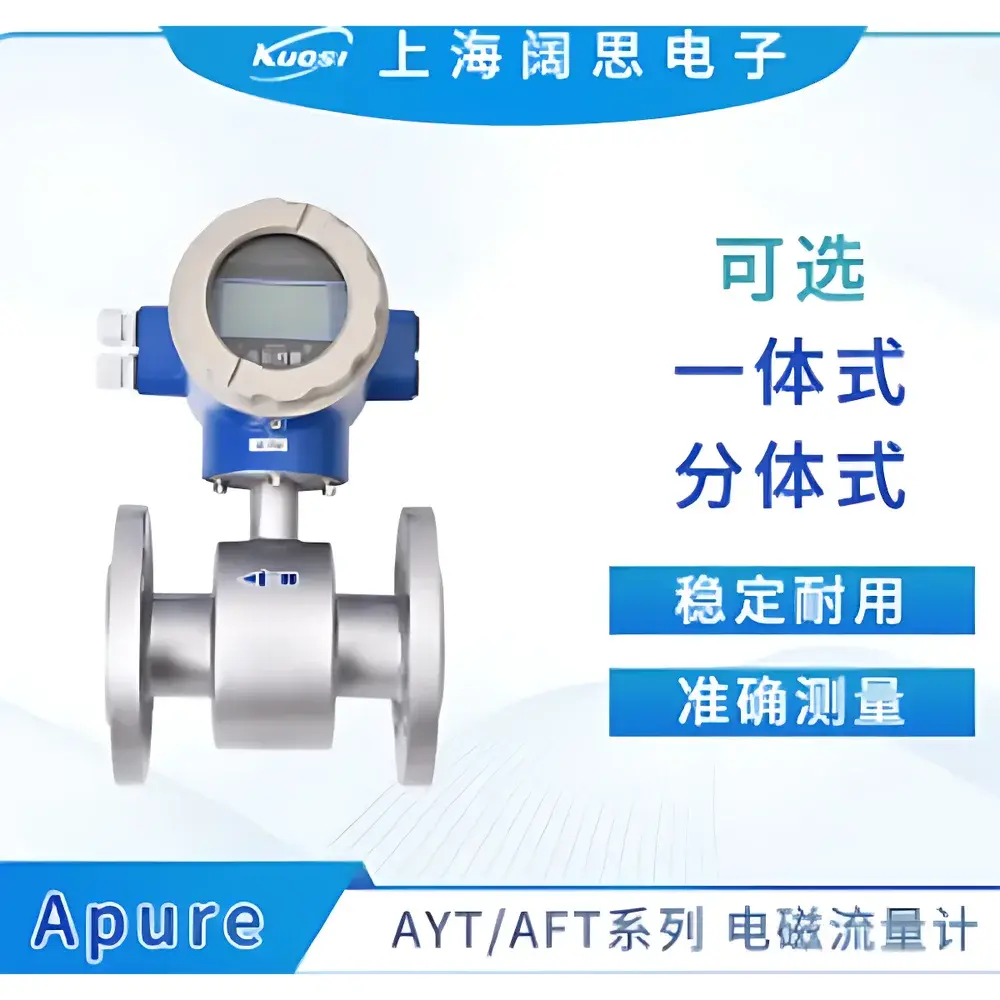
Apure AYT-50S Integrated & AFT Remote-Mount Smart Electromagnetic Flowmeter
| Brand | Apure |
|---|---|
| Origin | Shanghai, China |
| Manufacturer Type | Direct Manufacturer |
| Country of Origin | China |
| Model | AYT-50S |
| Price | USD 420 (FOB Shanghai) |
| Accuracy Class | ±0.5% of reading |
| Measurable Flow Velocity | 0.1–15 m/s |
| Effective Measurement Range | 0.3–10 m/s (at ±0.5% accuracy) |
| Nominal Pipe Diameter | DN10–DN2000 |
| Nominal Pressure Rating | PN0.6–PN6.3 MPa |
| Fluid Temperature Limit | ≤160°C |
| Display | Low-Power LCD with Local Digital Readout |
Overview
The Apure AYT-50S is a high-reliability electromagnetic flowmeter engineered for continuous, non-intrusive volumetric flow measurement of conductive liquids in industrial process environments. Operating on Faraday’s Law of Electromagnetic Induction, the device generates a magnetic field perpendicular to the direction of fluid flow; as the conductive medium passes through this field, a voltage proportional to the average flow velocity is induced across two electrodes mounted in the pipe wall. This voltage signal—linearly related to flow rate—is processed by an embedded microcontroller to deliver real-time volumetric flow output (in L/min, m³/h, or other user-selectable units). Designed for both integrated (AYT) and remote-sensor + transmitter (AFT) configurations, the AYT-50S supports flexible installation in pipelines handling water, wastewater, acids, alkalis, slurries, and other liquids with minimum conductivity ≥5 µS/cm. Its robust construction, wide pipe size coverage (DN10–DN2000), and stable performance up to 160°C make it suitable for municipal water supply, chemical dosing, food & beverage processing, and HVAC hydronic systems.
Key Features
- Two deployment options: fully integrated AYT version (sensor + transmitter in one housing) and modular AFT version (separate sensor and remote transmitter for hazardous or space-constrained locations)
- High-contrast, low-power LCD display with backlight—enabling clear local readout under varying ambient lighting conditions without excessive energy draw
- Wide dynamic flow range: measurable velocity from 0.1 m/s to 15 m/s, with certified metrological accuracy of ±0.5% of reading within the validated operating band (0.3–10 m/s)
- Full-bore liner options including EPDM, PTFE, and polyurethane—selected based on chemical compatibility, abrasion resistance, and temperature requirements
- Stainless steel (316L) or Hastelloy C-276 electrode materials, supporting corrosion-resistant operation in aggressive media
- IP67-rated housing (integrated unit) and IP68-rated sensor (AFT configuration), ensuring protection against dust ingress and temporary submersion
- Standard 4–20 mA analog output with HART® protocol support, plus optional pulse/frequency, RS485 Modbus RTU, and PROFIBUS-DP interfaces
Sample Compatibility & Compliance
The AYT-50S is validated for use with electrically conductive liquids having conductivity ≥5 µS/cm—covering potable water, seawater, diluted acids/bases, pulp suspensions, and many food-grade syrups and dairy streams. It is not suitable for hydrocarbons, distilled water, or steam. The device complies with international electromagnetic compatibility standards IEC 61326-1 (industrial environment) and IEC 61000-4 series for surge, ESD, and fast transient immunity. Electrical safety conforms to IEC 61010-1 (Measurement Category II, Pollution Degree 2). While not intrinsically safe certified out-of-the-box, explosion-proof variants (Ex d IIB T4) are available upon request for Zone 1/2 applications. Calibration traceability follows ISO/IEC 17025 principles via Apure’s in-house accredited calibration lab, with optional factory calibration certificates issued per ISO 17025 requirements.
Software & Data Management
The built-in firmware supports configurable totalization (forward/reverse/net), batch counting, damping time adjustment (0.1–100 s), and alarm thresholds for flow high/low, empty pipe detection, and electrode fault monitoring. Optional PC-based configuration software (Apure FlowConfig v3.2) enables advanced setup—including pipe material selection, liner thickness compensation, and zero calibration routines—via USB or Bluetooth connection. All configuration changes are logged with timestamp and operator ID, supporting audit readiness for GLP and GMP-regulated environments. Data export formats include CSV and PDF reports compatible with SCADA historians and MES platforms. Firmware updates are delivered via secure signed binaries, preserving integrity during field deployment.
Applications
- Municipal water distribution networks—real-time leakage detection and district metered area (DMA) balancing
- Chemical injection control in cooling towers and boiler feedwater systems
- Batch volume verification in pharmaceutical clean utilities (PW, WFI lines where conductivity permits)
- Effluent flow monitoring in wastewater treatment plants meeting EPA Method 1609 compliance requirements
- Process water recirculation in semiconductor fab wet benches
- Monitoring of liquid fertilizer delivery in precision agriculture irrigation systems
FAQ
What is the minimum conductivity required for accurate measurement?
The fluid must have a minimum electrical conductivity of 5 µS/cm. Below this threshold, signal-to-noise ratio degrades, leading to unstable readings.
Can the AYT-50S measure bidirectional flow?
Yes—the device provides true bidirectional measurement capability with separate forward and reverse totalizers, and directional indication in the local display and analog output.
Is zero calibration required after installation?
Yes. A zero calibration (performed with the pipe full and fluid static) is mandatory to compensate for minor asymmetries in magnetic field distribution and electrode offset voltages.
Does the flowmeter support NIST-traceable calibration documentation?
Upon request, Apure issues ISO/IEC 17025-compliant calibration certificates with uncertainty budgets, traceable to national standards via CNAS-accredited reference meters.
What maintenance is recommended for long-term accuracy?
Annual verification using a master meter or portable clamp-on ultrasonic reference device is advised; electrode cleaning may be required in scaling or coating-prone applications—frequency depends on process conditions.